
MONETABRIEF – Sri Lanka's will remove a CESS tax, most of which were slammed in 2004 as macro-economist triggered a currency crisis, will be removed in stages from 2028, Deputy Minister of Finance, Anil Jayantha Fernando said.
The CESS tax will be cut by 50 percent for most items in 2028, but industrialists had requested more protection for some items. Another 25 percent will be cut by 2029.
"By 2030 the CESS will be completely removed," Minister Jayantha told reporters. "But for selected items, after discussions with industries, who came with the argument that the removal will reduce their ability to compete.
"As a result they wanted the phasing out in a different way. The initial strategy was to remove 50-percent, 25 percent and 25 percent.
"But for selected HS Codes, if I remember 107, in 2028 we will remove only 25 percent, 25 percent in 2029 and the balance 50 percent in 2030.
"On the other hand we give protection through a four-band tariff system. That is zero, 10 percent, 20 percent and 30 percent.
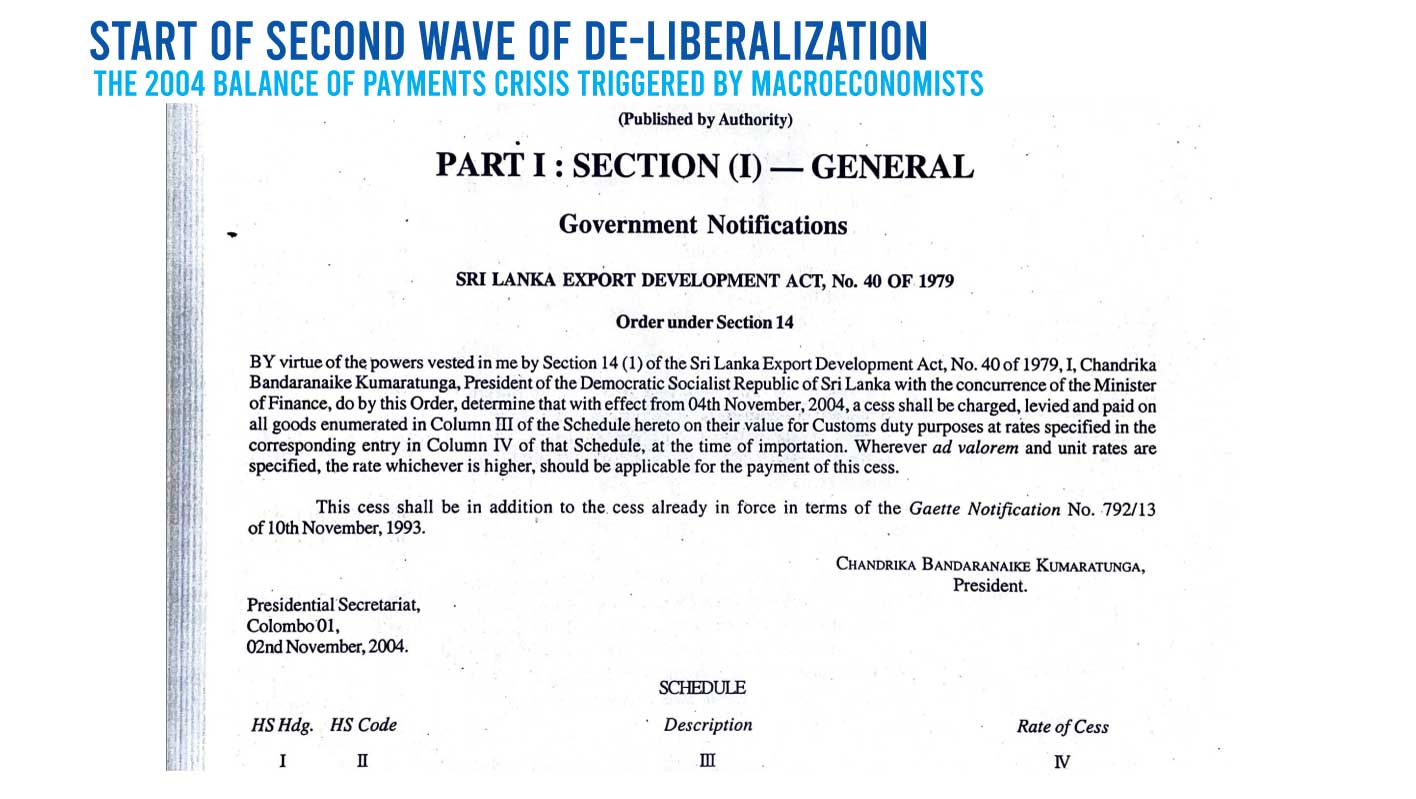
Sri Lanka's so-called de-liberalization started in November 2004 with a gazette detailing a vast array of items taxed suddenly, breeding a new class of protectionists who gouged customers with high tax-plus prices and pocketed the tax difference.
The 25 pages of new taxes were imposed as the rupee collapsed from money printed to subsidize oil. At the time the Treasury Secretary was P B Jayasundera, a macro-economist who was a former central banker.
Unlike now however, the central bank at the time was not for printing money as W A Wijewardene, a classical economist was in charge of monetary policy.
The taxes imposed by macro-economists overnight are being removed after almost 26 years.
The CESSes push up domestic costs of raw materials and food and ensure that almost no company outside of export processing zones can become export competitive.
Ironically the CESS taxes were introduced under the Export Development Board Act of 1979 to be slapped on exported raw materials in a bid to push down the prices for export firms.
Sri Lanka's import duties in general were slammed after the central bank created its first currency crisis in 1952, barely two years after it was set up with money printing powers, destroying the country's export orientation.
As stabilization measures after the monetary instability hit, income taxes were also raised.
At macro-economists continued to print money in subsequent years, including for central bank re-financing of private credit, currency problems and IMF programs came in quick succession with ad hoc tax increases, instead of restraining the central bank.
The central bank itself then said Sri Lanka's income taxes were out of line with the rest of the world, and investors will have to be given tax breaks.

Before the central bank was created, Sri Lanka was a free trading, export oriented nation. (Colombo/June29/2026)