
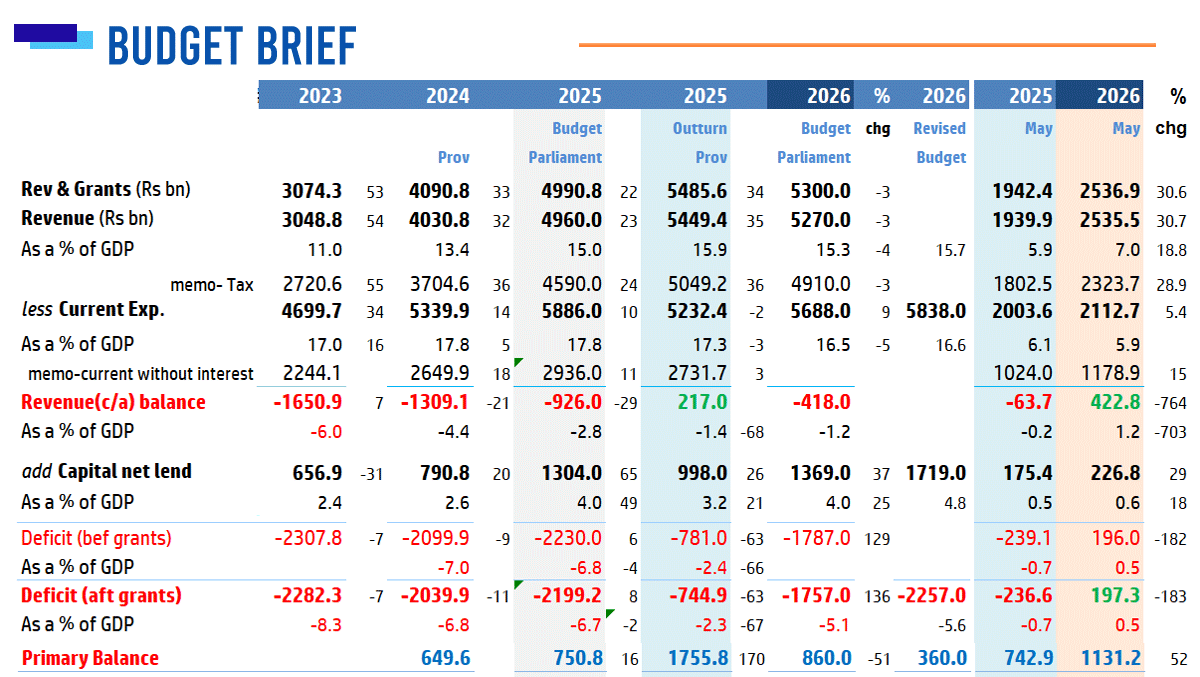
MONETABRIEF – Sri Lanka has reported a budget surplus of 197.3 billion rupees up to May 2026, higher than the 105 billion in April, helped tax revenues which grew 28.7 percent and a falling interest bill, official data shows.
Total revenues, grew 30.7 percent to 2535.5 billion rupees, made up of 2,323.7 billion rupees of taxes and 211.8 billion rupees of non-tax revenues.
Current spending grew 5.4 percent to 2,112.7 billion rupees. Current spending without interest grew 15 percent to 1,178 billion rupees.
The interest bill fell to 933.8 billion rupees up to May 2026, down from 979.6 billion in 2025.
Golden Rule
The budget recorded a current account surplus of 422.8 billion rupees, up from the March number.
Sri Lanka has been unable to record a surplus in the current account, once called the 'golden rule of budgeting' since 1987 but did so after 38 year in 2025.
Capital expenditure grew 29 percent to 226.8 billion rupees in the first five months of the year.
In Sri Lanka macro-economists have been calling for higher capital expenditure for the Keynesian multiplier effect, giving scant regard to whether capital projects are priority one or whether they give high returns.
Before macro-economics, politicians and classical economists valued capex over current spending because they brough returns for decades and made the economy more efficient and expanded its capacity.
The current account surplus however comes from current spending restraint and lower interest rates from a stable exchange rate, which is a reflection of monetary policy.
In the first quarter of 2026 however the rupee collapsed as the central bank denied convertibility to rupees it created by dollar purchases in earlier months (monetizing the balance of payments) and also money printed through swaps.
As a result, though the budget was in surplus by 116.3 billion rupees as people paid more taxes, the macro-economists triggered monetary depreciation, expanding debt by 198.5 billion rupees.
Sri Lanka's budgets became un-manageable after macro-economists started to debase the rupee from the early 1980s, after the Second Amendment to IMF's articles which left the island without a credible anchor. Latin American countries defaulted serially.
When macro-economists depreciate currencies, expenses go up and people's ability to pay taxes in real terms reduces, through nominal revenue numbers can go up initially social unrest also picks up, triggering authoritarian rule or political instability or both.
Government costs also catch up as salaries go up and inflation drives up nominal interest rates, as macro-economists destroy financial capital and savings of a nation with monetary debasement.

(Colombo/July12/2026)