
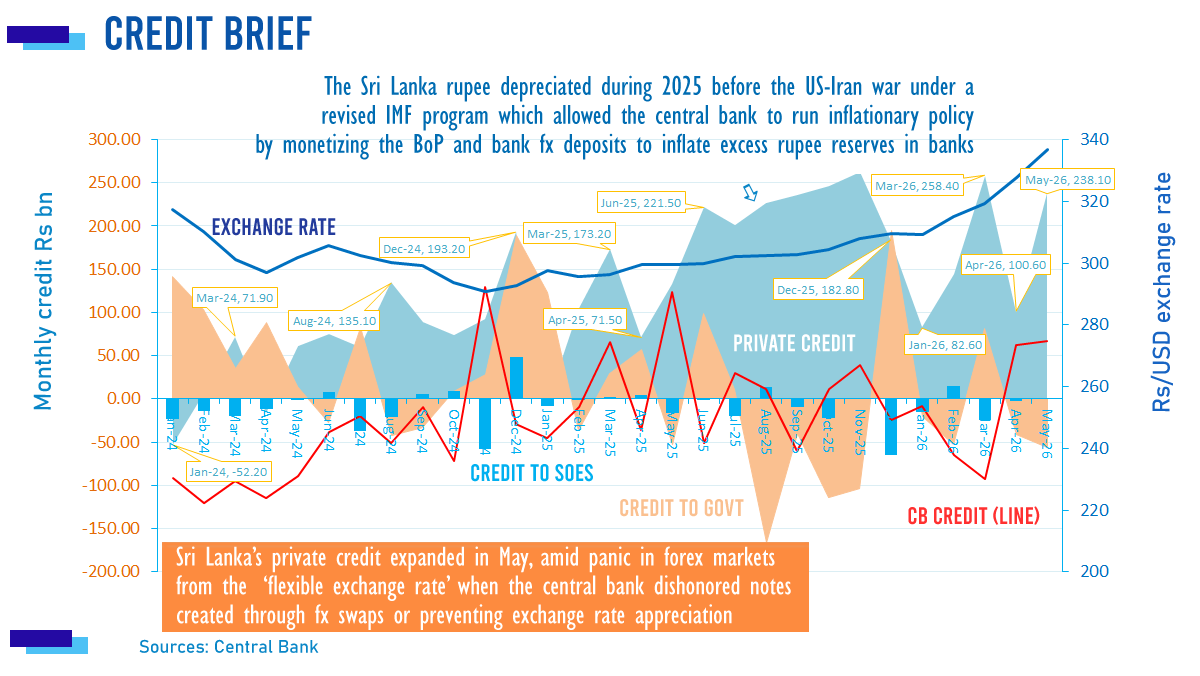
MONETABRIEF – Sri Lanka's private credit expanded 238.9 billion rupees in May from a slowdown to 100 billion rupees in April, official data showed as the rupee fell in the latest 'flexible exchange rate' shock.
Part of expansion could be driven by the depreciation of the rupee.
When the central bank depreciates the rupee through its 'flexible' exchange, dishonoring notes it has created in the preceding months, panicked importers and speculating exporters have in the past resorted to higher domestic credit.
Monetary Instability Driven Credit
When the flexible exchange rate slams into the economy, importers take credit to settle bills early while, exporters take more pre-shipment loans (packing credit) to delay dollar conversion using excess liquidity created by the central bank, the currency pressure can worsen.
The central bank, which has been unable to build reserves due to a flaw in the IMF program in 2025 as well as a rate cut early in the year, hiked rates in May 2026 after earlier claiming that currency pressure was from an 'external shock'.
When macro-economists debase money, food and energy prices go up, turning the public against democratically elected governments as economic hardships hit.
Sri Lanka's central bank has a toxic operating framework, involving inflation targeting without floating rate and a statistical framework where money is printed to cut rates, when the past inflation is low even as private credit picks up, requiring higher rates.
The central bank over 2025, also printed money, monetizing foreign exchange deposits of banks through buy – sell swaps, driving up credit and imports.
The currency collapse in the first quarter of 2026 came as the government recorded a budget surplus.
After printing money for rate cuts, driving up inflation and nominal interest rates and making budgets un-manageable, macro-economists have for decades blamed fiscal deficits for monetary instability.
Budget Surplus
However, the early 2026 currency crisis came as the government recorded a budget surplus, busting a cherished red herring that macro-economists have used for decades to escape accountability for social and political unrest created through rate cuts and depreciation.
Credit to the government fell 55.9 billion rupees in May, after also falling 41.5 billion rupees in April.
Credit to state enterprises rose marginally by 0.8 billion rupees.
Sri Lanka also market-priced fuel, at considerable political expense matching the external rise in fuel prices to domestic demand and neutralizing the effect of higher fuel prices on the exchange rate.
However macro-economists had worsened the pressure on the public and democratic rule by artificially driving up the rupee cost of imports through monetary depreciation through the flexible exchange rate. (Colombo/July14/2026)