
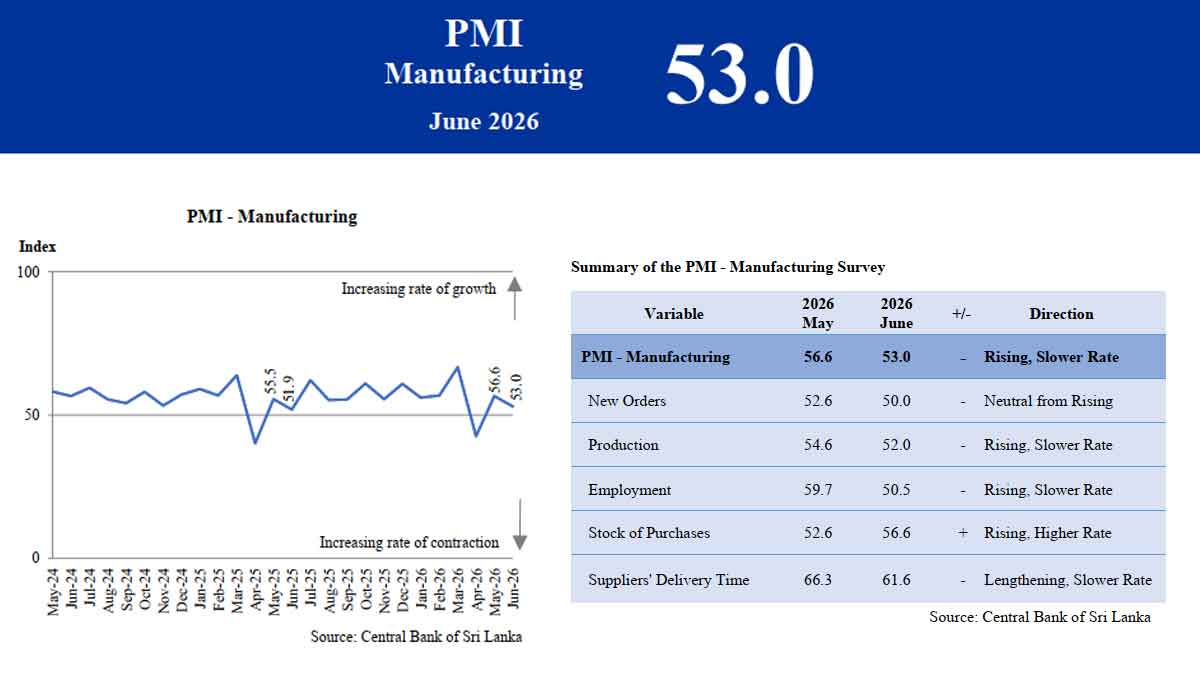
MONETABRIEF – Sri Lanka Purchasing Managers’ Index for Manufacturing recorded 53, showing continued expansion though slower than the previous month.
"Incoming orders in June were broadly unchanged from the previous month, with the New Orders sub-index remaining at the neutral threshold," the central bank which compiles the index said in a statement.
"The Production sub-index continued to expand, driven by the manufacture of food and beverages sector."
The central bank in 2026 steeply depreciated the rupee to 335 to the US dollar after keeping prices stable for around two years and pushed up inflation above 5 percent claiming there was an 'external shock'.
However, interest rates were hiked as the agency was unable to collect reserves, showing the problem was excessive expansion of domestic credit from mis-targeted rates.
Sri Lanka's central bank has steeply depreciated the rupee especially from the early 1980s after the International Monetary Fund's second amendment to its articles.
Millions of skilled and unskilled workers migrated out, especially to currency board regimes in the Middle East, as wage increases lagged inflation from monetary debasement.
"The Employment sub-index remained around the neutral threshold, indicating hiring trends similar to those in the previous month," the statement said.
"However, many respondents cited persistent skilled labour shortages and rising labour costs as key challenges."
Inflation and depreciation gives profits to manufacturers at the expense of the working class, due to the delay in wages catching up with monetary depreciation which classical economists call the 'Cantillon effect'.
When the workers strike and get higher wages, macro-economists then blame them saying there is 'cost-push' or 'wage-spiral' inflation.
After the last currency crisis triggered by rate cuts to boost growth (targeting a potential output gap) led to a sovereign default, many skilled workers including doctors fled the country.
Until mid 2025, Sri Lanka central bank kept the exchange rate stable and inflation low allowing people's wages to and consumer demand to recover, from the 2022 currency collapse which was the worst in the history of the central bank. (Colombo/July16/2026)