
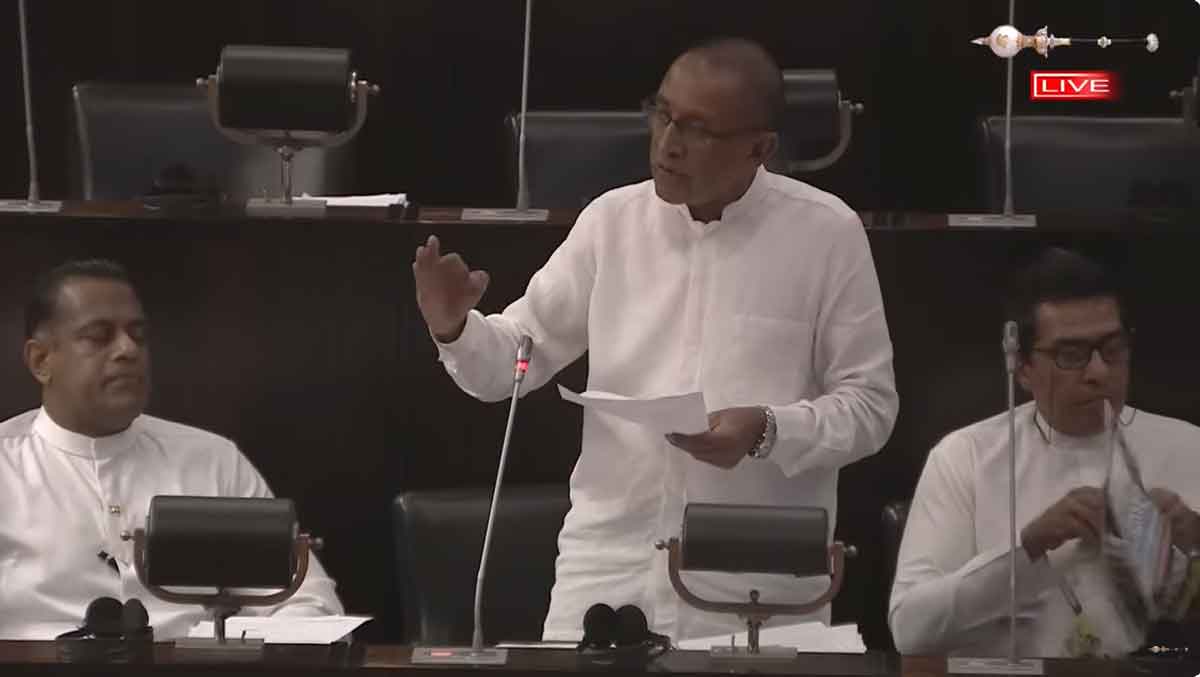
MONETABRIEF - Sri Lanka's rupee had started depreciating long before the war in the Middle East started, due to policy errors and attempts to boost output by inflating money supply with liquidity operations, opposition legislator Kabir Hashim said.
The central bank's own data showed that the exchange rate started to depreciate from early 2025 as the central bank bought large volumes of dollars and maintained excess liquidity in money markets when the war started, he said.
The December 2025 Market Operations Report showed that the central bank had bought 2 billion dollars from the market and conducted foreign exchange swaps with banks to inject 789 billion rupees, Hashim said.
Printing money against foreign exchange balances of banks through swaps was particularly harmful as they hit the exchange rate in the same way as hedge fund managers like George Soros once hit East Asian reserve collecting central banks, analysts had said.
Rupee Depreciated Before the War
"I am tabling a graph issued by the central bank itself. The rupee started to depreciate seven months or more before the war," Hashim told parliament.
"The government is saying the rupee depreciated due to the Middle East War."
By late February excess liquidity in money markets had climbed to 289 billion rupees.
"Because the liquidity was not mopped up at the correct time, the liquidity generated imports," Hashim said.
"The pressure on the rupee increased and created a vicious cycle.
"So this is a policy error both on the part of the government and the central bank. They have to take responsibility and the central bank has to take equal responsibility."
Lack of Democratic Control
In a democracy, the subject minister is responsible for the harm created to the general population by an agency coming under its purview.
However, in Sri Lanka due to 'central bank independence' an inflation-biased monetary authority can cut rates and inject money through swaps or other open market operations, or leave notes created through dollar purchases unsterilized.
When Hashim was a minister from 2015-2019, the central bank printed money through flexible inflation targeting and depreciated the currency, as a democratically elected government raised taxes and market-priced fuel, saying that fiscal policy is tight therefore monetary policy has to be loose to close a potential output gap.
Restrictions were placed on vehicle letters of credit, and gold taxes were also hiked for balance of payments purposes and there was heavy foreign borrowings to repay debt as flexible inflation targeting led to forex shortages.
A depreciation biased independent central bank can also buy dollars, prevent exchange rate appreciation or buy dollars till the rupee depreciates as in 2025 and leave the money unsterilized.
It can then and refuse to give dollars and disclaim its own notes when the liquidity turns into imports and trigger a crisis under exchange rate as the first line of defence and amplify either domestic or external shocks and bring a democratically elected government into dis-repute as happened in 2026.
Other analysts have pointed out that due to 'central bank independence' a democratically elected government cannot curb the inflationism of a flexible or arbitrary policy central bank.
Historically, parliaments and legislators who were aware of the evil of inflation and its root cause had controlled inflation-biased central banks through tight laws that forced them to tightly anchor money.
The Bank Charter Act of was brought against the Bank of England in the 19th century by the Conservative Party Prime Minister Robert Peel who had earlier chaired a parliamentary committee in which David Ricardo was a member.
It was the Thatcher administration that tamed inflation by ending full-employment policies that led to the then largest IMF program at the time amid strong opposition to deflationary policies by so-called Cambridge economists who spread the doctrine that drove the country to high inflation and near default.
In Germany it was the Odoliberal politicians like Ludwig Erhard who defeated inflationism and set up a new monetary authority to issue Deutsche Marks (the Bank Deutsche Länder) and controlled it though the Allied Control Council (occupation authority) laying the foundation for the German Economic Miracle.
Currencies depreciate because a reserve collecting central bank rejects classic economic principles, primarily the price-specie-flow mechanism described by David Hume.
Instead such agencies behave like a rogue note-issue bank that extends excessive credit as described by Adam Smith in the Wealth of Nations.
But unlike in Smith's day, the bankrupt central bank does not close its doors, leaving money from sounder one in circulation, a modern bank bailed out by the International Monetary Fund, confidence in its notes is restored by high interest rates, to kill credit, only to repeat the same errors when private credit recovers.
However, a democratic government has to answer to the voting public and also be accountable in parliament for an 'independent' inflation-biased agency over which it has no control.
Sri Lanka has exchange controls, which means the central bank is not accountable for its inflationism and has not been accountable for decades.
Instead flaws in its operating framework and its inflation bias is covered up in exchange and trade controls.
'An Ass Doing the Job of the Dog'
Meanwhile Hashim said tt was the job of the government to boost output and the central bank has to maintain stability.
However, the central bank appeared to be doing output stabilization as the government was taxing people heavily, and resulted in the 2026 crisis, Hashim charged.
The central bank has therefore violated its own act as output stabilization was not an equal objective under its 2023 law, Hashim said.
"In 2025 and 2026 the central bank has tried hard to target a 5 percent flexible inflation target. By violating the Section 6 (1) of the Act it tried to stimulate the economy. That is like "the ass trying to do the job of the dog," Hashim said in a pithy Sinhalese idiom.
By pushing up energy prices, fuel prices and food prices, people's disposable incomes have been reduced, Hashim pointed out.
Because the central bank is depreciation-biased, while the rupee is depreciated at the drop of a hat, it is not allowed to re-appreciate. Instead more dollars are bought for new money to keep the rupee weak and inflation permanent.
Under the IMF program the central bank has to buy 2.2 billion US dollars without no requirement to sterilize the new money created in their purchase, which was the original flaw in the program that led to depreciation and the hit on the poorest sections of the population from the fall of the rupee from 300 to 335 to the US dollar.
Un-anchored Money Through 5-pct Inflation Target
Under the 5 percent inflation target and liquidity injections, policies Sri Lanka could move to another debt crisis, he warned.
When the 5 percent inflation target with plus or minus 2 was proposed under then government of Ranil Wickremesinghe, his party had opposed it, he said.
"We fiercely opposed it and said it should be 3 percent and it should be plus or minus 01. But it was not accepted," Hashim said.
There is growing understanding among some members of the parliament about the flaws in the central bank's operating framework that leads to depreciation, inflation, social unrest and unseating of democratically elected governments and peacetime defaults.
Before the age of inflation, central banks were subject to strict laws and forced to produce sound money, especially through a specie standard or in the case of the US, through the constitution until the Fed triggered the Great Depression and depreciated in 1935.
Ultimately only the parliament can either break the central bank's money monopoly allowing citizens to move to money with a better anchor, or restrain its inflationism.
Hashim said the 2026 currency crisis was a result of domestic errors and not the war.
The central bank hiked rates 100 basis points as the rupee collapsed, giving credence to his claim that monetary instability did indeed come from excessive domestic credit from mis-targeted rates.
Analysts point out that the government, by raising energy prices, had neutralized the effect of the high oil prices on the balance of payments by killing domestic demand to match the higher import bill, which crowds out non-oil imports, excess liquidity was the real culprit. (Colombo/July16/2026)