
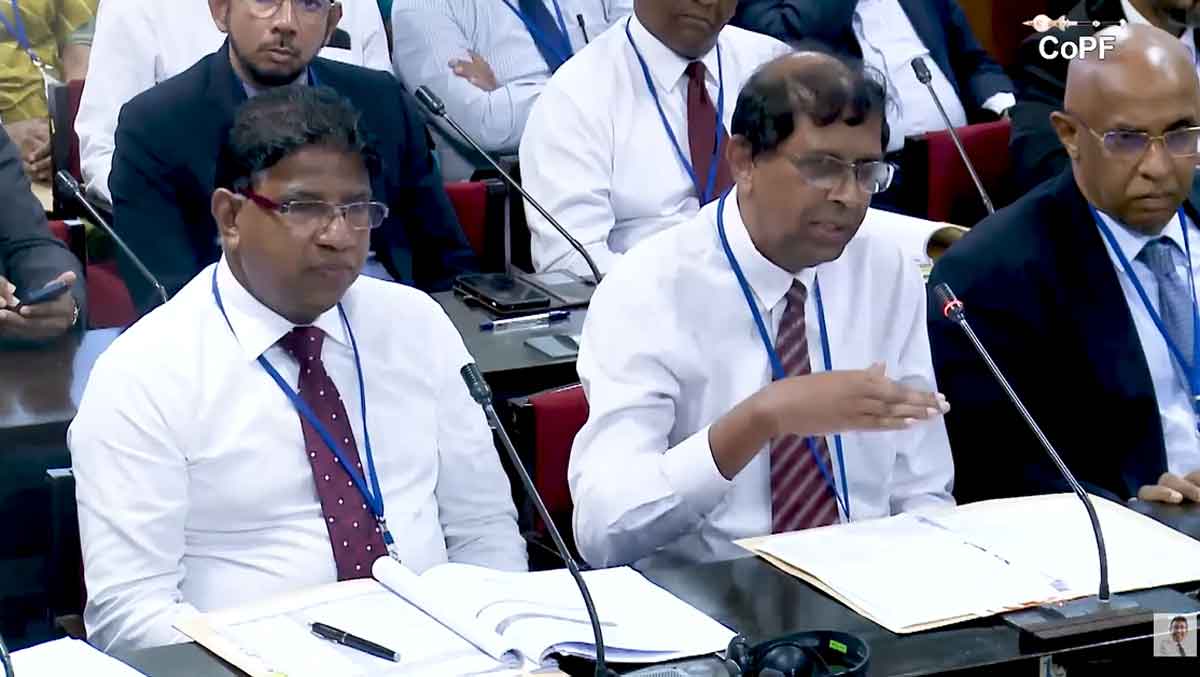
MONETABRIEF - A 'cash buffer' maintained by Sri Lanka's Treasury by overborrowing has shrunk to around 600 billion rupees by June 2026, Deputy Treasury Secretary A K Seneviratne said.
The Annual Report of Sri Lanka's Finance Ministry 915.83 billion rupees, including US dollar balances of the Treasury maintained in the central bank. The dollars are used to repay foreign debt.
The LKR amount was 600 billion rupees by June.
"Each month about 500 billion rupees of Treasury bills are rolled over," Seneviratne told the Parliament's Committee on Public Finance.
"Treasury bonds are around 750 billion rupees."
He was responding to questions from COPF members Ravi Karunanayake and Chairman Harsha de Silva.
The COPF had previously questioned the cost of maintaining an overborrowed buffer of around 1.2 trillion rupees.
"There is a margin of about 2 percent between the borrowing and the return we get," Additional Director General, Treasury Operations, Damitha Rathnayake told the CoPF late last year.
"So we are downsizing it."
Seneviratne said the idea was to keep a buffer equal to one month of debt service and not more.
"Because there is no central bank financing we have to keep a buffer," Seneviratne said. "As the buffer we are keeping one month of debt service."
The so-called buffer however is invested in state commercial banks. The banks in turn can lend it to customers (generating imports) or lend in the interbank market for other banks to lend to customers and generate imports.
As a result, the banks do not have large volumes of money to give to the Treasury. Any dislocation of domestic deposits will have to be finance by cutting interbank lending or borrowing printed money from the standing deposit window of the central bank.
Such newly printed money, when used will result in a reserve loss if the currency is defended against the liquidity or depreciation of the rupee if not.
The central bank also undermined the credibility of a 2015-2019 administration by developing such a 'buffer strategy' which led to borrowings from state banks which were in turn re-financed by the window cash, critics said at the time.
If the original deposits in commercial banks were placed in the central bank, reducing reserve money and driving short term rates, the resulting deflationary impact would allow the central bank to build reserves by reducing domestic credit.
However, if the cash was then withdrawn, boosting reserve money and domestic credit, and if the central bank did not spend reserves to mop up the money, the rupee would depreciate.
When the central bank started to manipulate interest rates with printed money in 1952 and started triggering balance of payments trouble (fore shortages), Sri Lanka's Treasury bill rates were less than 1 percent and the government raised 20 -year rupee loans at around 3 percent.
After the rupee started to depreciate in the early 1980s, in the wake of the IMF's Second Amendment to its articles led to un-anchored monetary policy, inflation started to soar, making the budget unmanageable and nominal interest rates shot up.
After the country was driven to external peacetime sovereign default in 2022 after the worst inflationary open market operations by the central bank in its entire history, bill rates hit 32 percent. (Colombo/July19/2026)