
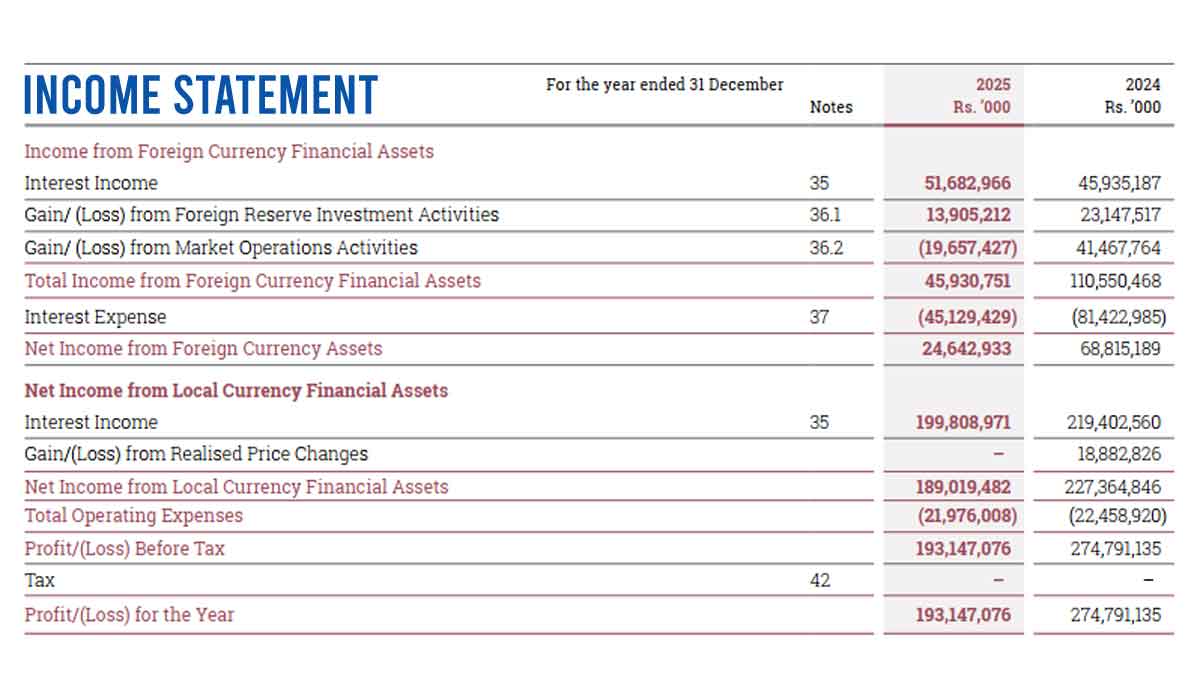
MONETABRIEF – The Central Bank of Sri Lanka has made profit of 193.1 billion rupees in 2025, down from 274 billion rupees a year earlier, amid losses from foreign exchange swaps, and some reduction in local currency income, its annual report shows.
Total interest income from local currency assets, which may also include any money loaned through its standing facilities or other inflationary operations, was 199.8 billion rupees, down from 219 billion in 2024.
Local currency interest expenses which come from its deflationary operations, involving money deposited by banks in its standing facilities or any deflationary overnight repo operations were 13.25 billion rupees down from 15.0 billion rupees.
The coupons on its bond portfolio, which are paid into the bank by the Treasury, are deflationary, reducing the ability of banks to give loans, and tends to appreciate the rupee and allow the central bank to collect foreign reserves.
On its foreign reserves, the central bank earned 45.9 billion rupees in 2025, sharply down from 110.5 billion rupees a year earlier.
Interest income on reserves rose to 51.6 billion rupees from 45.9 billion rupees.
Capital gains were 13.9 billion rupees, down from 23.1 billion rupees, with 8.6 billion rupees coming from gold up from 2.2 billion rupees. Gold shot up in 2025 along with other assets with the US Fed running an abundant reserve regime with excess liquidity.
Losses from foreign currency swaps were 19.6 billion rupees in 2025, a sharp reversal from a profit of 41.4 billion rupees in 2026.
The central bank's swaps are controversial as they have given the agency a tool to inject liquidity, using dollars, artificially depress rates, artificially boost imports amid public opposition to conventional tools to create external instability like outright rupee bond purchases or inflationary open market operations.
When its runs away and dishonors the notes created via swaps under 'flexible exchange rate', the currency depreciates, leading to an increase in the cost of living and social unrest as well as losses in its balance sheet, analysts had warned.
There was a 22.6 billion rupee realized foreign exchange gain, down from 41.4 billion rupees last year. Interest on foreign reserves were down to 45.1 billion rupees down from 81.4 billion rupees. During the 2020-2022 currency crises and default from its inflationary rate cuts, the central bank borrowed heavily from India to pay for imports and print money, and it also has an IMF loan from inflationary rate cuts that triggered external crises in 2015 to 2019 period.
Both IMF and Indian loans were settled after rates were hiked.
However, in 2025 rates were cut amid warnings that the central bank will find it difficult to collect reserves as the interest rate structure of the country was not determined by historical inflation as claimed under flexible inflation target but the IMF reserve requirement.
The central bank's operating expenses were 21.9 billion rupees, down from 22.4 billion ruepes.
The cost of issuing note were 4.9 billion rupees, up from 3.5 billion rupees.
Wages were 11.0 billion rupees, up from 10.5 billion rupees. Pensions contribution from the bank was 2.9 billion rupees in 2025 down from 4.7 billion rupees in 2024. Post employment benefit plan was a reversal of 1.2 billion riupees. (Colombo/July22/2026)