
MONETABRIEF – Sri Lanka cabinet has approved giving supplementary payments of up to 2.5 million rupees for students who are studying at foreign universities on government scholarships after the 2026 currency collapse, spokesman Nalinda Jayatissa said.
Under a 2025 budget proposal, students who got exceptional results at the Advanced Level exam were given scholarships to earn a first degree at a foreign university.
A student was given a maximum of 20 million rupees for up to four years. Thirty students were selected from the 2024 exam and nine students had left.
Early Effects of Depreciation
"After the rupee unexpectedly depreciated against major currencies, the students were unable to make payments under the current allocation," a post-cabinet statement said.
Until the rupee appreciates, an 'exchange equalization' of 2.5 million rupees was approved for each student.
The rupee fell from around 300 to 335 over the past after the central bank printed money through swaps, and initially over purchased dollars to build up liquidity depreciating the rupee from 300 to 309 over 2025.
In 2026 the central bank then suddenly dishonored the notes in 2026 using IMF-backed 'exchange rate as the first line of defence' doctrine, leading to a sudden collapse to around 335 to the dollar, pushing up inflation to 6.8 percent by June.
A fall in the currency, which takes place due to a combination of money and exchange policy that shatters the confidence of the forex market, is restored by the collapse (devaluation) which kills spending power of the people and higher interest rates.
Short term Revenue Gains
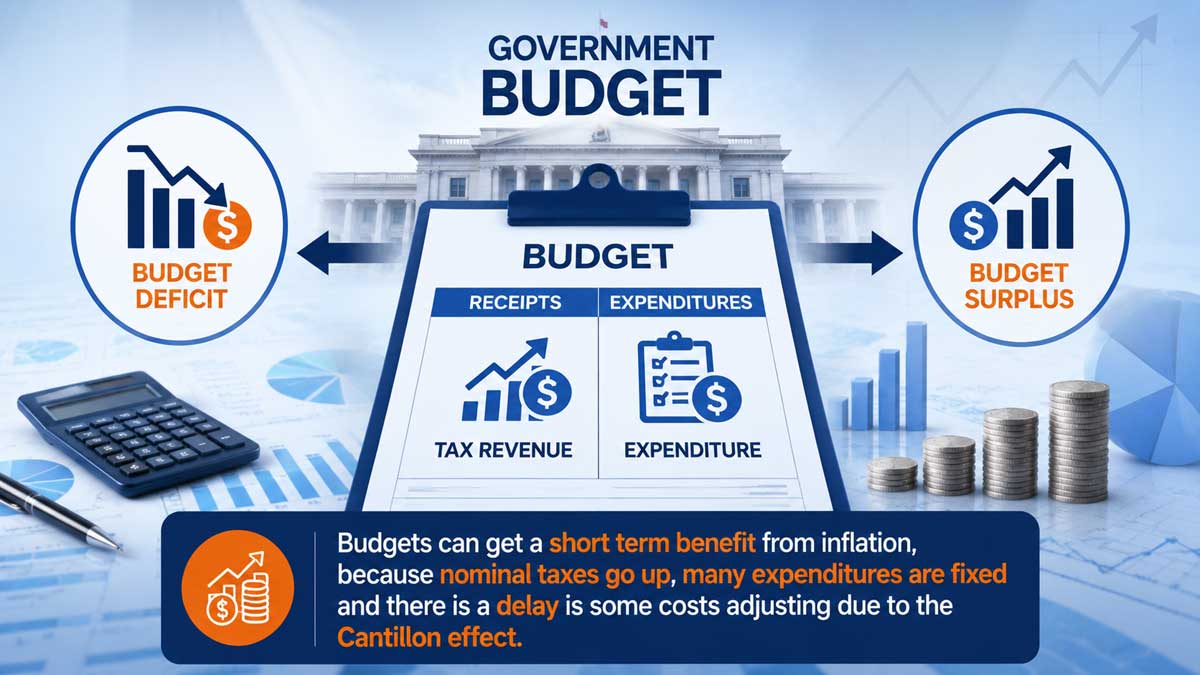
The collapse can initially push up import duties, and also value added taxes at the expense of consumption and disposable incomes of the people, where a big squeeze is placed on the poorest with food – which are not subject to VAT – also rising.
The government may initially benefit from lower real wages (compared to initially inflated tax revenues), which puts the squeeze on state workers and pensioners giving an illusion of improving budgets.
The depreciation and inflation undermines the benefit of salary increments and pension hikes of the government increasing voter displeasure until salaries and pensions adjust.
Private workers will similarly see their real wage and savings hit. Their pensions will never recover. Financial savings of all will be destroyed and their ability to build houses or acquire capital goods will diminish, hitting future growth prospects.
Cost Increases Catch up with Lags
Due to the same effect new capital projects of the governments will go up, and earlier contracted projects may be completed with lower margins for contractors.
A steep enough currency collapse by central bank mis-monetary management of the rupee can lead to halted projects or cost escalation clauses kicking in.
The inflation will also lead to 'bracket creep', giving extra income taxes at the expense of the public, sabotaging increases in income tax slabs given by the government to the people.
Until the income tax slabs are increased and salaries rise, there will be an illusion of improving tax revenues.
Classical economists call this the Cantillon effect, where there is a gap between monetary inflation (debasement) and their effects showing up in prices. Services in particular may see a delay.
Inflationists Escape Accountability by Pointing to Lags
Rents usually lag building costs. Eventually subsidy costs also have to be adjusted up.
"The main difference between the impact of inflation on tax revenues and on public expenditure is the timing and scale of adjustment," explained a study by the Public Finance Institute in 2023 as Fed and ECB money printing led to surge in commodity prices and inflation.
"Tax revenues react to inflation more or less immediately and proportionately – especially VAT, but also, via monthly withholding, personal income taxes and social security contributions.
"Public expenditure items adjust to inflation with varying lags.
"The short-term improvement in fiscal positions is partly due to structural changes that have made modern tax systems much more elastic with respect to inflation – notably the expansion of VAT and the spread of digital technology in tax collection – and partly due to the practice of setting expenditure targets in annual budgets in nominal terms without automatic indexation, so that higher than budgeted inflation generally does not increase spending to the same degree and as quickly as it does revenue,
Money is non-neutral only in the short term
Inflationist macro-economists claim that money is neutral because eventually wages and income adjust nullifying the benefits or losses to various groups as winners and losers are created by the central banks that depreciate money.
Nominal interest rates will also remain high, further hitting budgets, though without inflation indexed or floating rate notes there will be initial benefits to the budget, at the expense of pension and insurance funds.
Foreign debt service costs will go up instantly and the value of foreign debt stocks will go up instantly, which may be partially balanced by the losses to the Employees Provident Fund.
But in the intervening time, the public unhappiness will grow resulting in strikes against employers (or formal wage negotiations), and voter unhappiness, undermining democratically elected governments whose only fault may be the failure to restrain the inflation bias of central banks.
Though money is admitted to be non-neutral economists and macro-economists alike, macro-economists in the inflationist tradition will continue to claim that money is non-neutral in the short term and there are some benefits to 'growth' by tricking wage earners with surprise inflation. (Colombo/July30/2026)