
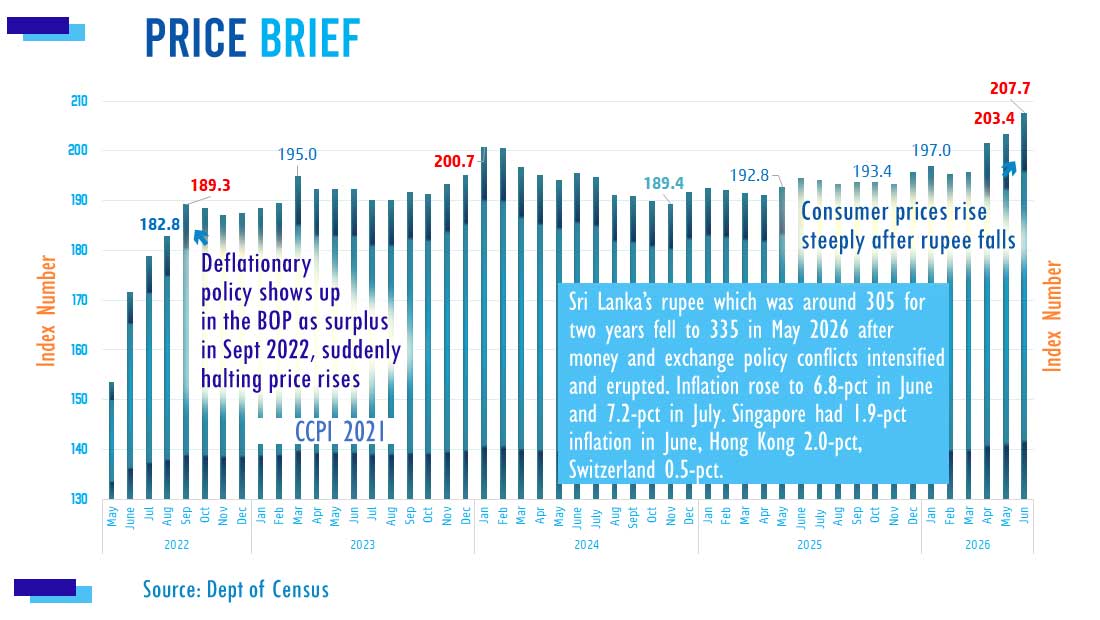
MONETABRIEF – Sri Lanka's inflation soared to 7.3 percent in June 2026, above the central bank's target of 7.0 percent, after a collapse of the currency from attempting inflation targeting while trying to collect forex reserves.
Inflation is now above the upper band of the International Monetary Fund program for two months.
Sri Lanka consumer prices rose only 2.3 percent in the 36 months to September 2025, after monetary stability was restored in September 2022.
Sri Lanka's rupee collapsed in 2026 as the money and exchange policy contradictions which are inherent in trying to target inflation through rate cuts without a clean float (trying to collect reserves) intensified and erupted.
The inflation to 7.2 percent came after an increase to 6.8 percent in June.
In contrast Sri Lanka, where money and exchange polices conflicts, good central banks like the Swiss National Bank, created only 0.5 percent inflation in June in Switzerland.
Sweden which also has an exceptional central bank created only 0.7 percent inflation in the 12 months to June.
Singapore which has only exchange rate policy, 1.9 percent.
Hong Kong Monetary Authority which has no monetary policy created 2.0 percent in i the 12 months to June. Diesel prices rose almost 50 percent to over 36 Kong Kong Dollars from 24.50 in February.
The central bank started to depreciate the rupee in the latter half of 2025 as it was unable to collect reserves outright amid rate cuts and money printed through buy-sell swaps.
Following a sharp fall in private credit from the Ditwah cyclone, the central bank bought 600 million dollars up to February, preventing an appreciation of the currency below 309, building up excess liquidity.
There had also been a central bank profit transfer in the month.
The rupee started to collapse from March, as the central bank refused to return dollars for the money it had created through buy-sell swaps and dollar purchases to the public as a war in the Middle East led to higher fuel imports.
The denial convertibility through 'exchange rate as the first line of defence' while purchasing dollars to create money, led to a collapse of confidence in forex markets, which was further compounded by moral suasion.
A de facto float led to a restoration of some confidence in the rupee and rates were also hiked shortly after.
But the central bank has since then refused to allow the rupee to appreciate above 335 to the US dollar, validating rise in traded goods, and increasing the pressure on the public and poorer sections of society.
There are increasing calls to impose a 2 percent inflation ceiling on the central bank to reduce its ability to trigger monetary instability, push people into poverty and turn the voting public against democratically elected governments.
The 2025/2026 collapse of the currency took place due to series of mis-steps by the International Operations Department of the central bank, which not only steadily depreciated the rupee but also killed the spot market for foreign exchange, analysts who observed the events say.
A 2 percent inflation target cannot restrain such actions or conflicts between money and exchange policies or the denial of convertibility that leads to a confidence collapse in the currency. (Colombo/Jul30/2026)