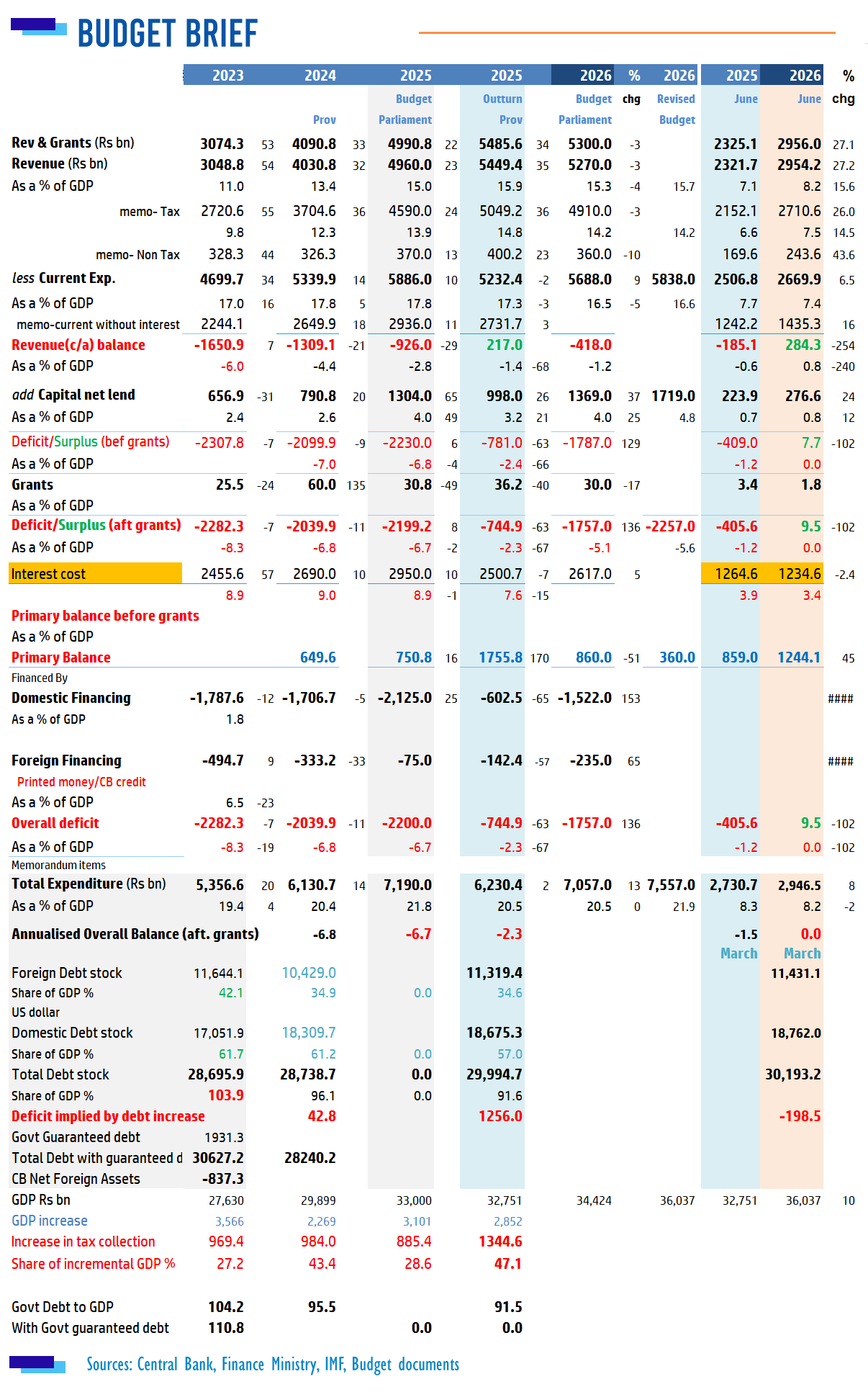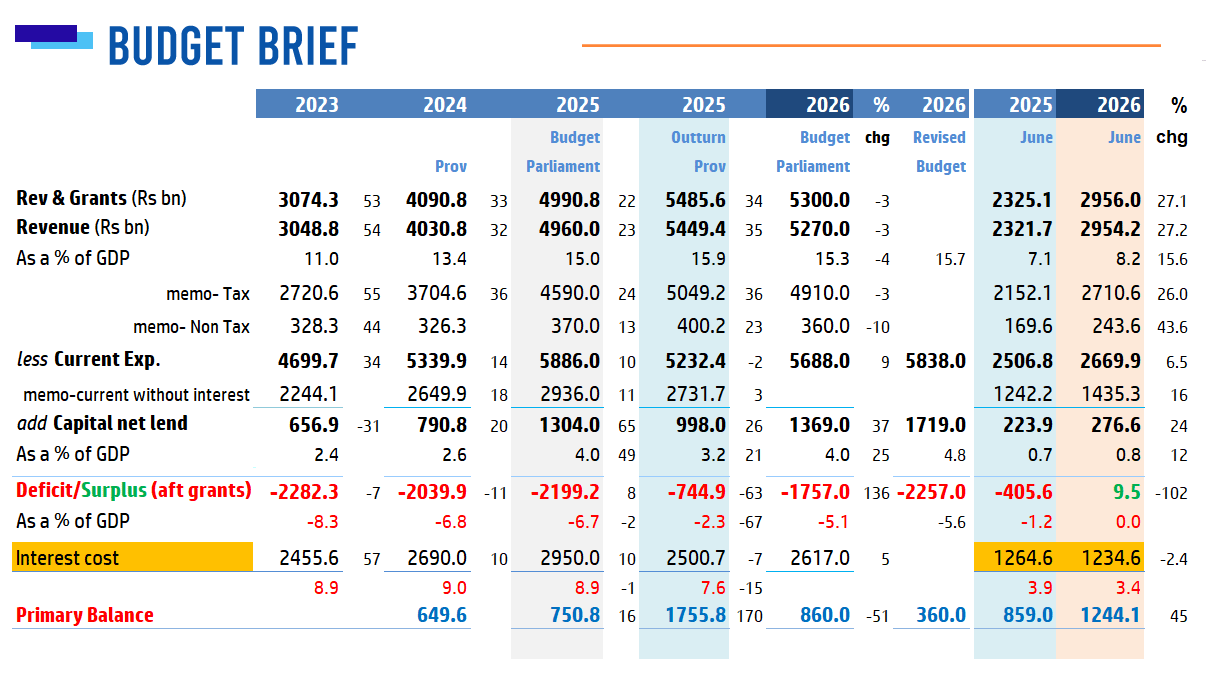
MONETABRIEF – Sri Lanka's budget surplus narrowed to 9.5 billion rupees in the six months to June 2026, down from a surplus of 197 billion in May but still a big improvement from a deficit of 405.6 billion rupees last year.
Revenues grew 27.2 percent to 2,954.2 billion rupees, in six months with tax revenues rising 26 percent to 2710 billion rupees and non-tax 243 billion rupees.
Non tax revenues in 2026 included 41 billion rupees in central bank profits, which pushed up liquidity in the first quarter and may have contributed to the currency collapse as the central bank dishonored notes under exchange rate as the first line of defence.
Weak Monetary Regime
The currency collapse exposed the weakness of Sri Lanka's monetary regime, triggering warnings on the external front by Standard and Poors who confirmed a CCC+ rating.
'Exchange as the first line of defence' which critics say allows the central bank to escape accountability for flaws in its operating framework, may have cost Sri Lanka a rating upgrade from improved fiscal metrics.
Pakistan, which appreciated the currency amid a deficit, earned a rating upgrade.
Current spending grew 6.5 percent with interest costs falling 2 percent to 1,234 billion rupees on the back of monetary stability maintained up until around the third quarter of 2025.
Sri Lanka's nominal interest rates started to rise sharply from 1980 after the IMF's Second Amendment to its articles left the country without a credible anchor and the central bank started to target money supply without a floating rate.
Sri Lanka in 2022 hit a typical Latin America style external default without war after running a textbook single policy rate (floor system) which is now seen in the Fed and ECB and other troubled Western nations which have seen a rise in nationalism, inflation and asset price bubbles that benefited the rich.
Dress Rehearsal?
Sri Lanka's current troubles come from targeting inflation without a floating regime and the central bank running a pegged regime to collect reserves, but printing money or keeping high levels of excess liquidity to boost inflation, which are then dishonored, critics have said.
The central bank selectively honors liquidity for the government to repay debt.
The monetary troubles that led to a collapse of the currency from 300 to 335 to the US dollar in 2026 as well as the 2015-2019 experience shows how easy it is to get into external payment difficulties under flexible inflation targeting and exchange rate as the first line of defence.
In 2015-2019 however Sri Lanka had rating space to borrow abroad as inflationary rate cuts for flexible inflation targeting triggered forex shortages and reserve losses.
Current spending without interest rose 16 percent to 1,435.3 billion rupees, compared to a 3 percent rise in 2025 when there was no inflation. In 2026 Ditwah spending pushed up current spending.
However, after the central bank busted the rupee, and pushed up inflation, subsidy allocations have risen.
Though fuel is market priced, petroleum distributors have to pay 335 to the US dollar compared to 300 before the bout of monetary instability. Fuel distributors and electricity utilities are given subsidies despite market pricing amid currency depreciation.
Though inflationist macro-economists who bust currencies and escape accountability usually claim that revenues go up with inflation, currency deprecation is also claimed as a remedy to balance the external, which means consumption and investment spending is curtailed with incomes being fixed.
Despite the rise in current spending, the budget recorded a 284.3 billion current account surplus, in line with the golden rule of budgeting, leaving some current revenues to finance capital spending.
Capital Expenditure
Capital expenditure rose 24 percent to 276.6 billion rupees.
The current account surplus in theory allows capex to be financed without borrowing. As the current account surplus was bigger than the capex, there was a 9.5 billion rupee overall surplus in the budget.
Without inflation, spending cuts and tax increases can easily generate a budget surplus and real reductions in debt. However, in inflation, both current and capital spending becomes moving target.
When macro-economists bust currencies and push up inflation, costs of new capital projects go up with a delay compared to initial spikes in nominal revenues, and cost escalation clauses can also kick in.
Monetary depreciation may also force suppliers to the government to quote prices with higher margins based on 'exchange rate expectations' or costs of forward booking when there are imports.
The parliament's Committee on Public Finance has already received requests to revise already issued contracts, where unfortunate contractors have bid with low 'inflation expectations' without being aware of the flawed operating framework of the central bank.
Macro-economists expect 'growth' from monetary debasement essentially by tricking economic agents with un-anticipated inflation. Anticipated inflation (where money is truly neutral immediatel) such as wages or costs indexed to inflation cannot bring any extra economic activity.