

MONETABRIEF – Sri Lanka is probing online gaming operations as the South Asian island and its Port City Special Economic Zone is gaining ground as a safe haven for criminal syndicates ejected from areas like POGO compounds in the Philippines.
Thousands of workers from China, Philippines, Vietnam and Cambodia have shifted to Sri Lanka with and without legal work permits to work in illicit online gaming operations targeting jurisdictions where gambling is banned or illegal.
Some of the firms are run by criminal syndicates controlled by Chinese kingpins that employed tens of thousands of workers in illegal gaming and scam compounds in East Asia, an investigation by MonetaBrief has shown.
Port City POGO Paradise?
Recruiters seek out former workers and fresh talent from East Asia to work in Sri Lanka aggressively using social media platforms ranging from Facebook to Tiktok and specialist local social media networks in the targeted countries.
"Are you feeling overwhelmed by the strict inspections in Cambodia's Special Economic Zones or the sudden policy changes in the Philippines?" asks one online advert.
"Are you looking for a new, more stable market with clear legal frameworks but still offering attractive income?
"Sri Lanka, especially the Port City special economic zone in Colombo, is emerging as a new "paradise" for the online entertainment industry."
Some of the largest syndicates in Sri Lanka appear to be former Philippine Offshore Gaming Operators (POGOs) whose compounds were shut down by President Ferdinand Marcos jr, after an upsurge in human trafficking, money laundering, cyber crimes and other criminal activities.
MonetaBrief has contacted the Port City on this story and is awaiting a reply.
In late 2024 President Ferdinand Marcos Jr., ordered an absolute ban on all POGO operations which had expanded under former President Duterte into sprawling compounds in multiple cities.
The POGOs had not only corrupted law enforcement authorities but also elected local government officials.
"The Philippines used to be a major hub for the POGO (Philippine Offshore Gaming Operators) industry. Metro Manila – particularly Pasay, Makati, and BGC – once attracted tens of thousands of online gaming workers," explains a recruitment site.
"The Philippine government has tightened its grip and implemented bans or closures on many POGO activities.
"In this context, a segment of the workforce has begun shifting towards emerging markets such as Sri Lanka – where the gaming industry has developed in a more stable model and has not yet gone through the "boom-bust" cycle like the Philippines."
Gaming, Scamming, Hacking, Trafficking
Senator Risa Hontivero, a leading figure in the campaign to shut down POGO operators, has testified that gaming operatives in a large POGO compound hacked government websites and engaged in cyber crimes in addition to online gaming. (Pogo hubs linked to surveillance activities, hacking of websites-Senate and President Commission on Pogo Links to Hacking Murder)
Sri Lanka's Treasury was also scammed by cyber operatives this year.
When hackers stole 81 million dollars from the central bank of Bangladesh, a part of the money was ultimately recovered in 2016 from casino boss Kim Wong in the Philippines, where they surfaced.
Wong who owned the Eastern Hawaii Lesure Company, had a license from the Cagayan Special Economic Zone and Freeport. He claimed the money came from two Chinese junket operators.
Online gaming, scamming and hacking go hand in hand.
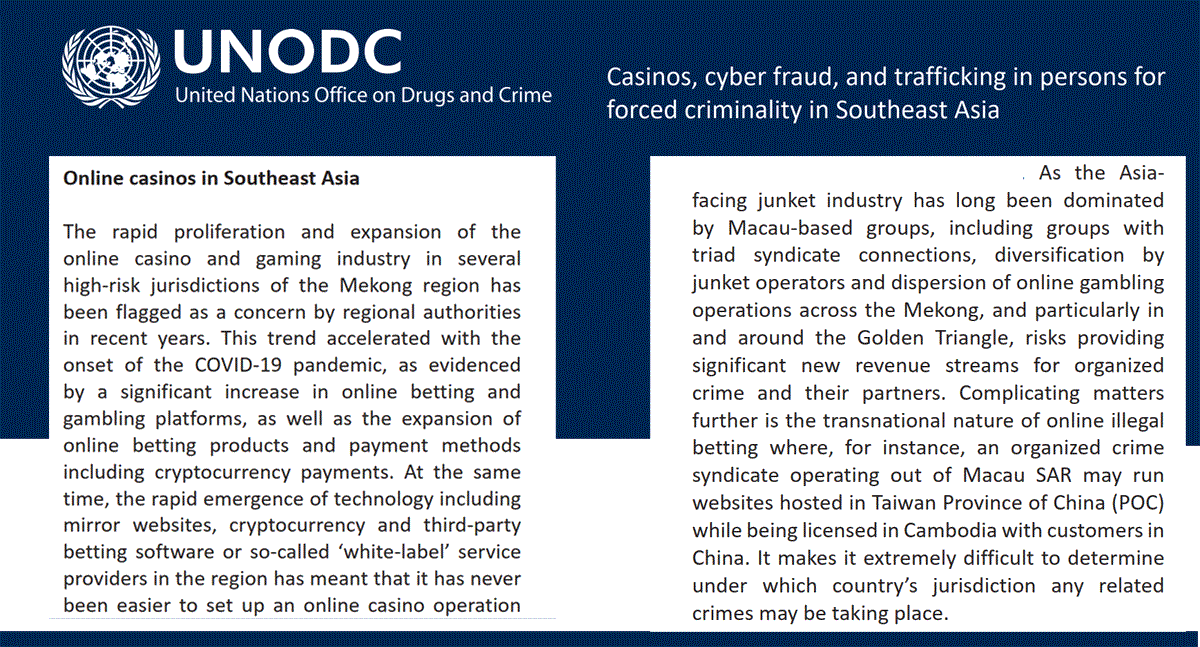
TRANSNATIONAL - A UN report found that illegal online casinos became a hot business for Transnational Organized Crime syndicates duringthe Covid
In his annual address to Parliament in 2024, delivering the decision to shut offshore gaming operators, President Marcos jr, said he wanted to stop the "desecration of our country".
"Disguising as legitimate entities, their operations have ventured into illicit areas furthest from gaming such as financial scamming, money laundering, prostitution, human trafficking, kidnapping, brutal torture, even murder," he said.
Last week suspected Chinese gangsters abducted another group in Sri Lanka's Colombo Port City and one was later found murdered in a forest patch hundreds of miles inland.
Why Are I-Gaming Syndicates Criminal?
Illicit gaming sites are run by criminal syndicates targeting customers in jurisdictions where gaming is banned. As a result, law abiding companies do not enter the industry in such countries.
In cricket, the corruption comes mostly from operatives in India where betting is illegal.
In countries like the UK where sports betting has been legal for generations, public companies have been involved in betting on horses and cricket or football without major problems for centuries.
Sri Lanka has now set up a gambling regulator, and it is expected to come up with regulations later in the year.
Sri Lanka shut down 122 websites targeting the country this week, the Digital Economy Ministry said.
A gaming regulator has now been set up and the issue of online gaming is being discussed by the government and the "right legal enforcement authorities" Deputy Minister for Digital Economy Eranga Weeraratne said.
The planned rules of the gambling regulator will apply everywhere including the Port City, he said.
While Sri Lanka can regulate gaming operations within the island and take a decision on legalizing such activities subject to similar oversight as in Western nations, the island cannot 'legalize' an activity that is targeted to offshore jurisdictions where online gaming is illegal.
International Collaboration
Deputy Minister Weeraratne said there are ongoing consultations with foreign countries including Thailand, Cambodia and some others.
"The international collaboration is building on this," he said. "This is not affecting a single country. This is a cross-border issue. So, the knowledge sharing network is now getting developed."
"I have spoken to the minister in Thailand about this. And Thailand is willing to support, including other countries as well."
Cambodia has shut down 250 scam compounds and 91 online casinos by April 2026, Thailand's The Nation newspaper reported following the crackdown in that country. Some were operating on the border with Thailand.
Deputy Finance Minister Anil Jayantha said authorities were looking into reports on the matter.
China has been shutting mushrooming online gaming operations for several years.
According to a United Nations Office on Drugs and Crime report, in 2020 alone China arrested 75,000 suspects and extradited 600 I-Gaming operatives from Cambodia, Malaysia, Myanmar and the Philippines.
In 2022, Chinese police investigated over 37,000 cases of cross-border gambling and shut down 2,600 online gaming platforms and 2,500 payment platforms.
Sri Lanka the Colombo Port City was reclaimed from the sea and is managed by a Chinese state corporation.
Opposition legislator Harsha de Silva, Chairman of Sri Lanka parliament's Committee on Public Finance has been raising a red flag on offshore online casinos for many years.
High Pay
There appears to be two levels of online casinos and scam sites in Sri Lanka.
At the top end, the larger online gaming syndicates ejected from East Asia seem to be operating within the Port City or as Board of Investment approved Business Process Outsourcing companies.
Since Port City has designated several high rises in Colombo for its companies, until the office towers are set up in the zone itself, the workers cannot be kept incarcerated in compounds.
As a result, they are given high pay and facilities.
Recruiters roaming on Tiktok, Telegram and Facebook offer 1,200 to 2,000 US dollars a month in pay, 4 to 14 percent tiered commissions, 5 days off and 9 hour shifts for marketing, customer service, SEO, and "administrative assistants".
Pay is offered variously in US dollars, Yuan and in part also in US dollar Tether (crypto).
Workers are offered free dorms in 'luxury apartments' with gyms and swimming pools with 2 to 4 persons per room.
As a results rents have rocketed in areas like Kollupitiya and Bambalapitiya, one resident said.
"You can save half your salary," promises a Tiktok recruitment advert. "Living costs in Colombo is cheaper than in Manila. Most of your expenses are paid for by the company."
"Colombo is quiet," says a post in a community group in a social media channel. "Not much activity like in Manila to spend your money."
The companies also offer 2 to 4 meals for workers. Since Sri Lankan food is spicy and it gets some getting used to, to keep their mental state in equilibrium the companies promise 2 to 3 meals a day cooked in Chinese or other East Asian styles.
Headhunters working for some of the shadowy recruitment companies who were in the Philippines calling themselves 'Shang Shui' and 'Thien Vu' are actively recruiting former workers, training new ones and assigning them to various companies.
After contacting likely workers through Tiktok, Facebook or country specific social media channels, recruits are taken underground to Telegram channels to 'close the deal'.
Chinese Owners, Malaysian Managers
While the companies appear to be mostly owned by Chinese, some of the senior managers are Malaysian, who can speak English and deal with local authorities and other businesses.
There are Sri Lankan 'BPO' and IT companies who are facilitating resident visas and work permits.
In Colombo, key online gaming hubs are in high rises in Fort, off the Town Hall area and also around Havelock City.
While some of the bigger online gaming syndicates are offering carrots to retain staff including tickets home at the end of the year (re-imbursed with the February salary if they come back to work) there are also other companies who are doing closed compound scam and casino operations by taking away passports of workers, especially in remote locations outside Colombo.
In 2026 Sri Lanka authorities have raided scam operations in several outlying provinces.
In any case, with food supplied by specialized kitchens, and shuttle buses taking workers from luxury apartments to the promised 'Grade A' office block in Colombo, the workers with resident permit also do not have a need to interact with locals.
"Organized crime groups first recruit victims," notes a UN report. "They primarily target university graduates who are fluent in multiple languages (especially English and Mandarin), have skills in Information Technology (IT), familiarity with social media, and some working knowledge of cryptocurrency.
"These conditions are important for the organized crime groups because they require a skilled labor force to carry out criminal activities in cyberspace, from various scams to money laundering and illegal gambling."
Target Countries
While China is a big target, Vietnam, where people are getting more prosperous and where gaming is illegal, is a key market for illegal gaming syndicates.
Sri Lanka has been arresting scam workers in several buildings, for immigration and other offences. At least one online casino has also been shut down.
The Chinese Embassy in Sri Lanka has also commented on the cyber scams.
Vietnam President To Lam in his address to Sri Lanka's parliament called for co-operation in combatting cross border cyber crimes.
Vietnam's ambassador to Sri Lanka in an interview with the Vietnam News Agency, warned citizens not to come to Sri Lanka to work in illegal activities.
"After entering Sri Lanka, some people are enticed or participate in activities involving online scams, financial fraud, online gambling, or other acts that violate the law," she said in the report reproduced in the Foreign Ministry website.
Recruiters however tell young people that offshore online casinos that hit their own countries are legal in Sri Lanka.
In July, Vietnam's Cyber Security and High-Tech Crime Prevention Department (A05, Ministry of Public Security) working with provincial police shut down a string of online gaming sites called fi88 and King group.
King Group has actively recruited staff for its operations in Sri Lanka.

Large gaming rings targeting Vietnam including KJC and P3Bet are operating out of Sri Lanka and recruiting workers.
They operate multiple websites with domain names registered in locations ranging from South Africa to Montenegro.
Foreign arrivals to Sri Lanka from Cambodia rose 70 percent in the first quarter of 2026, Myanmar (another cyber scam and offshore gaming hub) rose 458 percent and Vietnam 258 percent, according official data.
Since large volumes of tourists are coming from from China in any case, it is less easy to track sudden changes.
Online gaming rings in Sri Lanka are also targeting African countries like Nigeria.
One strategy seems to be to get into countries where sports betting is legal and offer online casino services which are not legal.
They pay no taxes and profits are large. They can also engage in practices which are banned in regulated jurisdictions like the UK.
European countries like UK troubled gamblers sign up to services like Gamstop to block their phone and computers from registered gaming sites to stop the habit. However offshore online gaming companies circumvent the online blocks to reach them.
Crypto Currencies and Money Laundering
Recruits to Sri Lanka gaming BPOs are offered a mix of currencies ranging from Yuan, to US dollars as well as crypto currencies like US dollar tether, a fixed exchange rate with the US dollar.
Of late, some are also offered in part in rupees. It is not clear where the rupee revenues are coming form.
It is not only staff that are offered crypto. In Sri Lanka suppliers to the companies, are also offered, USDT.
Their websites accept payments in variety of options including, Binance Pay, USDT, ETH, and apps called PayME and OnePay.
A few months after President Marcos shut down POGOs, Philippines was removed from the FATF grey list.
Philippines News Agency reported Presidential Communications Office Undersecretary and Claire Castro as saying that "that the POGO issue was a significant reason for the Philippines’ inclusion in the grey list." (POGO ban major factor in PH exit from FATF grey list)
The casinos and scam networks are also starting to recruit Sri Lankans who are now getting 'technology transfer' and getting knowledge on how to hack phones, pass around money and use and transfer cryptocurrencies and other money.
Sri Lanka's Securities and Exchange Commission recently raised a red flag on an investment scam where people were lured into investing stocks through a false app.
However, in Sri Lanka there are also a large number of returnees who worked in scam compounds in Cambodia who have brought back the "technology" and has built links with offshore operatives and tax havens.
One returnee told MonetaBrief that he was used to target Indian and Pakistani victims. (Colombo/Aug07/2026)