
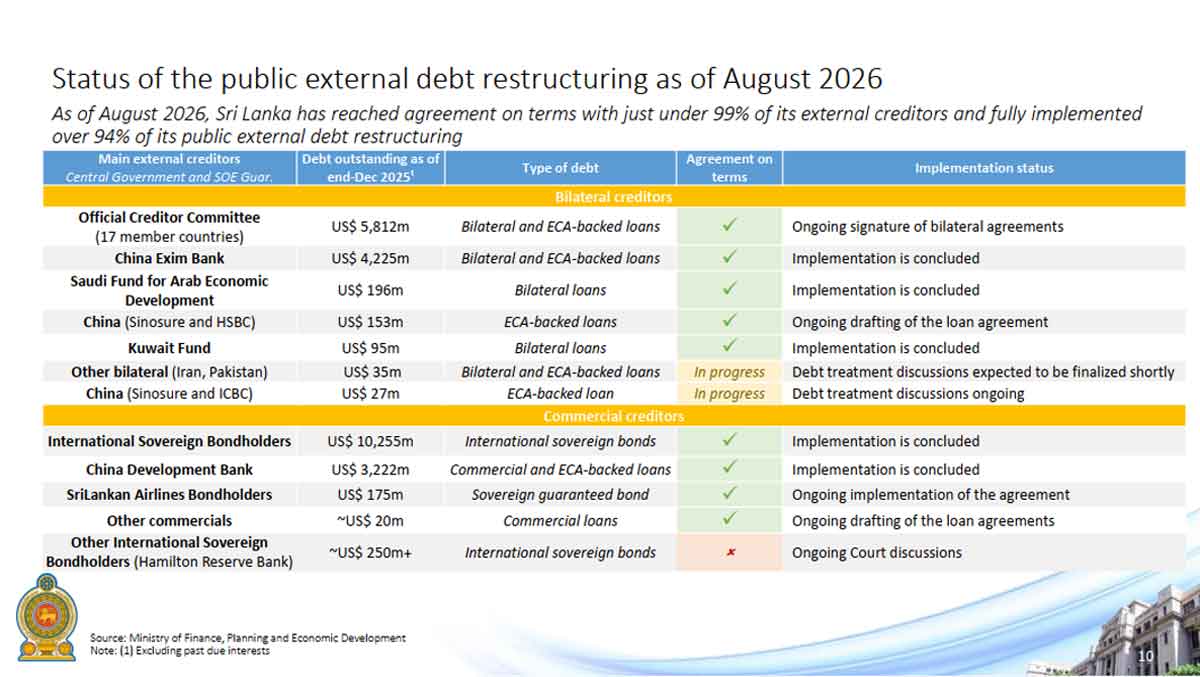
MONETABRIEF – Sri Lanka has fully implemented the restructure of 94 percent of its defaulted debt by August 2026 and the reached agreement with 99 percent of creditors, the Finance Ministry has said.
A 250 million dollar tranche of sovereign bonds linked to Hamilton Reserve Bank was in court, debt treatment discussions were ongoing on a 27 million dollar export credit loan of Sinosure/ICBC, according to a presentation made to investors.
In bilateral and export credits worth 35 million dollars due to Iran and Pakistan, debt treatment was expected to be finalized shortly.
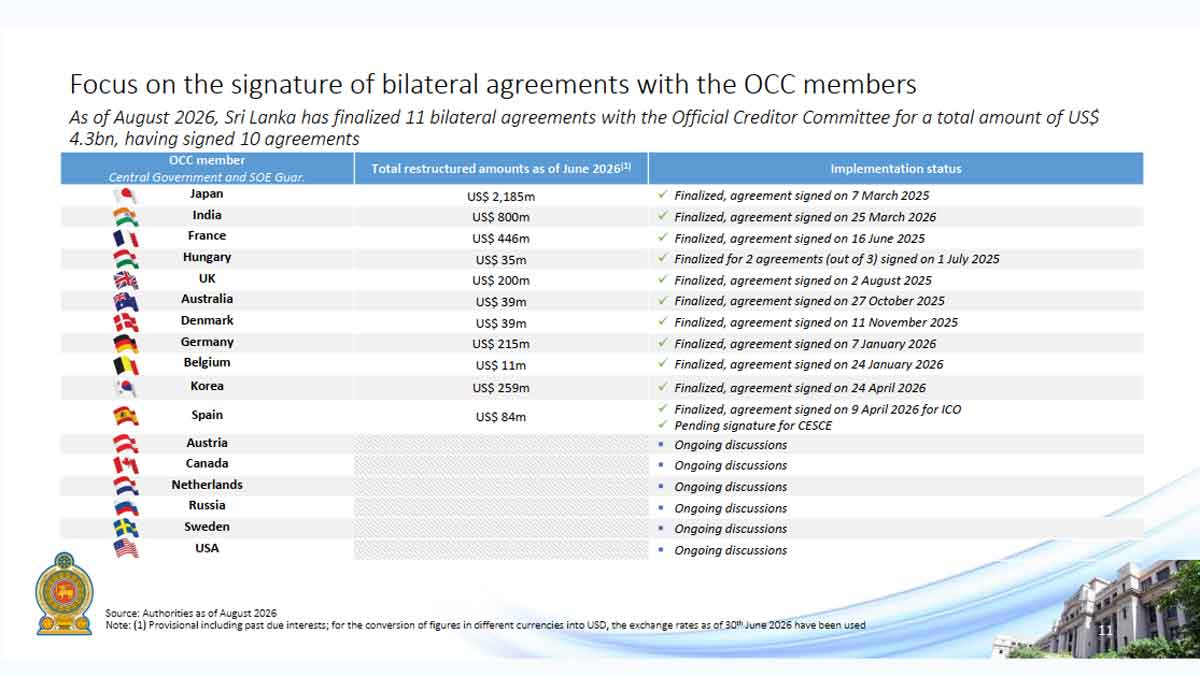
In the case of a 153 million dollar Sinosure/HSBC loan agreement was being drafted. Discussions were ongoing with Canada, the Netherland, Russia, Sweden and the USA.
Sri Lanka defaulted in 2022 after serial currency crises from 2015 as the central bank printed money to target a rate in the middle of its policy corridor under cover of a 5 percent inflation target.
Money was printed to close an 'output gap' between 2015 and 2019 as the then Deputy Economic Minister Harsha de Silva pleaded with the central bank not to print money and borrowed heavily as forex shortages emerged to repay maturing debt busted the currency.
The next government was fully in line with potential output targeting and printed money and cut taxes to close the gap.
The administration and the central banks also put maximum yields on short term treasuries and implemented true floor rate (single policy rate) until default and then rates were raised.
In 2025 the International Monetary Fund gave technical assistance to implement a single policy rate (a true floor rate).
In 2026 reserve targets were relaxed before they were missed, (as warned by analysts after the 2018 experience) and the March indicative target was missed.
The currency collapsed amid a budget surplus. From February 1952, in the first external crisis and stabilization crisis, in which the Prime Minister resigned after street riots, the macro-economists have blamed budget deficits and not 'guiding interest rates along the desired path' or 'easing cycles' for the country's ground hog day currency crises.
Rates have since been raised – after the horse had bolted and the currency collapsed – and excess liquidity is building up in money markets, which the central bank has no intention of honoring under 'exchange rate as the first line of defence'.
A survey showed that the government popularity has taken a hit, from the first currency collapse after default. (Colombo/Aug18/2026)