
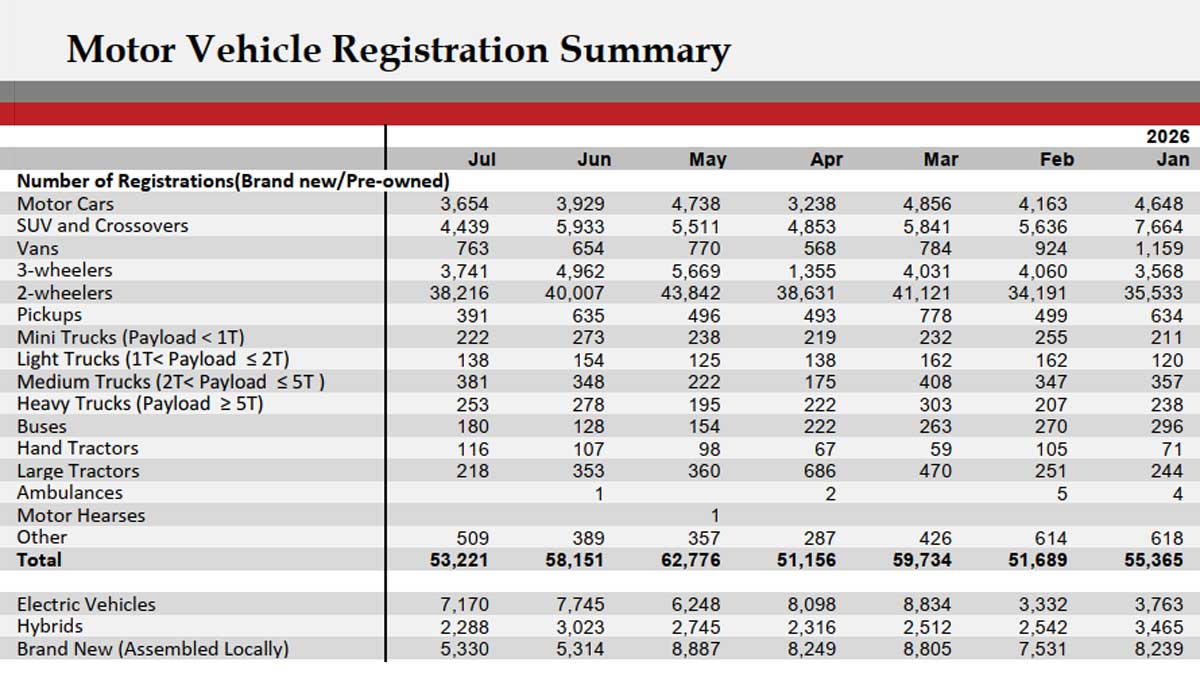
MONETABRIEF – Sri Lanka's vehicle registrations fell to 53,221 from 58,151 with mobikes and three wheelers taking the biggest hit after the rupee collapsed from wrong central bank policy and trade restrictions were slapped instead of holding the agency accountable.
Motorcycle registrations fell 38,216 units in July from 40,007 in June and 43,842 in May after the rupee fell in the wake of rate cuts and money printed through buy-sell fx swaps of the central bank,
Three wheelers fell to 3,741 in July from 4,962 in June and 5,669 in May, an analysis of vehicle registry data by JB Securities, a Colombo-based brokerage shows.
Sri Lanka's rupee collapsed from 300 to 335 to the US dollar in the second quarter, on top of a depreciation to 309 by the end of 2025 as the central bank printed money through swaps and dollar purchases and denied convertibility.
As the rupee collapsed, vehicle taxes were raised and credit restrictions were imposed by raising loan to value ratios, instead of holding the central bank accountable for policy errors through its deeply flawed operating frameworks.
Import spend on personal vehicles were falling from December highs when the rupee collapsed.
Import spend on personal vehicle imports which peaked at 240.9 million US dollars in December, fell to 163.8 million in January, 148.4 million in February and 147.5 million in March, according to central bank data when the rupee collapsed.
The central bank had bought 600 million dollars in January and February 2026, creating new money and dishonored them as they were used to import oil in 2026 sowing panic in forex markets and killing a spot market with moral suasion as uncertainty went up.
The rupee collapsed. Though rates were corrected, the rupee remains depreciation and public unhappiness in the government has risen, through the central bank has reached its controversial target to raise the cost of living by 7 percent a year.
When macro-economists trigger inflation, by printing money or dishonourable forex operations, the least affluent pays the biggest prices with heavy political costs are heavy.
Analysts hard warned earlier that rejoicing by macro-economists as the central bank reached its inflation target was in bad taste and not in line with classical economics where the foundations lay on moral philosophy.
While two-wheeler registrations fell by 1,729, motor car registration fell by 275. SUV and crossover registrations which surged to 5,933 in June from 5,511 in May after restrictions were imposed fell back to 4,439.
While some may have bought June vehicles fearing further rises or restrictions, there are sales and vehicle registrations do not tally.
There are reasons to suggest that "a meaningful portion of registrations may be dealer inventory registrations rather than final customer deliveries, reflecting efforts to avoid the 90-day registration deadline and associated penalties," JB Securities noted.
"The vehicle registration data that we receive only show first time registrations, subsequent registration due to final sale or transfer to the financier is not visible in these statistics."
Sri Lanka authorities had imposed a 90-day restriction on dealer inventory to 'save foreign exchange' in another restriction on economic freedoms of the public, instead of holding the central bank accountable for money printing or dishonoring notes.
Analysts have blamed the parliament for failing to hold macro-economists responsible for their inflationism.
Sri Lanka's path to de-liberalization started in 1952 as the newly set up central bank exercised its musles to print money and suppress rates, triggering steep loss of reserves accumulated during and after World War II.
Ironically, macro-economists blamed the 2026 currency collapse on an external shock, a distant war in the Middle East but raised rates, showing that the problem was a domestic policy error.
There is pushback against the inflationists as a controversial target to raise the cost of living by 7 percent comes up for review this year.
Since 1952 - except for a brief period between 1994 and 2011- inflationists have largely dictated policy and succeeded in fomenting monetary instability and political unrest.