
MONETABRIEF – Top Sri Lanka economist W A Wijewardene has suggested a staggered reduction of the central bank's inflation target as victims push for a lower target in the hope of ending currency crises and the next sovereign default.
Sri Lanka's inflation spiked above 8 percent in August after the currency collapsed from 309 to 340 level in the second quarter as the central bank dishonored excess liquidity (note issue) it had created in course of monetizing a balance of payments surplus in the first quarter and money printed through buy-sell swaps.
Undemocratic Discretion
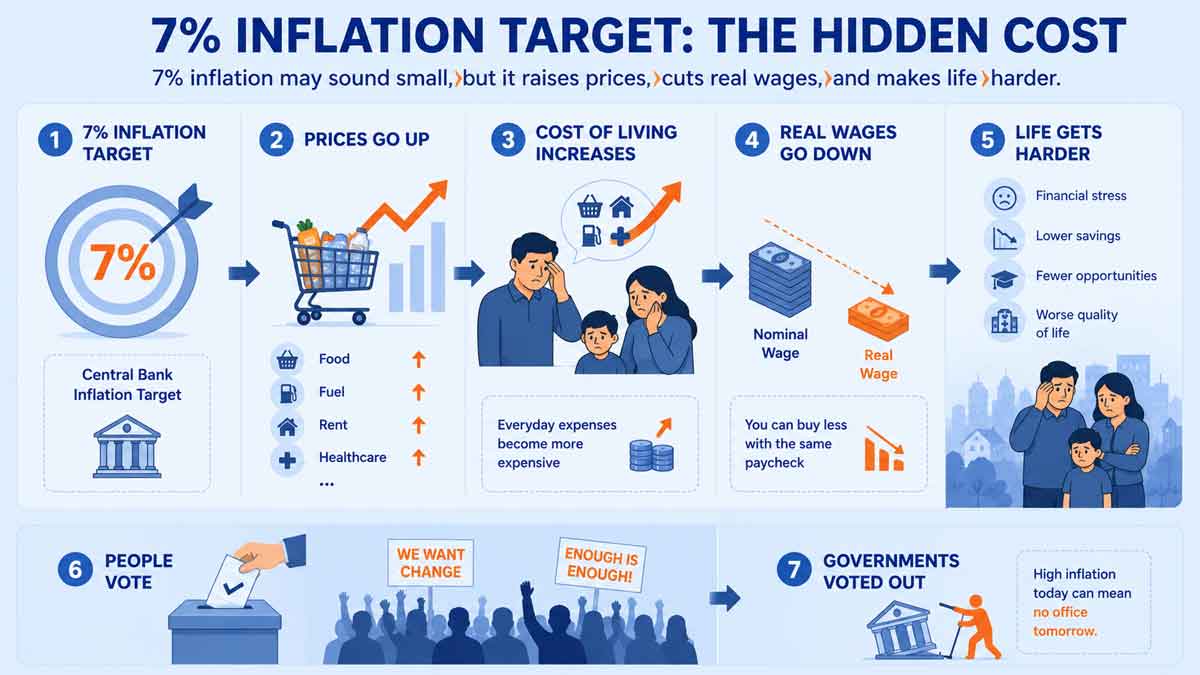
Analysts had pointed out that the high inflation target gave too much room for the central bank to destabilize the external sector and undermine democracy by turning voters against democratically elected governments given the experience after 2015.
Giving flexibility (discretion) to a state monopoly which amounts to arbitrary rule also goes against democratic norms, which are based on rules and restraint.
Sri Lanka's inflation spiked above 7 percent upper level of the inflation and 6.5 percent in an IMF program, after the currency collapsed from 309 to 340 level in the second quarter delivering the first blow to a democratically elected government.
The high inflation is coming as the US Fed has not tightened monetary policy since 2022 and early signs of a new commodity bubble are emerging and countries like Singapore have appreciated the currency to keep prices down.
The currency collapse and 8.0 percent inflation came, came amid a 5 to 7 percent inflation target.
Central Bank officials including P K G Harischandra are pushing to raise the cost of living by 5 to 7 percent a year in the unfortunate belief that inflationary policies leads to growth and not balance of payments trouble and default.
Half a Pound of Flesh
Wijewardene, an ex-Deputy Governor, who had kept monetary stability in the midst of the collapse of the housing bubble and also an internal war, suggested a compromise.
To meet stability advocates half-way, Wijewardene suggested cutting the inflation hit over three years writing in Sri Lanka's Daily FT newspaper.
"To reconcile these competing concerns and align price stability with real-economy growth, I propose that the following path be incorporated into the new monetary policy framework agreement for the next three years:
"Year 1: Bring down inflation from the current level of above 7% to a target of 5%. Year 2: Transition the target from 5% down to 4%. Year 3: Ease the target further from 4% down to 3%.
"Under this phased approach, CBSL would have the necessary runway to tighten monetary policy gradually without imposing a sudden shock on the real sector."
Sri Lanka inflation was the same as the US until 1978, when macroeconomists got a 'license' to depreciate the currency, leading to soaring inflation, shattered budgets, strikes and internal strife after the IMFs Second Amendment to its articles, critics have pointed out.
Latin American countries then started to default.
Before the mid 1960s till 'full employment policies' gained currency, Sri Lanka (and much of the rest of the world) had one to two percent inflation with food commodities taking up 80 percent of the index.
Classicals tracked commodities, not services as commodities are among the first to respond to inflation (over expansion of money supply).
Any inflationary policy by a reserve-collecting-central bank leads to forex shortages as explained by classical economists, especially David Hume (price specie flow mechanism) and Ricardo.
Modern macro-economist (so-called post-Keynesians) believe that by "calibrating" interest rates, inflating reserve money, or by heedless state spending (deficits), growth (or full employment) can be achieved rather than balance of payment trouble, in line with spurious doctrines promoted by the likes of John Maynard Keynes.
Deadly Monetary Fallacy
In his General Theory, Keynes in one go dismissed the very basis of sound money and self-correcting balance of payments of specie backed note-issue banks that had laid the foundation for the industrial revolution and liberalism in the UK up to the eve of the World War I.
After the Fed triggered the Great Depression by inventing the policy rate and firing the roaring twenties bubble, Keynes made an about face.
He said the doctrine of the classicals that the "rate of interest and the volume of investment are self-adjusting at the optimum level, so that preoccupation with the balance of trade is a waste of time," was somehow wrong as the state (or economic bureaucrats) had to control the interest rate.
"For we, the faculty of economists, prove to have been guilty of presumptuous error in treating as a puerile obsession what for centuries has been a prime object of practical statecraft," he said reviving Mercantilist fallacies involving the trade deficit andcurrent account deficit.
"Under the influence of this faulty theory the City of London gradually devised the most dangerous technique for the maintenance of equilibrium which can possibly be imagined, namely, the technique of bank rate coupled with a rigid parity of the foreign exchanges.
"For this meant that the objective of maintaining a domestic rate of interest consistent with full employment was wholly ruled out.
"Since, in practice, it is impossible to neglect the balance of payments, a means of controlling it was evolved which, instead of protecting the domestic rate of interest, sacrificed it to the operation of blind forces."
Sri Lanka's central bank in May hiked rates for exactly the same reason as do all IMF programs.
Because he was an academic, Keynes was able to mislead many.
However, wishing away laws of nature and two centuries of classical economics does not make the problem go away.
Countries that rejected Keynesianism and interest rate manipulation like Singapore (no policy rate), have not only killed unemployment but imported labour.
Hong Kong was the first such nation in the age-of-inflation to see industrial exports with local and inward investment in the absence of a policy rate under Colonial administrator John James Cowperthwaite under whom the main East Asian export powerhouse elements (monetary stability and free trade and low taxes as a consequence) evolved without intervention. The strategies were copied by Taiwan in 1960 and Singapore, a few years later.
GCC countries which used Indian rupees, did the same thing in the 1960s as the RBI printed money and are mow importing labour as Ceylon did before the central bank.
Today countries like Dubai, Qatar in a war zone also maintain monetary stability by not fiddling with interest rates as Sri Lanka then Ceylon did in two world wars, but is now complaining of an 'external shock'.
One of Keynes' foremost critics, Friedrich von Hayek, whose students also brought monetary stability to East Asia, suggested that, had Keynes lived and seen what full employment policies did to Britain after World War II, he would have once again changed his mind.
"It would be unfair to blame Lord Keynes too much for the undoubted harm his theories have done, for I am convinced from personal knowledge that had he lived he would have been one of the leaders in the fight against the postwar inflation," Hayek wrote.
After cutting rates and rejecting Hume (price specie mechanism) Sri Lanka's central bank had to hike rates post-haste in 2026 as the balance of payments gave way under excess liquidity (which classicals called the super abundance of paper money).
Excess liquidity is again building up and critics have noted that under 'exchange rate as the first line of defence' the agency has no intention of honoring its note-issue.
In countries with reserve collecting central banks punishment in the form of forex shortages and external default comes quickly.
But under prolonged stimulus, floating rate countries can also default or get into debt crises. (Colombo/Sept05/2026)