
MONETABRIEF – US Treasury Secretary Scott Bessant has said America the looming debt crisis in America will be avoided in the expectation that higher economic growth will outpace debt expansion.
If the US tries to contain spending coupled with 3 percent growth, he said, "we [can] grow our way out of this," Bessent was quoted as saying by Yahoo finance news, during a forum at SMU Cox School of Business in Dallas.
"We'll get to the other side of this Iran conflict and the underlying economy is very, very strong, and I think reaccelerating," Bessent said.
The Denominator
"The Sri Lankan economy has demonstrated strong signs of broad-based recovery, with a real GDP growth of 8.0 per cent in the first half of 2021," the island's central bank said in a statement slamming a rating downgrade in October 2021 referring to Covid instead of the Iran war.
"The vaccination drive is progressing at full strength, covering over 60 per cent of the population with both doses and almost 100 per cent of the population over 30 years, thus providing confidence of a strong rebound in economic activity in 2022."
In calculating the debt burden, GDP is the denominator, which leads macro-economists to think that debt crises can be avoided through statistics.
However, unlike amortized debt, bullet repayment bonds, that depend on roll-over is driven by investor confidence. Finance managers who want to safeguard capital, make decisions, not macro-economists.
"We don't have a revenue problem. We have a spending problem," Bessent said.
President Trump had extended tax cuts both on individuals and corporates, in his 'Big Beautiful Bill' in 2025, some of which were originally legislated in the 2017 Tax Cuts and Jobs Act.
Policy Support
Sri Lanka cut taxes in 2019 and wanted to create a "production economy".
Macro-economists believe that by 'caliberating' taxes or interest rates by printing money, growth and employment can be increased in so-called full-employment policies flogged by the University of Cambridge (J M Keynes), Harvard (Alvin Hansen) and MIT (Paul Samuelson).
Sri Lanka's then Presidential Secretary P B Jayasundera, former Treasury Secretary and macro-economist who had been in the central bank, said growth will come from low taxes.
Income tax will remain at gazetted rates, while VAT will be 8 percent for the next five years, he was quoted as saying by Sri Lanka's Daily FT newspaper a business forum. There will be no other new taxes for five years, he said.
There were also curbs "on unnecessary imports" via a policy of import substitution.
Trump has also tried to control imports through high taxes – which however brings some revenue – in the hope of boosting domestic investments and jobs.
Bessant said the tax incentives had led to new manufacturing plants, with Pepsi expanding a Frito-Lay plant in Arizona, Winnebago buying a battery plant, and Boeing increasing capacity of its Dreamliner.
Plus ça Change
In 197I, UK Chancellor of the Exchequer, Anthony Barber, who was an Oxford graduate also cut VAT and interest rates in exactly like Sri Lanka did in 2019/2020. The so-called 'Barber Boom' led to widespread strikes from the Cantillon effect and eventually triggered a debt crisis, leading to the biggest IMF bailout by then.
The UK was rescued by the Thatcher administration that ran deflationary policy, raised VAT but reduced income tax progressively.
The old Mercantilist idea of interest rate control originally articulated by John Law was revived by Keynes in his General Theory leading to balance of payments problems in many countries including Sri Lanka and destroying monetary stability.
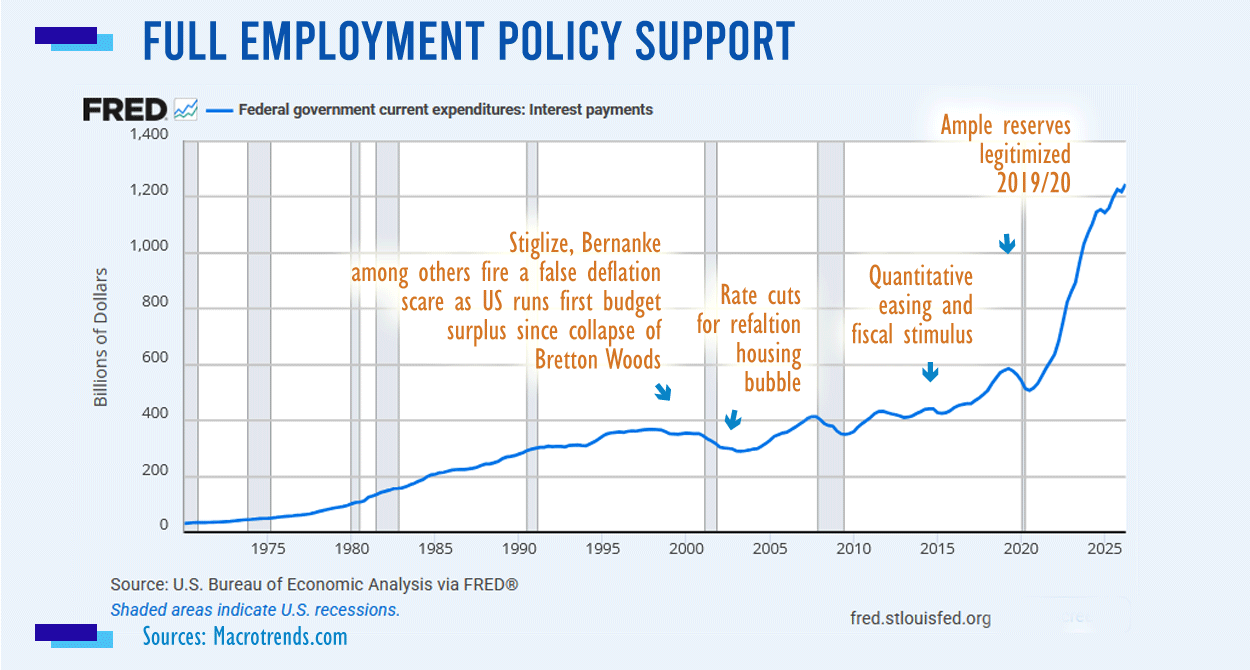
The US now runs an 'ample reserves regime' (a floor system) with massive amounts of excess liquidity, which was officially legitimised in 2019 with the Fed abandoning the previous plan of 'normalization' or a return to a scarce reserve regime.
In a country like Sri Lanka, inflationary policy leads to swift currency collapses – as seen in 2026 – but balance of payments crises are absent in a clean float.
However persistent inflation can destroy capital, kill savings, and boost government non interest expenditure including wages and costs of purchasing goods and services.
Eventually the destruction of capital by inflation coming from rate cuts or quantitative pushes up interest rates further hitting budgets.
The US started to 'reflate' its economy driven by the doctrine by the likes of Joseph Stiglitz and Ben Benarnke about 20 years ago, firing the housing bubble.
The collapse of the housing bubble led to a revival of Keynesianism and worse – quantitative easing – which has now made inflation uncontrollable.
The US Fed has not raised interest rates since March 2022. The usual Fed cycle that avoids big asset price bubbles is 4 year with rates hiked in from the third year. It is now nearly four and a half years since the start of the last hiking cycle. (Colombo/Sept15/2026)