
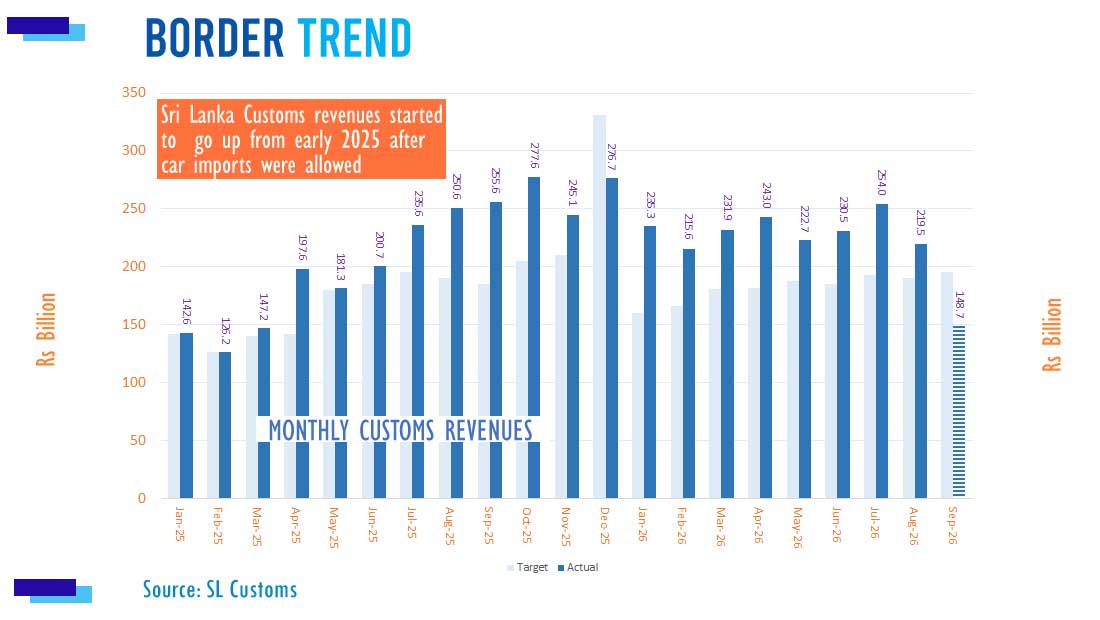
MONETABRIEF – Sri Lanka Customs has exceeded two trillion rupees in revenues by September 15, official data showed, with monthly collections exceeding targets, amid some signs of peaking after a currency collapse.
Sri Lanka closed vehicle imports in 2020 as the central bank cut rates with printed money to boost growth under flexible inflation targeting, despite operating a pegged exchange rate regime to collect reserves.
Instead of fixing the central bank's operating framework, macro-economists banned imports, blocking revenues worsening a fiscal crisis in what critics call a 'cascading policy error'.
Sri Lanka opened vehicle imports in February 2025, increasing state revenues.
Customs revenues are still stable in rupee terms, though monthly numbers appear to have peaked.
In 2025, Sri Lanka Customs collected, 2,557 billion rupees, higher than a revised target of 2,231 trillion rupees.
The 2026 target is 2,206 billion rupees.
In 2026 the rupee collapsed as oil prices went up and the central bank dishonored its note issue which included massive excess liquidity in money markets and money printed through dollar fx swaps.
Macro-economists who reject economics (price specie flow mechanism/monetary approach to balance of payments) believe that by debasing money and impoverishing the people to reduce their purchasing power, balance of payments problems can be solved.
In May import tax surcharges were slapped as the central bank dishonored its notes and the rupee fell.
Sri Lanka's habit of controlling trade to cover up errors in the operating framework of the central bank which had reduced from the late 1990s, pick up from 2015 after the IMF taught the central bank to calculate potential output.
As money was printed to reflate under flexible inflation targeting or to close an 'output gap' that was supposed to existg, serial currency crises were triggered in peacetime.
Mandatory exporter conversion which were lifted 1994, re-imposed marking a decisive shift in both the doctrine and operating framework of the central bank from 2015.
LC margins especially on cars were raised each time forex shortages imports, gold imports were taxed heavily as the fallout from flexible inflation targeting worsened.
In 2020 more than 2000 imports were banned in an all-out 'policy support' drive to close the output gap, triggering a peacetime default and an even bigger currency crisis.
The 2026 collapse of the rupee came as poor people in particular were barely recovering from the 2022 currency collapse. Mandatory exporter conversions were also tightened. (Colombo/Sept17/2026)