
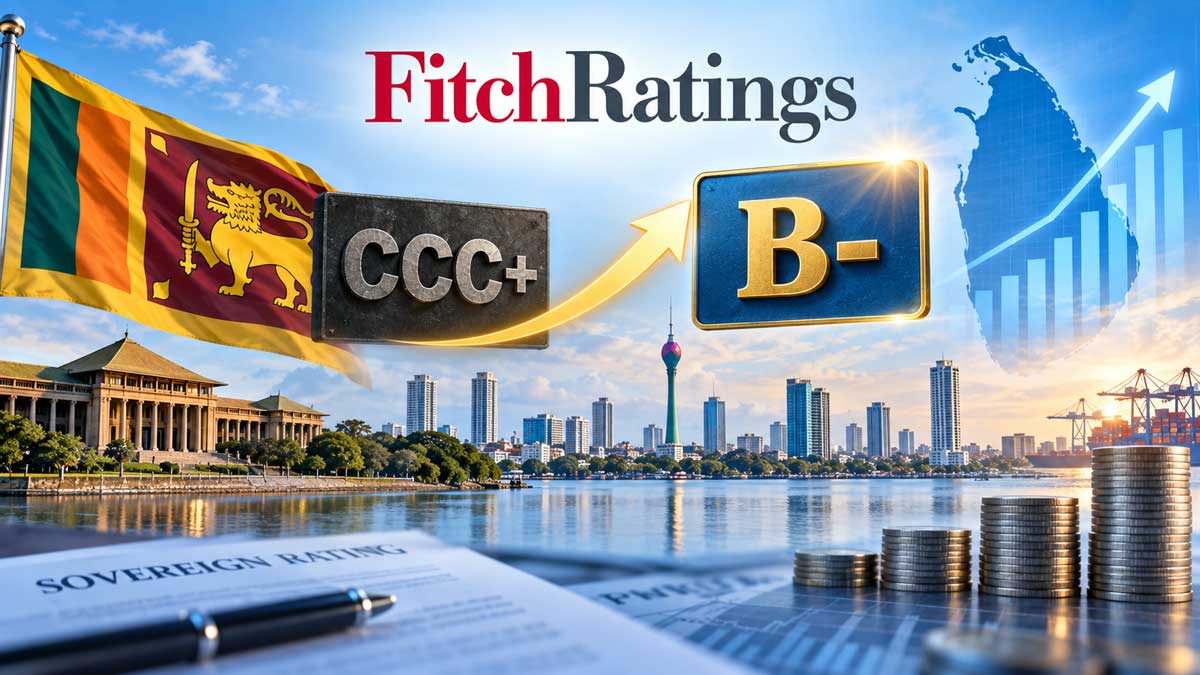
MONETABRIEF - Fitch Ratings has upgraded Sri Lanka's sovereign rating to 'B-' from 'CCC+' saying fiscal balances have improved and there were modest reserve collections.
"Sri Lanka's credit profile remains hindered by still-high government debt-to-GDP and debt service ratios compared to rating peers, despite the recent restructuring and macroeconomic adjustment," Fitch Ratings said.
"FX reserve buffers remain modest, particularly considering a rise in external debt service over the next five years."
Sri Lanka reserve collections (foreign assets) weakened from 2025 which analysts attributed to the removal of the central bank requirement to run deflationary policy involving sell downs of domestic assets in the IMF program, which led to big build ups of excess liquidity.
There have been calls for the Treasury to buy dollars and remove what looks like a quasi-fiscal activity from the central bank.
The full statement is reproduced below"
Fitch Ratings - Hong Kong - 22 Sep 2026: Fitch Ratings has upgraded Sri Lanka's Long-Term Issuer Default Ratings (IDRs) to 'B-' from 'CCC+'. The Outlook is Stable.
The upgrade reflects the implementation of macro-stabilization policies, underpinned by structural reforms, which have eased external financing risks and provide a degree of resilience to shocks. This is reflected by sharp improvements in fiscal and external balances, and a modest rebuilding of FX reserves. Fiscal discipline and revenue mobilization efforts should support sustained primary surpluses that keep government debt-to-GDP on a downward trend and reduce risks of a reemergence in external imbalances.
Sri Lanka's credit profile remains hindered by still-high government debt-to-GDP and debt service ratios compared to rating peers, despite the recent restructuring and macroeconomic adjustment. FX reserve buffers remain modest, particularly considering a rise in external debt service over the next five years.
A full list of rating actions is at the end of this rating action commentary.
Key Rating Drivers
Revenues Boost Primary Surpluses: We forecast a healthy primary surplus of 2.6% of GDP in 2026, albeit down from the record 5.4% surplus in 2025, buoyed by sustained revenue growth. This is consistent with the overall deficit rising to 4.1% of GDP in 2026 from 2.3% in 2025. Rising revenue reflects tax reforms and a temporary surge in import duties from pent-up demand for imported cars. Revenues are offsetting higher expenditures for reconstruction after Cyclone Ditwah in 2025 and targeted energy support measures.
We expect primary surpluses to remain above 2% of GDP over the next few years, supported by steady revenue and expenditure restraint. Although revenue will moderate with easing auto imports, revenue mobilization efforts should keep collections at just under 16% of GDP in the coming years. The 2024 Public Financial Management Act caps non-interest spending at 13% of GDP through 2031 which should maintain fiscal discipline, though the cap has been exceeded in 2026 for cyclone reconstruction. Even amid reforms, risks of slippage may rise as the 2029 elections draw near.
Fiscal Weaknesses Persist; Easing Gradually: Government debt and interest/revenue ratios remain high relative to peers but are gradually improving. We forecast debt to fall to 92.9% of GDP in 2026 (B median: 54.7%) from 96.7% in 2025 and continue declining in the next five years to the low-80% levels. We expect the interest/revenue ratio to ease to 41.0% in 2026 from 45.6% in 2025 and a 2023 peak of 76.3%. This is still 3x above the 12.7% 'B' median. Fiscal space is limited and adherence to recently developed fiscal frameworks will help ensure continued sustainability.
Energy Shock Hits Current Account: We expect high energy prices to flip the current account to a deficit of 1.2% of GDP in 2026 following three years of an average surplus of 1.5%. The US-Iran conflict has pushed up the energy import bill and temporarily dented tourism inflows. However, remittances continue to rise steadily, helping to offset these headwinds. Risks remain elevated given uncertainties in the US-Iran conflict and Sri Lanka's position as a large net energy and fertilizer importer. As the shock eases in 2027, we expect the current account to return to near balance.
Near-Term Financing Conditions Adequate: Financing from the IMF and other multilateral agencies continues to provide steady external financing to mitigate near-term current account pressures. This support, along with adherence to greater exchange rate flexibility, will also allow the country to further build its FX reserves to our forecast of USD7.7 billion (2.9 months of current external payment) by end-2026. Still, the external shock has dampened the degree of reserve accumulation and risks are tilted to the downside.
Debt Repayments Rising: External buffers remain thin and external debt repayments are set rise over the next five years, particularly after 2028, implying sustained vulnerability to external shocks or policy slippage. We expect the highest macro-linked bond threshold to be reached, triggering higher interest and principal payouts. The government is considering a return to global bond markets in 2027. The current IMF Extended Fund Facility programme ends in March 2027. A follow-on IMF facility is possible, which could help anchor policy settings and provide a financing backstop.
Resilient Economic Performance: Sri Lanka's economy has been resilient to recent shocks from Cyclone Ditwah and the US-Iran conflict, though we do expect GDP growth to moderate to 4.1% in 2026 from an average of 5.0% in the past two years. Risks are tilted to the downside, especially from the country's energy vulnerabilities. We see medium-term GDP growth at just over 4%. Challenges persist in attracting FDI, enhancing the export sector and revitalizing SOEs, though sustained reform momentum could provide some upside.
Inflation Rising: We forecast headline inflation to average 6.3% in 2026 up from -0.5% in 2025, as the global energy shock and El Nino are adding to domestic price pressures. The Central Bank of Sri Lanka (CBSL) raised its policy rate by 100bp in May to 8.75% to address inflation risks and support the exchange rate. We do not expect further hikes. Price pressures are likely temporary, and we forecast inflation to recede to just below the CBSL's 5% target by next year.
ESG - Governance:/ Sri Lanka has a medium WBGI ranking at the 39.6 percentile, reflecting a recent track record of peaceful political transitions, a moderate level of rights for participation in the political process, moderate institutional capacity, established rule of law and a moderate level.
RATING SENSITIVITIES
Factors that Could, Individually or Collectively, Lead to Negative Rating Action/Downgrade
- Public Finances: Reduced fiscal discipline or weakened revenue mobilization efforts leading to lower primary balances and a substantial slowing in the decline of government debt/GDP.
- External Finances: Renewed external liquidity pressures reflected by an inability to further build FX reserves and a reemergence of persistently large current account deficits.
Factors that Could, Individually or Collectively, Lead to Positive Rating Action/Upgrade
- Public Finances: A substantial decline in the general government debt/GDP and interest/revenue ratios underpinned by strong implementation of a credible medium-term fiscal consolidation and debt management strategy, revenue mobilization and faster economic growth.
- External: A large and sustainable rise in FX reserves, for instance driven by further improvements in remittance inflows or export performance.