
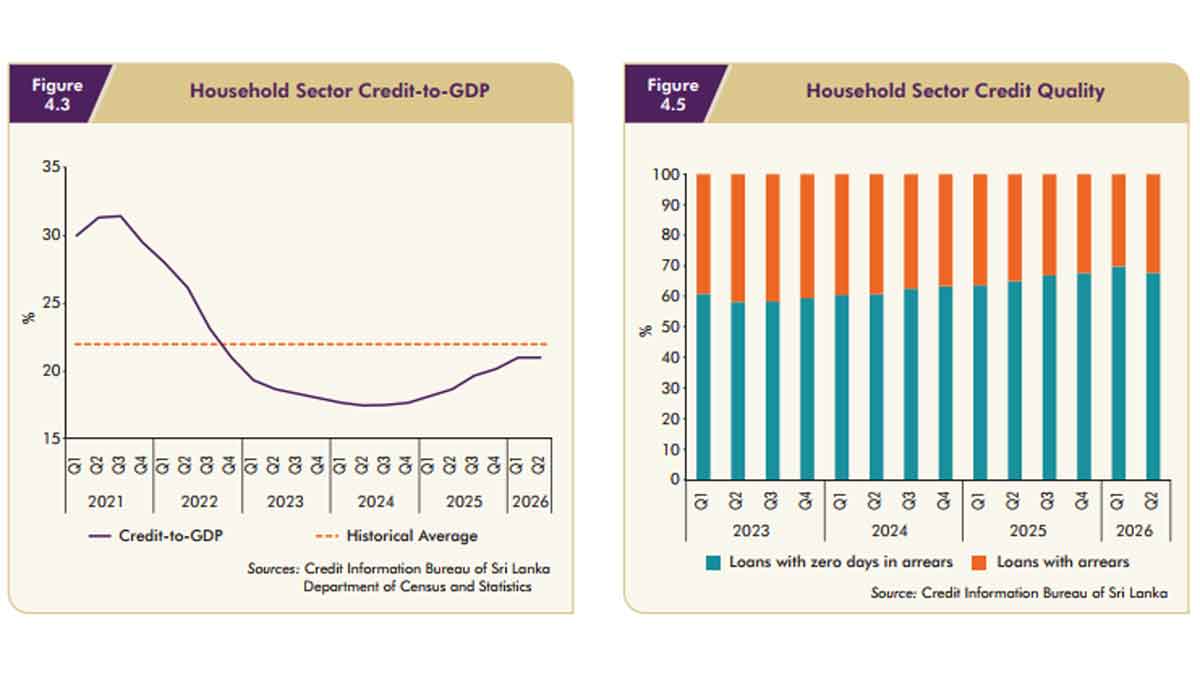
MONETABRIEF – Sri Lanka's household debt which accounts for 41.8 percent of total formal sector lending has grown fast over the past year, especially in the Western province but customers are servicing the debt, a central bank report said.
Household credit grew 25.4 percent at the end of Q2 2026, up from Q2 2025, but was slightly lower than Q1 growth of 28 percent.
The share of credit provided by non-bank financial institutions (NBFIs) had increased over the previous year.
Vehicles are a key generator of household credit.
"Looking ahead, tighter monetary conditions and macroprudential policy through the implementation of more stringent Loan to Value (LTV) requirements on motor vehicle financing and gold backed lending are expected to contribute to a gradual moderation in Household sector credit growth," Financial Stability Report issued by the central bank said.
"Nevertheless, given the high expansion in household credit, with y-o-y growth exceeding 20 percent in each of the past four quarters, close monitoring of household indebtedness and debt servicing capacity remains important from a financial stability perspective."
There was no separate categorization of gold loans at the moment into household and business, Central Bank officials said.
Nearly half of the loans were given in the Western province reflecting a geographical pattern that has been seen historically.
At the moment however households were servicing debt.
Loans with zero days in arrears accounted from 67.7 percent of loans from 65.0 percent last year.
"These developments in repayment behaviour indicate that the continued expansion in Household sector credit has not, thus far, resulted in a broad based deterioration in overall borrower repayment capacity," the report said.
Borrower creditworthiness in the Household sector, as measured by the weighted average CRIB score11 of borrowers, improved during the first half of 2026, although overall borrower profile remained in the high risk category.
Sri Lanka's Credit Information Bureau calculates a credit score.
Credit scores in the range of 250-500 are considered as very high risk, 500-550 are considered high risk, 550-580 are considered average risk, 580-610 are considered low risk and 610-900 are considered very low risk.
The weighted average CRIB score increased to 538.2 during Q2 of 2026 from 511.6 recorded in the corresponding quarter of the previous year.
Borrowers within the Banking sector showed stronger credit profiles, with the average CRIB score increasing to 557.2 by end Q2 of 2026, placing the sector within the average risk category.
Borrowers of the NBFI sector recorded a lower average score of 497.4, remaining within the very high risk category despite the continued improvement during recent quarters. (Colombo/Oct12/2026)