
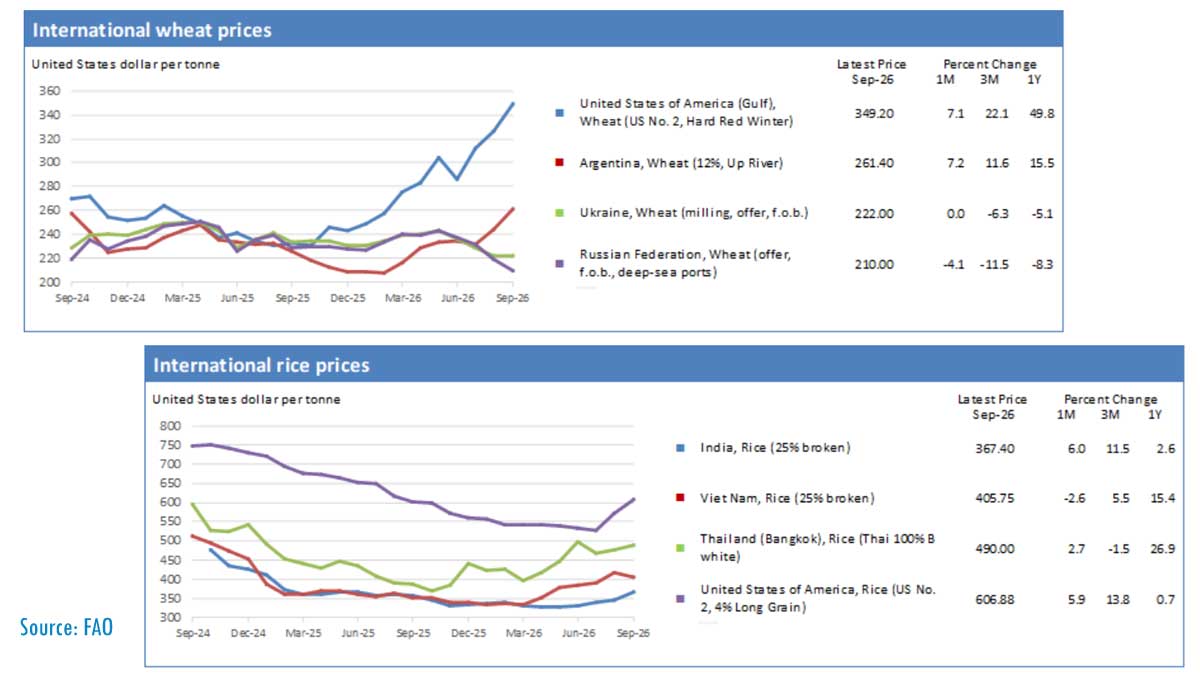
MONETABRIEF – Sri Lanka's Consumer Affairs Authority, the national price controller, said it planned to raid shops which raised wheat prices, after importers announced a wheat price hike amid a rise in global prices and rupee depreciation.
The CAA has created shortage of basic foods through its price controls when the rupee fell or the Fed fired a global commodity bubbles in the past.
Wheat importers announced a 13 rupee hike a kilogram two days ago.
"We only learned about it from the media," Chairman of Sri Lanka's Consumer Affairs Authority Hemantha Samarakoon, was quoted as saying in Sri Lanka's Derana Television.
"We have asked them why they raised prices. According to our governing Act, if wheat prices are changed, they have to inform the Consumer Affairs Authority, discuss and come to an agreement.
"We will take necessary action against those who sell at higher prices."
Global commodity prices including wheat and maize have been rising for several months as the Federal Reserve failed to control inflation operating an abundant reserve regime, which analysts say tends to accommodate all shocks.
Rice, which usually lags wheat and sugar, has also started to pick up.
The Fed last raised rates in 2022 and by 2026 over 4 years had lapsed before policy was tightened. Usually policy is tightened in the third year of the cycle.
The Housing Bubble was fired with an 8 year cycle.
The Fed has started to hike rates, but it is not reducing excess liquidity (quantity tightening) as it did 2022 when it fired also massive commodity bubble which macro-economists and the IMF blamed on Vladimir Putin.
Sri Lanka's central bank has also amplified external shocks by busting the rupee from 300 to 330 to the US dollar in 2026 to reach its controversial inflation target with a percentage point to spare so far.
There has been no punishment for the central bank for exceeding its already controversially high inflation target.
Sri Lanka central bank reflated the country to satisfy its belief that inflation helps growth and not social unrest and external trouble after claiming that falling or stable prices were bad.
When central banks destroy the value of money and wages do not go up wages do not go up in step, though macro-economists claim that money is neutral.
Sri Lanka's central bank has suggested that the government give subsidies to people hit by its inflation target.
In the time gap between wages going up, people turn against employers or the government.
When wages adjust, macro-economists turn on workers claiming that there is 'wage-price inflation' blaming the victims of their inflation target.
The blame game was popularized by Anglophone central bankers in the 1960s and 1970s to escape accountability as inflation soared due to their so-called full employment policies.
Analysts had urged the government not to allow the central bank to create high inflation and to restrain it to a ceiling of 2 percent, while others have called for an exchange rate target given its actions since the end of a civil war.
In 2026 the central bank busted the rupee primarily by dishnoring excess liquidity that was built up by monetizing a balance of payments surplus (buying dollars) and also by monetizing bank foreign assets through buy-sell swaps.
Classical economists like B R Shenoy had said the technique of inflating an economy through BoP surplus was only of 'academic interest' in Sri Lanka in the 1960s.
Excess liquidity in money markets has been around 300 to 400 billion rupees for the past several months.
Sri Lanka-style protests also broke out in France, which have since spread to Belgium and Italy.
The riots in France are among the worst since 1968, when full employment policies by macro-economists pushed up inflation.
The US has among the worst monetary regimes with fully - fledged abundant reserves, while the ECB has been gradually reducing its excess liquidity.
The new US Fed Chair Kevin Warsh had been critical of abundant reserves before his appointment. (Colombo/Oct22/2026)