
MONETABRIEF – Sri Lanka has requested waivers for missed targets in the International Monetary Fund program and changes to targets in the program going forward, at a forthcoming Board review.
The Executive Board has scheduled a meeting on December 02, for the review and Article IV consultation.
The Board will consider "waivers of Nonobservance of Performance Criteria, Modification of Performance Criteria," the notice said without elaborating.
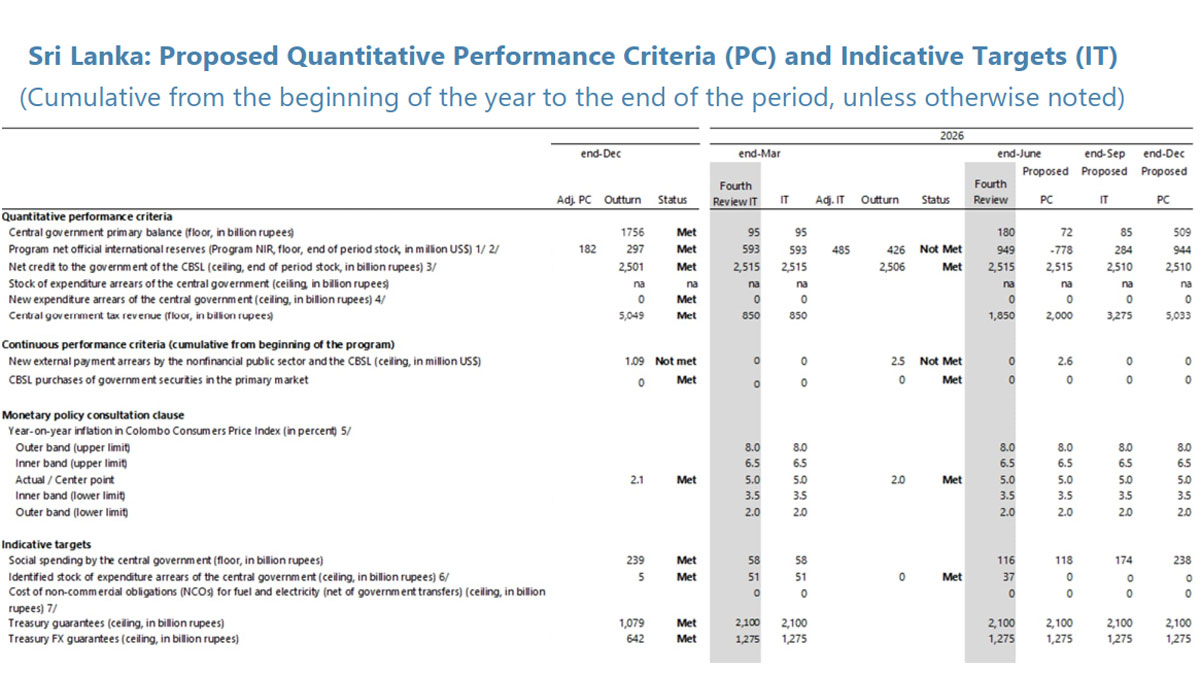
The performance criteria include a primary balance in the budget, as revenue floor which may have been exceeded based on published data. There are also performance criteria on no new domestic or external arrears.
It is not clear whether a payment involving hacking to Australia has been settled yet.
There is also a net international reserve target on the part of the central bank and central bank credit to the government.
In 2025 the requirement to sell down the bonds stock ended, which analysts warned would reduce the ability of the central bank to meet reserve targets, though coupons on the bonds are deflationary.
Sri Lanka missed the March indicative target and has since collected some dollars.
The June target was previously relaxed.
In 2026, the central bank was planning to collect 2,200 million dollars from the market. Up to October 1,728 million dollars were collected.
Without a requirement to deflate excess liquidity, the central bank maintained high levels of redundant money, which it promptly dishonored under flexible exchange rate doctrine to amplify the shock of the Middle East war.
As a result, the inflation soared above the targets (monetary policy consultation clause) in the IMF program of 6.5 percent (inner band) and 8.0 percent (outer band).
The redundant notes that the central bank dishonored when oil importers and banks used the excess liquidity, was made with the depreciating notes given to unfortunate migrant workers and Ditwah victims who got help.
Due to previous depreciation and inflation from the central bank which has denied a living wage and prevented people from building a roof over their heads, millions of Sri Lankans have gone to countries in the Middle East without monetary policy work.
The busting of the rupee by 10 percent, and full accommodation of higher costs through the excess liquidity, has so far pushed inflation up to 8.3 percent.
In Sri Lanka depreciating the rupee has turned out to be the best tool to turn the electorate against democratically elected governments.
In a small trading nation, it is not that easy for a central bank to generate high inflation of 5-7 percent without depreciating money, though excess liquidity can push up non-trade goods prices in the index. (Colombo/Nov23/2026)