
Share your email and we'll share the latest news
Exclusive economic intelligence, political and business coverage
Friday, October 23 2026
Friday, October 23 2026
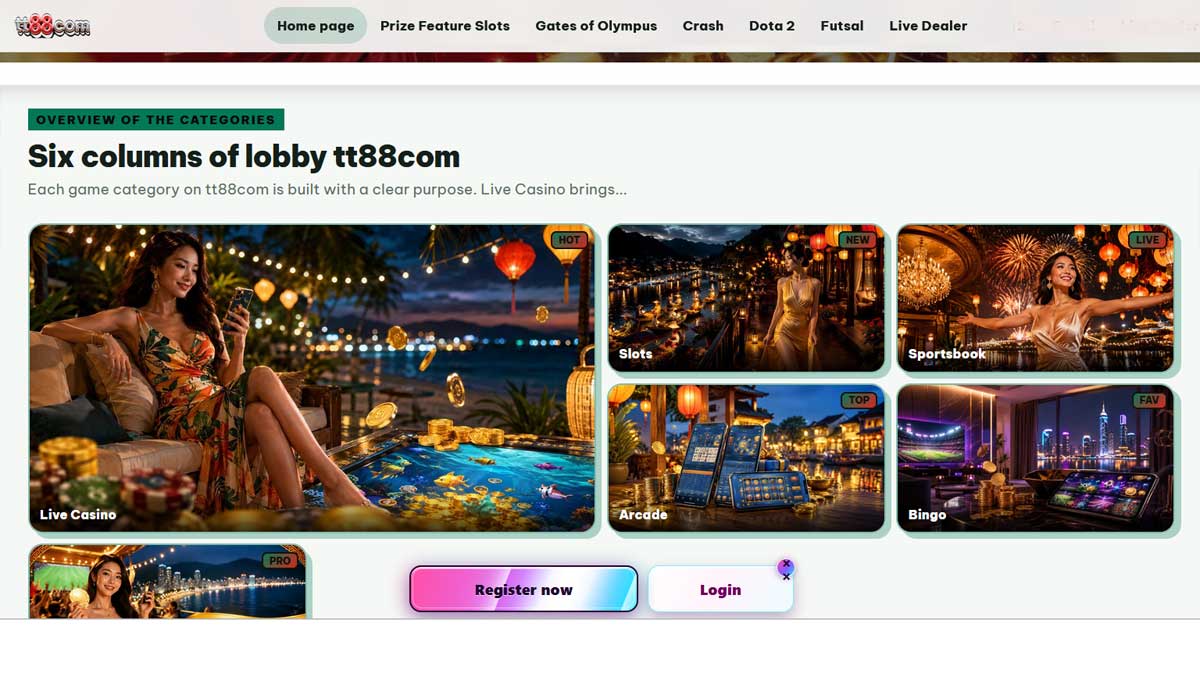 CRIMINAL CASINO : A white lable operator in Colombo Port City is currently recruiting staff to run the TT88 online casino syndicate
MONETABRIEF – Sri Lanka Parliament's Committee on Public Finance has fired a shot across the bows of POGO style casinos in Sri Lanka's Port City, issuing a warning on money laundering and implications to the island's banks and image.
Sri Lanka is being promoted as the next 'paradise' for thousands of ex-workers of Philippine Offshore Gaming Operators and Cambodian operations by recruiters working for illegal casinos in Colombo Port City business process outsourcing firms.
COPF was told by the Port City Economic Commission that 14,300 resident visas were issued for foreign workers in the Special Economic Zone, drawing exclamations of surprise from members.
There are a number of firms engaged in legitimate business in the Port City, including Chinese state companies.
Outside of the Port City there BOI firms.
In addition large numbers of 'peripheral' ecosystem of POGOs are also present in the country using 6 month business visas, according industry sources. Others come and go on tourist visas.
COPF Chair Harsha de Silva and member Shanakiyan Rasamanickam queried the nationalities of the foreign workers and whether the commission was tracking what they were doing and to report back.
There were only 16 employees in the Economic Commission and no Director legal, they were told.
Money Laundering
"This is a valid question for more than one reason,"de Silva told the Port City Economic Commission.
"One is on financial sector stability. Another one is money laundering. And we don't want to get a bad name. You know, we've seen some terrible headlines in some foreign newspapers."
Firms in the Port City are offering recruits salaries in cryptocurrencies such as tether (USDT), though it is not an approved currency for use in the Special Economic Zone.
In the past, there was no requirement for anybody to check what BPOs in Sri Lanka were doing as they usually did equity research, legal legwork, back-office work for legitimate companies, mostly in the West.
At least one Colombo Stock Exchange listed company is also involved in online casinos through its BPO.
Criminal casinos, which were innovated by outlawed junket operators, already had and underground banking system to shunt money from countries with capital control to Macau and other destinations in the physical casino era.
Companies in Sri Lanka have also recruited workers through telegram channels for payment networks.
One money transfer operation has the same name as a Philippine based regulated payment company that was offering gaming company level salaries ($1300 probation, $1500 after confirmation) for female customer service and deposit withdrawal (called XNK) staff to work in Sri Lanka in September.
"..[I]in an attempt to make the job advertisements look more legitimate, some advertisements have started to fraudulently use the names, logos, and other branding of real companies," a UN report on illegal gaming observed.
"The shift into online casinos has been exhibited by both a major increase in online betting and associated gambling platforms as well as the expansion of online betting products and payment methods," another UN report on underground banking said.
"Online gaming and the rise of social gaming has also been changing the industry and its associated money laundering risks as so-called ‘crypto casinos’ and non-fungible token (NFT) playto-earn games become more popular."
U8.com, a Chinese language website widely advertised around Colombo in Chinese restaurants, takes deposits and makes payouts in Crypto.
Offshore Casino Paradise
There has been a shift of illegal online casinos run by East Asian criminal syndicates which used to operate in the Philippines and Cambodia to Sri Lanka. The flow began to surge from last year as crackdowns began in the two countries.
The origins of online casinos and their scam compound offshoot lay in the physical casinos of the Special Economic Zones of the Mekong Delta and the Philippines.
They went online as lockdowns and travel restrictions during Covid-19 cut off their traditional high roller customers.
Thousands of young East Asian school leavers and college graduates are being lured to work in the offshore casinos at the Port City in textbook human trafficking operations under false pretences, an investigation by MonetaBrief has revealed.
Port City recruiters are looking for young people for their criminal activities.
"Most trafficking victims are young adults, often educated professionals, between the age of 20 and 30 years," notes a United Nation Office on Drugs and Crime report on Casinos and Trafficking for Criminality in South East Asia.
"The organized crime groups are mostly interested in recruiting young people because they are familiar with social media, smart phones, and cryptocurrency."
IT skills are also needed to build and operate gaming engines, websites and promote them on the web and manage accept deposits and make payments, with cryptocurrencies, underground payments systems and mule accounts.
Trafficked
When Macau based criminal syndicate expanded into Special Economic Zones in the Mekong Delta in Laos Cambodia, Vietnamese youngsters were chosen as victims as the country had an advanced education system, which had earned the praise of the Economist magazine.
Port City recruiters boast that Vietnamese youngsters are among the best at adapting to foreign conditions.
Though university graduates are bright and hardworking, many are not rich, as is the case in most countries. As a result are easy targets for recruiters promising twice or three times the $400-$500 starting salary in the home economy.
The UN notes that consent is irrelevant when deceptive means are used to lure individuals to be exploited in illegal activities.
Port City and BOI recruiters specifically deceive fresh talent and also former workers that offshore online casinos are illegal in Sri Lanka.
However, a director of Sri Lanka's Gambling Regulatory Authority has said that none of them have license to operate gaming platforms domestically let alone nor offshore.
Another dodgy tactic used in the Phillippines was the practice of giving 'master licenses'. It allowed the First Cagayan Leisure and Resort Corporation, to give 7-year licenses to foreign corporations.
The tactic was also used by Curacao to allow licenses to give 'sub-license'. Some illegal casinos targeting China and Vietnam use the Curacao logo.
The Caribbean Financial Action Task Force has pushed Curacao to end the practice, noting also that its Gambling regulator, did not have expertise to regulate online gaming, though it had instituted anti-money laundering measures for physical ones.
In Sri Lanka's Port City however gaming companies are now in BPOs, with no oversight from any authority.
Port City resident visas themselves have also become part of the deceptive recruitment for trafficking.
"We provide comprehensive support, ensuring that you work legally without worrying about legal issues," says one recruitment advert.
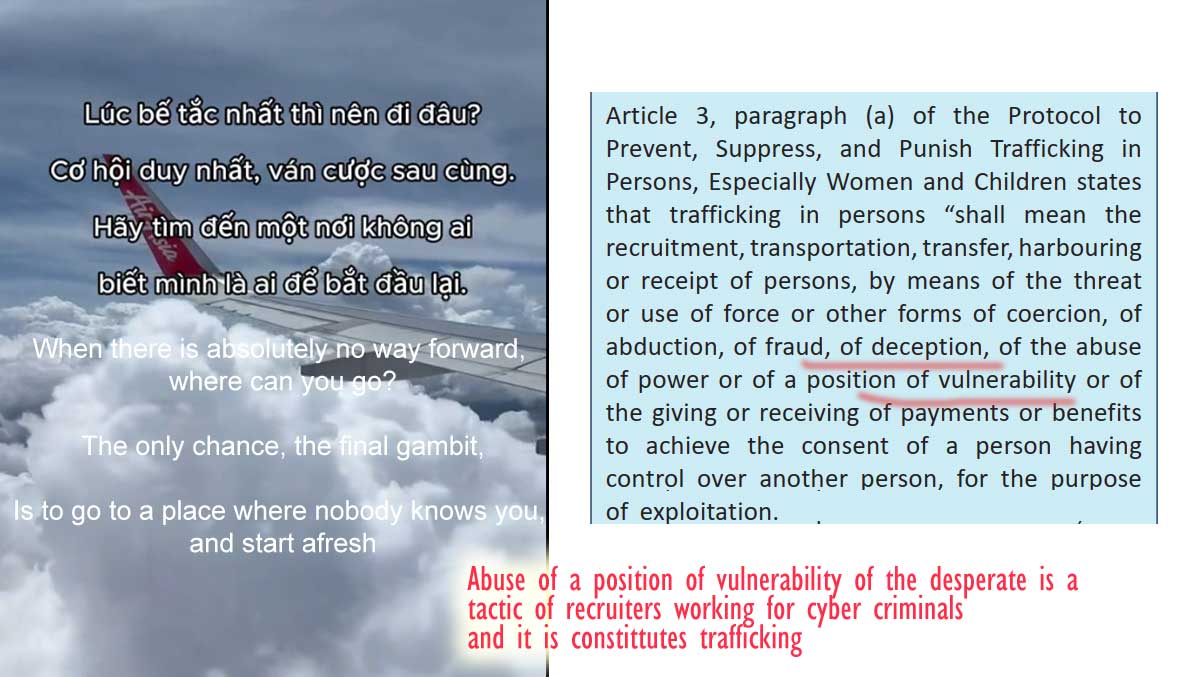
Recruitment ads use Port City visas to convince workers that online casinos in Sri Lanka is not a cyber-enabled crime, further satisfying what the UN calls the 'MEANS' of trafficking with recruitment itself being the 'ACTION'.
Targeting the Vulnerable
In another classic tactic identified by UN trafficking experts, Colombo Port City recruiters target people in difficulties and in debt.
"Where should you go when you feel most stuck or have reached a dead end?," says one such advert from a recruiter in Colombo.
"This may be your last chance. Leave for somewhere unfamiliar and start a new life."
Port City Economic Commission officials told the COPF five people who were issued Port City visas were denied entry deported by immigration recently.
They were not fully aware of the reasons, but it appeared that their answers were not satisfactory to immigration officers.
Visas and tickets are provided by the gaming companies and new recruites travel in small groups, sometimes with a guide or pre-arranged immigration clearance.
UN experts found that the lack of knowledge is typical of trafficked workers.
"Ignorance of the ultimate company that they are going to work or the place that they will stay are normal in trafficking situations," notes the UN report.
The recruites are then 'received' at the airport and 'harboured'.
"The person is met by an unknown individual upon arrival (e.g. airports, border crossings) and taken to an unknown location, directly to the company, or to accommodation provided by the recruiters and/or company."
The Gilded Cage
In Sri Lanka, illegal gaming companies pay 1200 to 1500 dollar base salaries, tiered commissions, lodging in luxury apartments and free food.
Port City workers are not in closed compounds in plain sight. In the Philippines, POGOs in Manila who were also housed in high rises devised sophisticated methods to harbour workers and keep them separate.
Unlike in Special Economic Zones, they could not be kept in gated communities in the middle of a bustling capital city.
In Sri Lanka's capital, South East Asian youngsters are paid salaries from 1,300 dollars upwards with commission if KPI's are met.
They are given three meals from company kitchens, kept in luxury apartments two or four to a room, and taken by shuttle buses.
The tactic is sometimes referred to as a 'Gilded Cage'.
Sophisticated tactics have been devised to keep the workers separate from the local community with language already forming a barrier.
Offshore casinos in Sri Lanka also arrange for recreation and extra-curricular activities, hiring sports facilities, and specialist travel agencies also offer them excursions to tourist areas giving them no reason to interact with local communities.
Criminal FDI
The flow of criminal foreign direct investment into South East Asian Special Economic Zones in the form of online casinos, reflected regulatory arbitrage between a complete ban gambling and a 'permissive' system, the UN found.
The complete ban on gaming also created a market where no regulated player operated and represented massive no-holds-barred opportunity, observers say.
Criminal FDI is a search for regulatory arbitrage that is fluid and fast.
"When law enforcement pressure builds in one area, operations will merely adapt and/or displace to other parts of the region," the UN Drug and Crime office said in a July report.
"This displacement is not driven solely by differences in formal legal frameworks. Operators migrate to jurisdictions where enforcement is weak, corruption reduces operational risk, and state capacity is insufficient to monitor or disrupt large-scale digital criminal enterprise."
The speed with which criminal casinos move are enabled by so-called white label operators.
"A white-label arrangement allows an entity to launch a fully functioning online casino within days.." the report says.
"The white-label provider supplies technology, game content, payment processing, and customer support, while the operator handles branding and player acquisition."
One of the top white label operators in the Port City, is now recruiting staff for a gaming syndicate called TT88 at a salary of 1300 US dollars a month, with incentives for getting more than 30 FTD (First time depositors).
Another is seeking an SEO specialist at a salary of 1700 tether.
COPF Chief de Silva, who was urging for the Gambling Regulator to be active, was also involved in the Colombo Port City when he was a state minister in an earlier administration.
"We are happy that you are making progress," de Silva told the Port City Economic Commission officials.
"But please take into consideration the points we raised. These matters go beyond your jurisdiction.
"It impacts the entire country. It impacts our national brand. It impacts finances."
In Sri Lanka the online casinos rushed before Gambling Regulatory Authority acquired enforcement capacity and before authorities realized that offshore casinos are a loophole that criminal organizations exploited and one that has come into international disrepute.

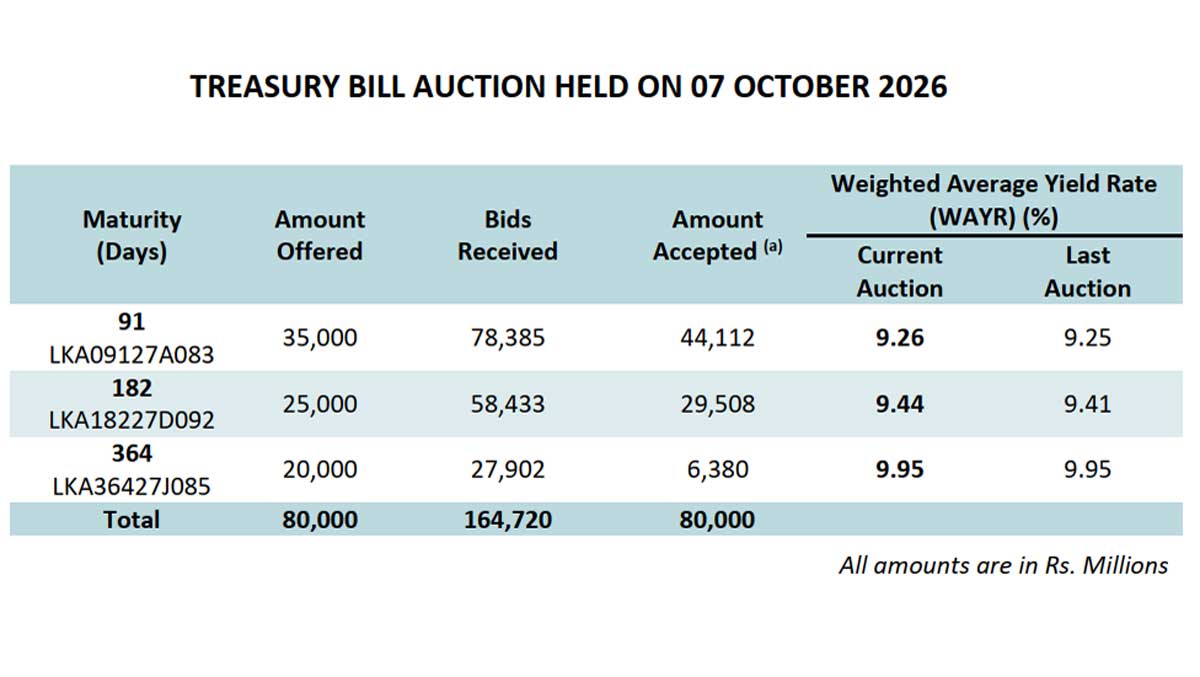
| 3 month bill | 9.26% | 1bp ▲ |
| 12-m bill | 9.95% | 2bp - |
| Gold (Ounce) | $4187 | - ▼ |
















Comments
Be the first person to comment and join the debate