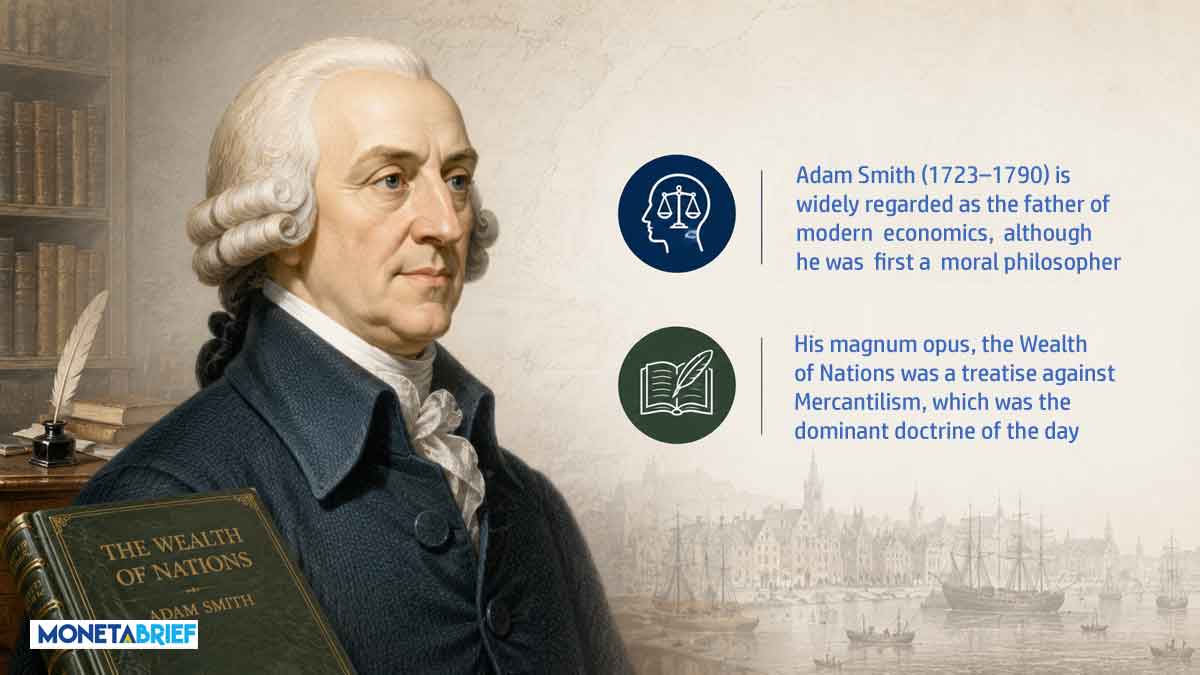
MONETABRIEF - Adam Smith is widely regarded as the father of modern economics, although he was first a moral philosopher. His ideas transformed the study of wealth from a branch of political advice into a systematic social science, laying the foundations for political economy, which later developed into modern economics.
Adam Smith (1723–1790) died exactly 260 years today on July 17, 1790.
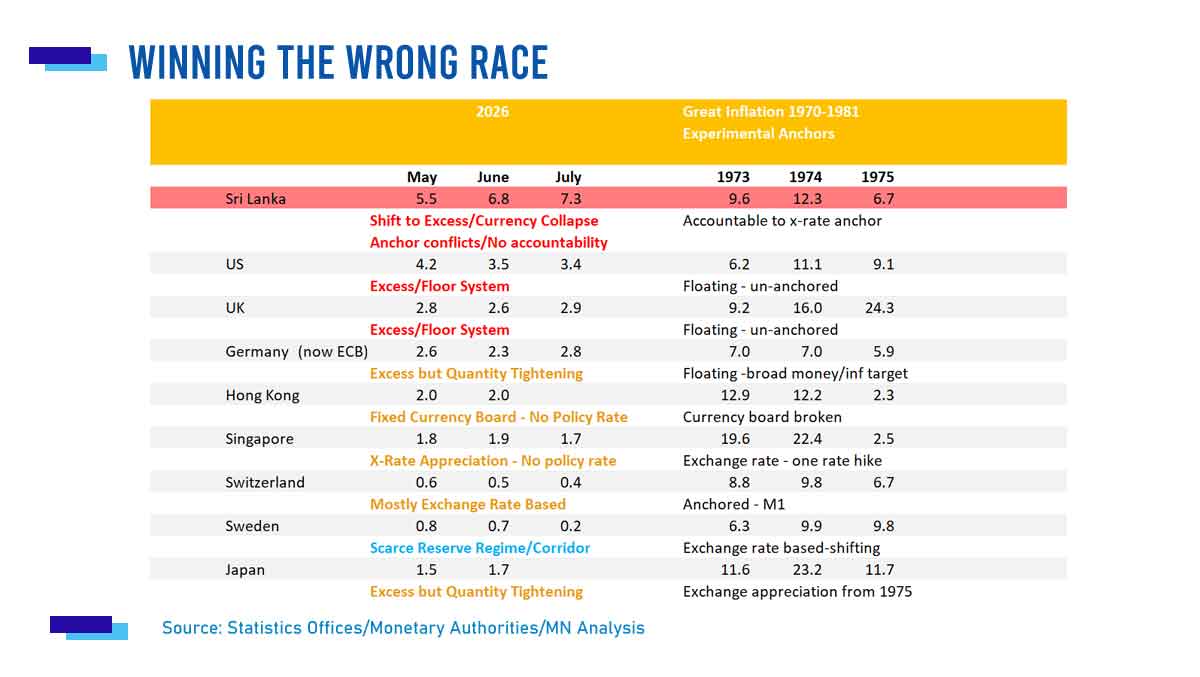
In firing the housing bubble and especially the through abundant reserve regimes after that, his ideas on money and note issue banks, found in Chapter 2, or Book II of Wealth of Nations, is widely violated by major central banks of the world who are firing asset price bubbles, pushing up inflation triggering social unrest leading to the election of interventionists and nationalists with extreme ideas.
Smith studied at the University of Glasgow, where he was deeply influenced by the Scottish Enlightenment, particularly the moral philosopher Francis Hutcheson. He later became Professor of Logic and then Professor of Moral Philosophy at Glasgow. His lectures covered ethics, jurisprudence, politics, and economics, reflecting his belief that economic life could not be separated from human morality and social institutions.
His first major work, The Theory of Moral Sentiments (1759), examined why people cooperate and behave morally. Contrary to the view that humans are purely selfish, Smith argued that people possess sympathy (what we would now call empathy)—the ability to imagine ourselves in another person's situation. He introduced the idea of the "impartial spectator," an internal moral judge that helps individuals evaluate their own actions. For Smith, markets function well only within a society where justice, trust, and moral norms are respected. This work demonstrates that Smith did not advocate greed as a virtue; instead, he believed self-interest operates within a broader framework of ethical behavior and legal institutions.
Smith's most influential book, An Inquiry into the Nature and Causes of the Wealth of Nations (1776), revolutionized economic thought. He argued that the wealth of a nation comes not from accumulating gold and silver but from increasing the productivity of labor through specialization, division of labor, and free exchange. His famous example of the pin factory showed that dividing production into specialized tasks dramatically increases output.
Smith criticized the prevailing Mercantilist system, which dominated European economic policy from the sixteenth to the eighteenth century. Mercantilism viewed international trade as a zero-sum game, encouraging governments to maximize exports, restrict imports through tariffs, grant monopolies, and accumulate precious metals. Smith challenged these ideas on several grounds:
• A nation's true wealth lies in its productive capacity, not its stock of bullion.
• Free trade benefits all participating countries through voluntary exchange.
• Competition generally produces better outcomes than government-protected monopolies.
• Government intervention should be limited to functions that markets cannot efficiently provide.
His critique undermined Mercantilism by demonstrating that economic prosperity arises from productive labor, capital accumulation, specialization, and open markets, rather than state control over trade. These ideas strongly influenced later movements toward freer trade, including nineteenth-century British economic policy.
Smith is also associated with the metaphor of the "invisible hand." Although he used the phrase sparingly, it expresses the idea that individuals pursuing their own legitimate interests can unintentionally promote the welfare of society through competitive markets.
Smith's work marked the birth of political economy because he sought to explain economic phenomena through general principles rather than simply recommending policies for rulers. He analyzed production, prices, wages, profits, rents, taxation, and economic growth as interconnected systems governed by observable patterns. Later economists such as David Ricardo, James Mill, John Baptiste Say, John Stuart Mill, and eventually Alfred Marshall built upon Smith's framework, transforming political economy into the modern discipline of economics.
The classical tradition was continued by later philosophers including Ludwig von Mises and Friedrich Hayek, whose ideas helped some countries escape the devastation and inflation from Keynesian and Post-Keynesian state intervention.
Several misconceptions deserve clarification. Smith did not argue that greed is inherently good, nor did he advocate complete laissez-faire in every circumstance. Instead, he believed that markets require strong institutions, secure property rights, impartial justice, and moral citizens. His economic theory and moral philosophy are complementary rather than contradictory.
Lasting Contributions
• Founded the systematic study of political economy.
• Explained the productivity gains from the division of labor.
• Demonstrated why free trade generally creates mutual gains.
• Replaced Mercantilist ideas with a productivity-based theory of national wealth.
• Integrated ethics, law, and economics into a coherent social philosophy.
• Influenced classical economics and many modern economic theories.
READ MORE
• The Wealth of Nations (Project Gutenberg)
• The Theory of Moral Sentiments (Liberty Fund)
• Adam Smith's Moral and Political Philosophy (Stanford Encyclopedia of Philosophy
• Adam Smith Biography (The Library of Economics and Liberty)
• Mercantilism (The Library of Economics and Liberty)























Comments
Be the first person to comment and join the debate