
Share your email and we'll share the latest news
Exclusive economic intelligence, political and business coverage
Wednesday, October 21 2026
Wednesday, October 21 2026
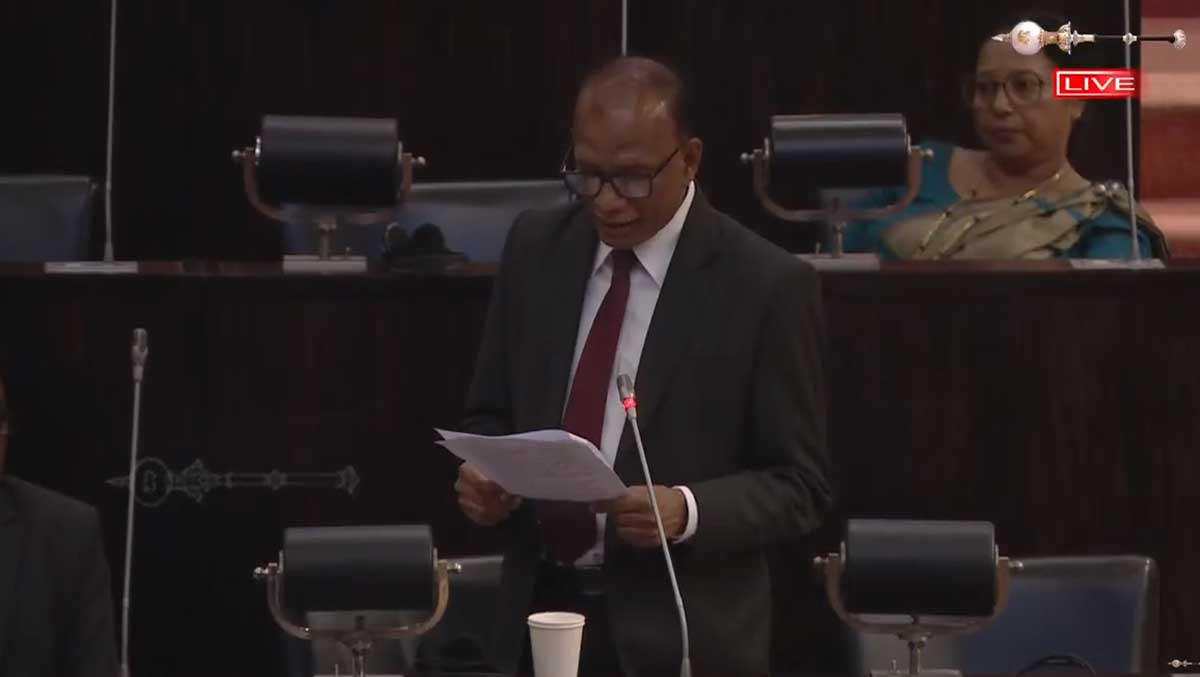
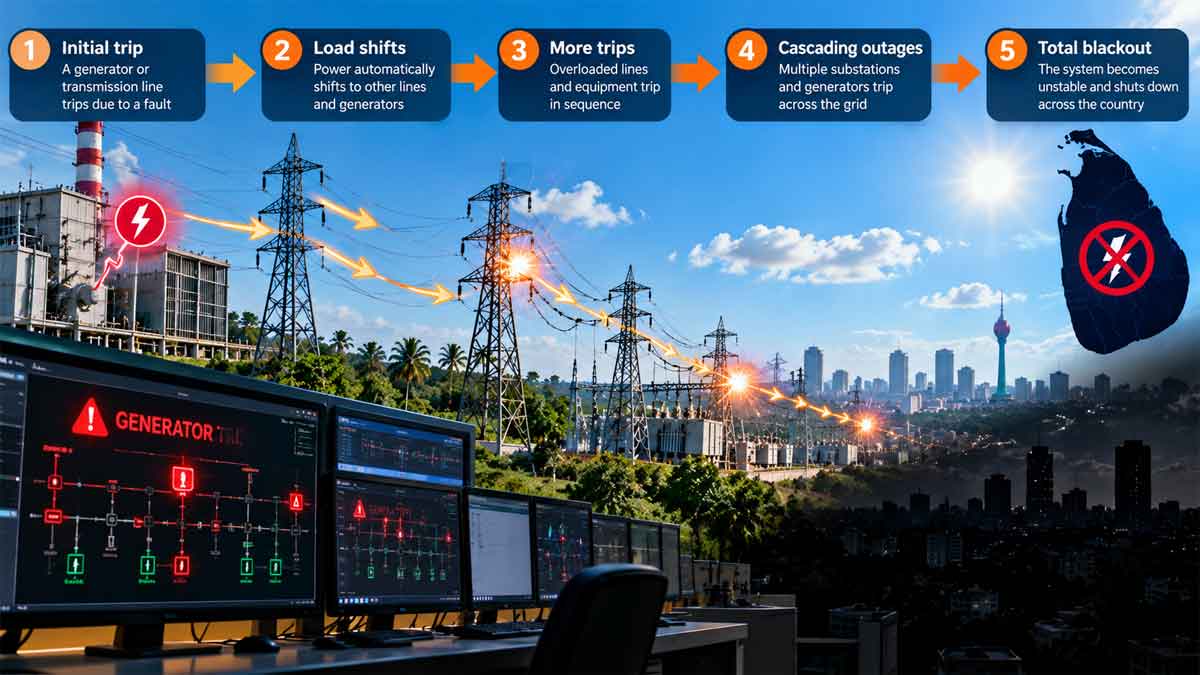
MONETABRIEF – Energy Minister Aruna Karunathilaka managed to avoid using the word rooftop solar in providing an explanation for the cascading failure on October 14 and the difficulty in re-energizing the national grid on a Sunny Saturday.
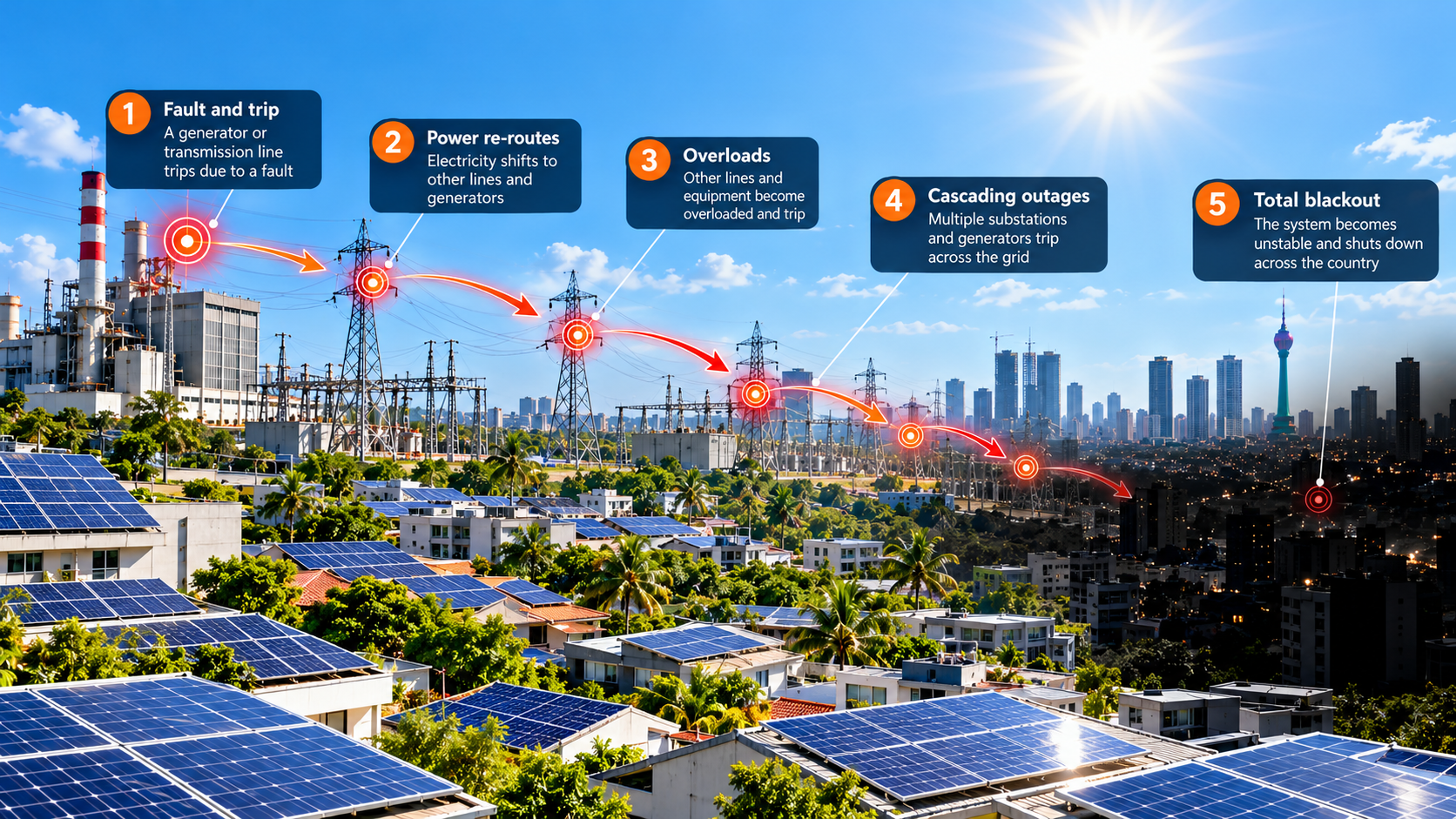
The power grid lost a 187MW coal plant due to a technical defect, setting off an irrecoverable cascading failure of the grid on October 14.
When the failure started at 11.43 am, the grid had 1,137 MW of power that the system could control and 1,700 in solar power it could not control, there was no visibility but was estimated.
At the time the demand was estimated at 2,800 MW, Chief Executive of the National Systems Operator, Buddika Samarasekera said earlier.
A 11.43 and 30 seconds Victoria Unit 1 (hydro) was being used as the frequency control generator. There was a spinning reserve equal to 29 percent of the system, he had said.
The technical problem with Norochcholai had started at 11.43 am and 32 seconds. Twenty seconds later the grid was down.
Meanwhile Minister Karunathilaka told parliament that there were 1,700 MW of renewable power in the system.
Grid Stability At Risk
"There were some solar plants that were off the grid. This was a day that there was an excess of renewable power," he said, without using the word rooftop solar.
"The lesson we learned from the blackout on February 09, 2025 was that in a day when demand was low and there was an excess of renewable power the grid (stability) was at high risk.
"After the 2025 February incident about 1,000 MW of renewable power had been added to the system."
There were some repairs being done to Norochcholai Unit 1 and due to complication, its generation fell steeply reducing the frequency of the system.
In the past the Norochcholai unit 01 and other large plants had tripped out of the system without cascading failure, sector officials point out.
The CEB generally did not acquire 500MW plants and only took 300MW when demand was lower than now because the loss of 300MW plant could be absorbed by the system.
Meanwhile Minister Karunathilaka said when the frequency dropped other generators had supplied more power.
"But the extra power that was generated was exceeded by the amount that the grid lost, from the sources that had no visibility and was not under the control of the NSO, " he said again avoiding using the word rooftop solar."
When the system controllers had started to re-energize the system, again system stability was lost.
By 13.37 pm, power from Kotmale hydro system was brought to Biyagama and some customers had been given power.
"By this time some of the generators that was out of the control of system got re-connected to the system the system again lost stability," Minister Karunathilaka said, avoiding the use of the word rooftop solar once again.
"With the help of everybody by 4.58pm the high voltage system was up amid great challenges.
The NSO had requested solar rooftop owners to switch off their systems. However many do not know how to do so. As a result, when there is a blackout the system cannot be restored until the sun goes down.
In the past, when a large generator tripped, not only could the system ramp up other generators from the spinning reserve, but could also shed loads even faster.
However, with rooftop solar in the daytime in the distribution network, loads and generation is lost at the same time, industry officials say.
In 2025 an animal strike led to the cascading failure on a sunny holiday. The last energy minister was lambasted in social media by renewable energy advocates for blaming rooftop solar for grid instability.
The government also comes under fire for curtailing solar power during holidays and for delaying connection of new solar until batteries are installed or the grid is strengthened from both activists and the parliamentary opposition.
The inability to recover from a disruption to generation or transmission during a Sunny holiday when there is high level of rooftop solar is usually called Sunny Sunday blackout, though in this instance it was a Saturday. (Colombo/Oct21/2026)

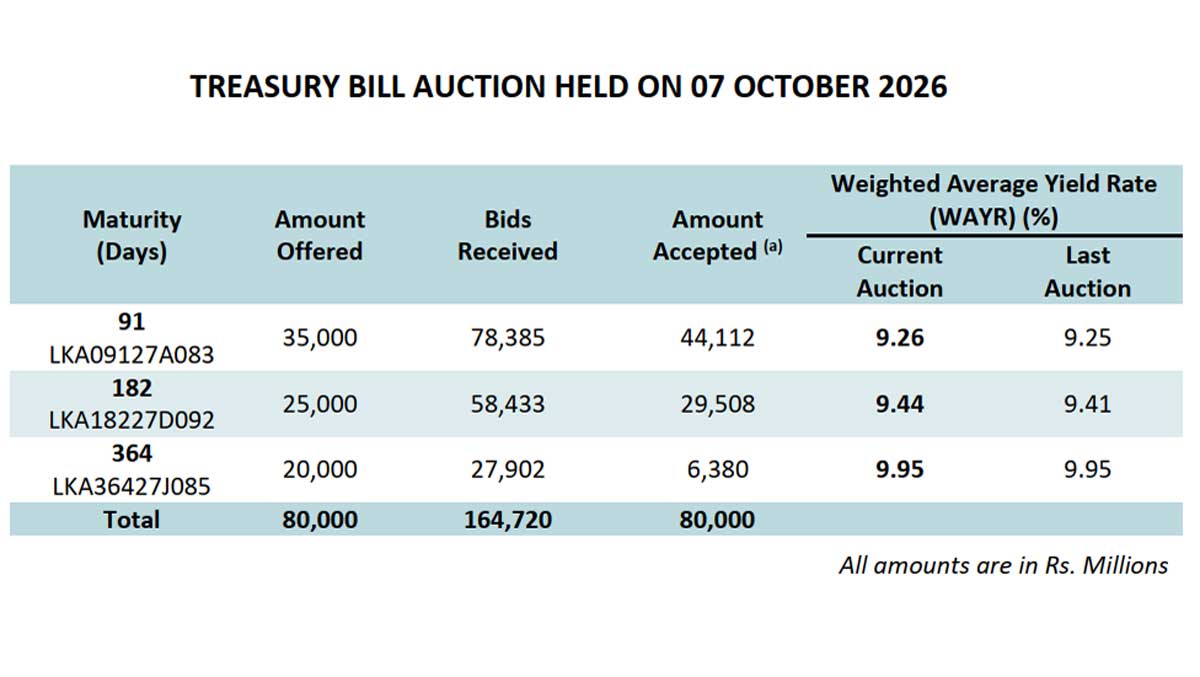
| 3 month bill | 9.26% | 1bp ▲ |
| 12-m bill | 9.95% | 2bp - |
| Gold (Ounce) | $4187 | - ▼ |















Comments
Be the first person to comment and join the debate