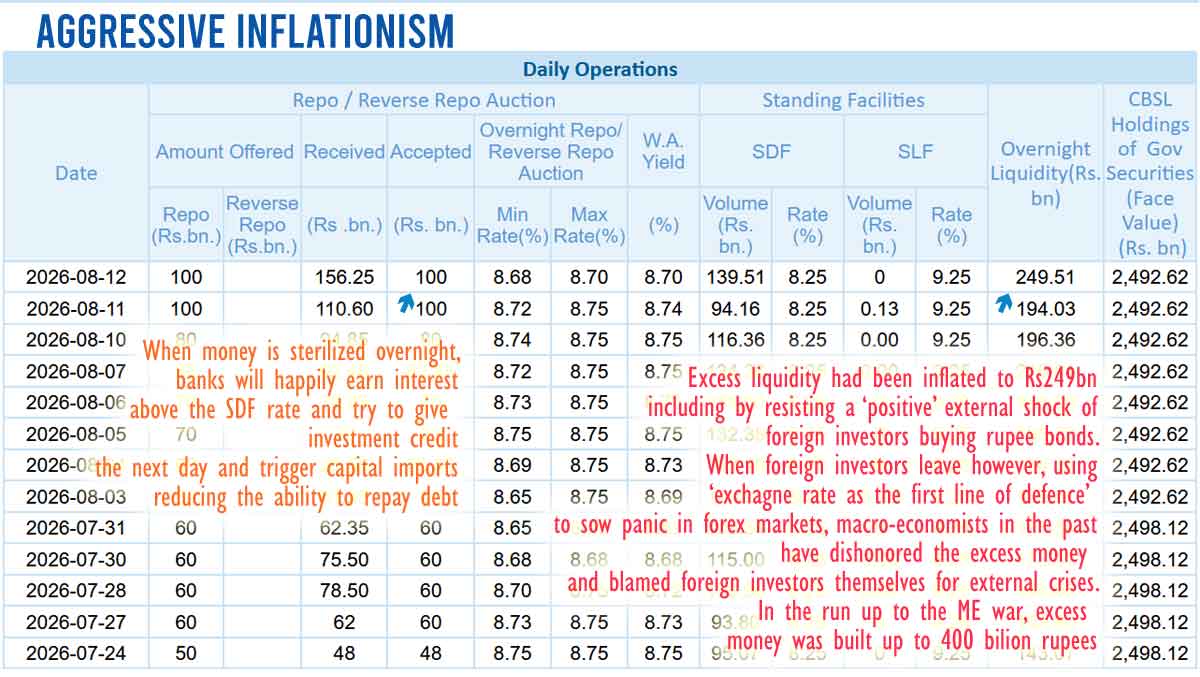
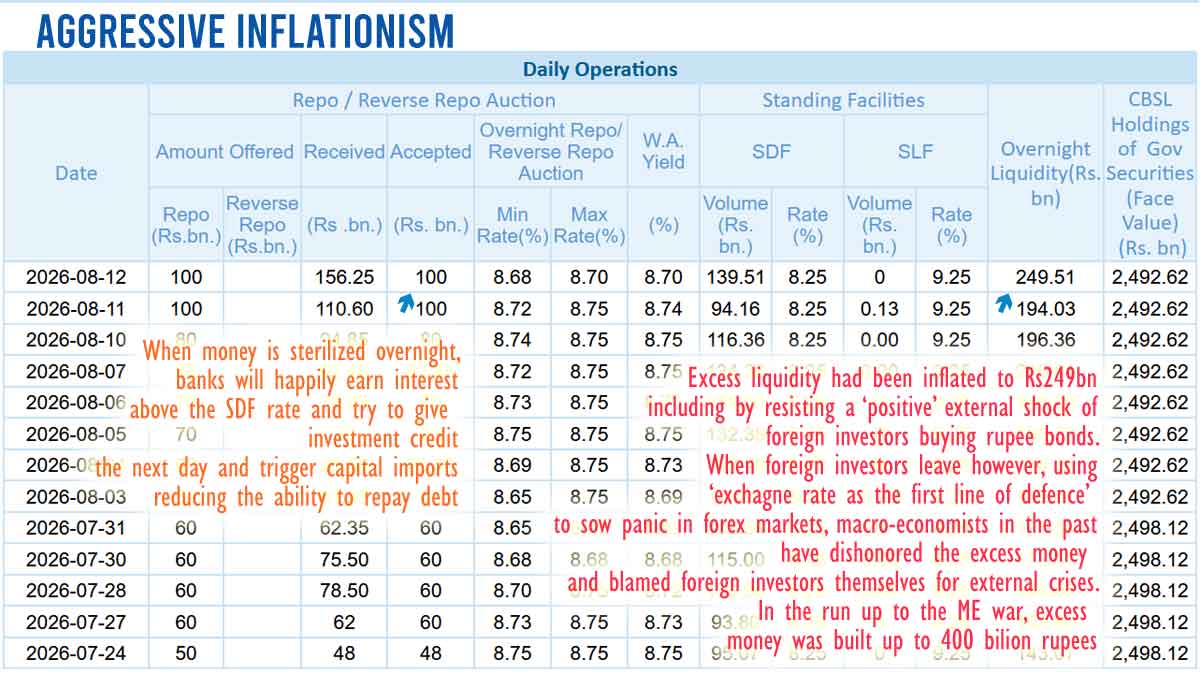
MONETABRIEF – Excess liquidity in money markets have risen to 249 billion rupees by August 12, official data show, in a country where notes are often dishonored selectively by macro-economists to trigger panic in forex markets and monetary depreciation.
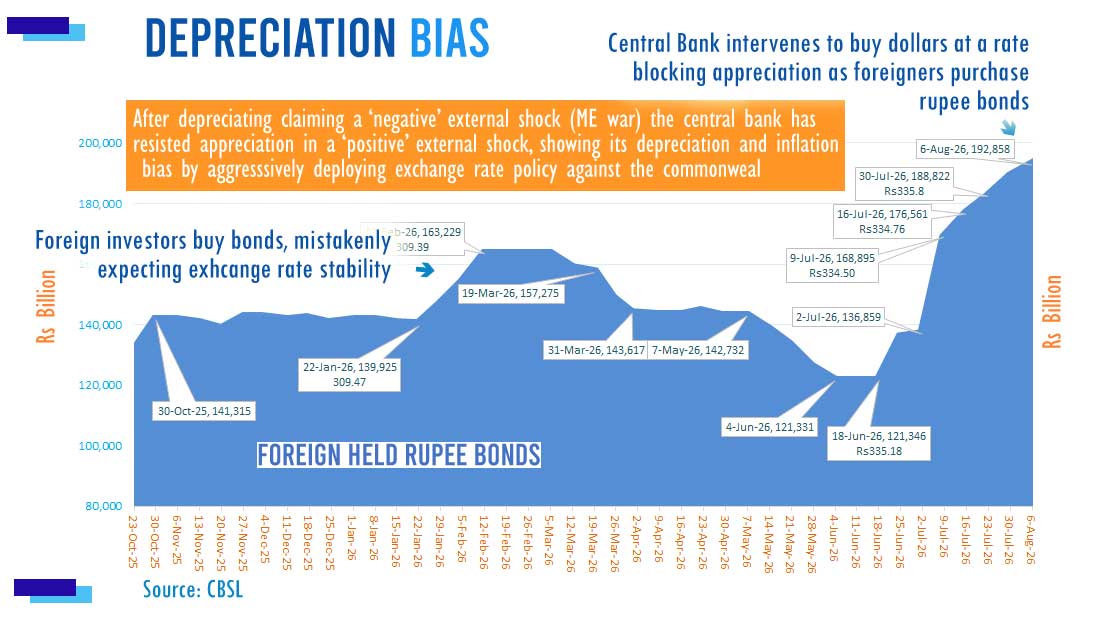
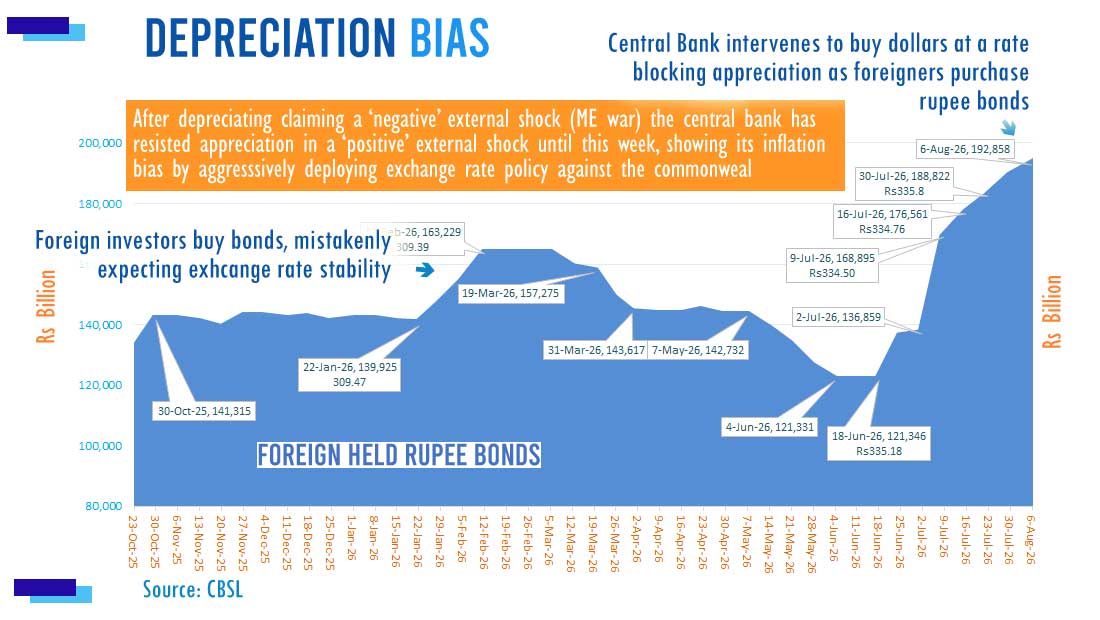
Over July the central bank monetized the balance of payments, buying 348 million dollars to create over 100 billion rupees in new money, including through the purchase of dollar bought by foreign investors in rupee bonds.
The liquidity can trigger large swings in short term rates which can reverse when the currency depreciates under 'exchange rate as the first line of defence' panics.
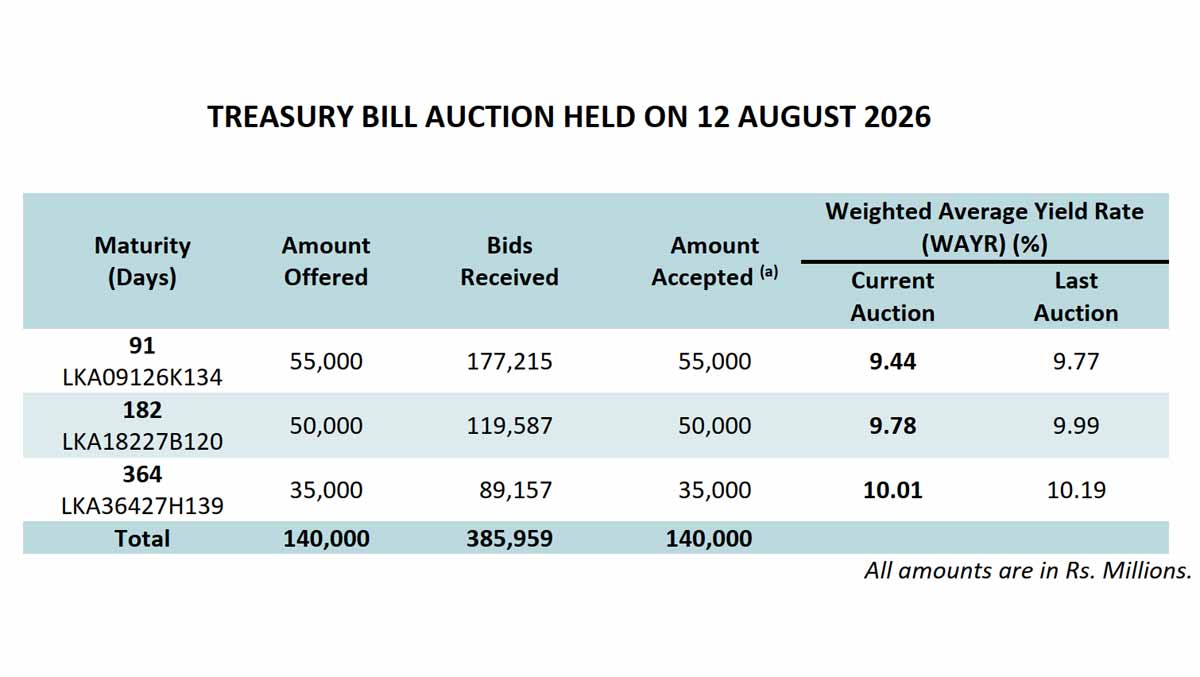
The central bank is now taking money out through overnight repurchase deals at around 8.70 percent, below its single policy rate, but above the SDF rate, giving extra profits to banks.
Other than keeping rates marginally above the SDF rate, overnight mopping up cannot 'safeguard' reserves as the excess money linked to the reserves will be eventually loaned for investment projects which will trigger capital or imports through credit.
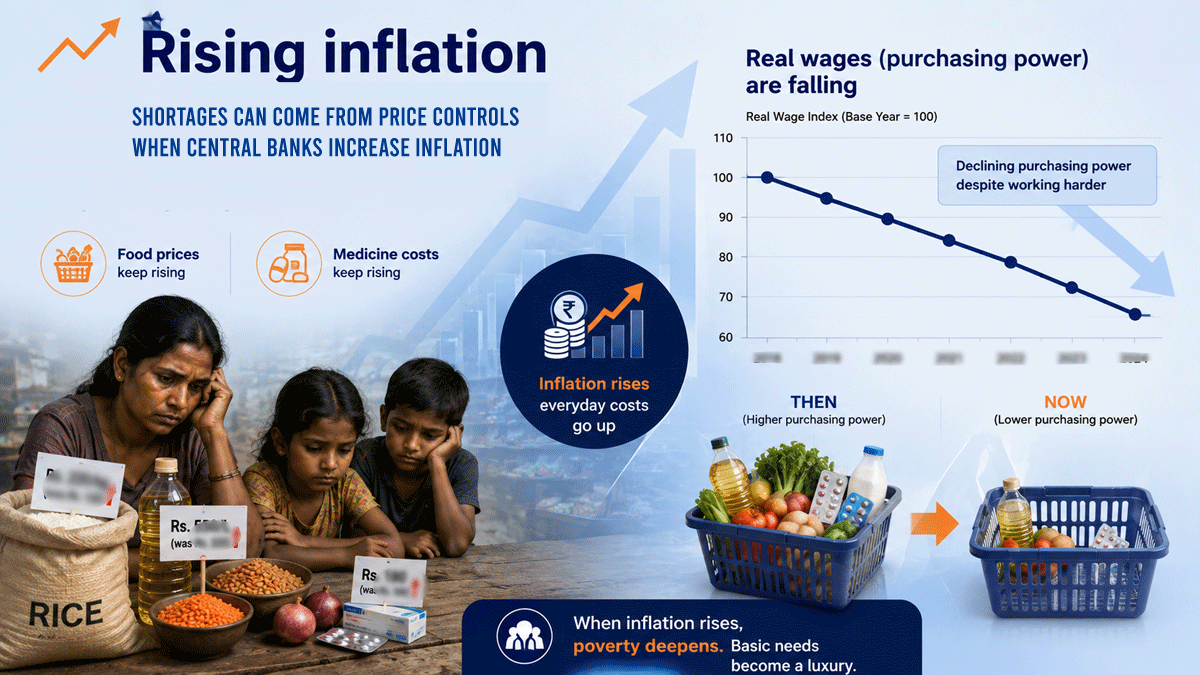
When excess liquidity is immorally dishonored, there is rapid monetary depreciation, high inflation and social unrest and political instability when wages do not go up quickly.
If non-debt money from current inflows are to be used to repay foreign debt, domestic investment has to be reduced by an equal amount.
Analysts have pointed out that the central bank is "supremely unqualified" to build reserves as it can only buy dollars by creating new money, which has to be honored with dollars when they finally hit forex markets.
There are calls to break the central bank's monopoly in supplying dollars to the Treasury so that it can buy dollars without pushing the country into a debt trap as happened under potential output targeting from 2015 to 2020.
Any dollars purchased by the Treasury does not expand the note-issue does not trigger imports and are therefore automatically 'safeguarded'.
The 249 billion rupees of excess liquidity represents around 740 million dollars of 'at risk' monetary reserves.
If the excess money is immorally dishonored the currency will fall as in 2025 and 2026.
Sri Lanka's external troubles come from violating classical economic theory (primarily Hume's price-specie-flow mechanism, later known as MAPB or ISLM-BoP) to run a corrupted pegged regime with a domestic anchor (inflation target).
Excess liquidity was around 200 billion rupees in the forex trouble created ahead of a default using true single policy rate (most by purchasing bills at a floor rate).
In the run up to the US-Iran war excess liquidity was built-up to around 400 billion rupees, with dollar purchases in a credit downturn from Cyclone Ditwah which reduced imports (a positive domestic shock to the rupee) and also increased foreign aid, resisting appreciation beyond 309 to the dollars.
As oil prices rose, 'using exchange rate as the first line of defence' authorities turned their backs upon their own notes, sowing panic in forex markets and killing a spot market for foreign exchange and the rupee collapsed.
There was a de facto float of the rupee to end money and exchange policy conflicts, but appreciation of the currency was subsequently resisted.
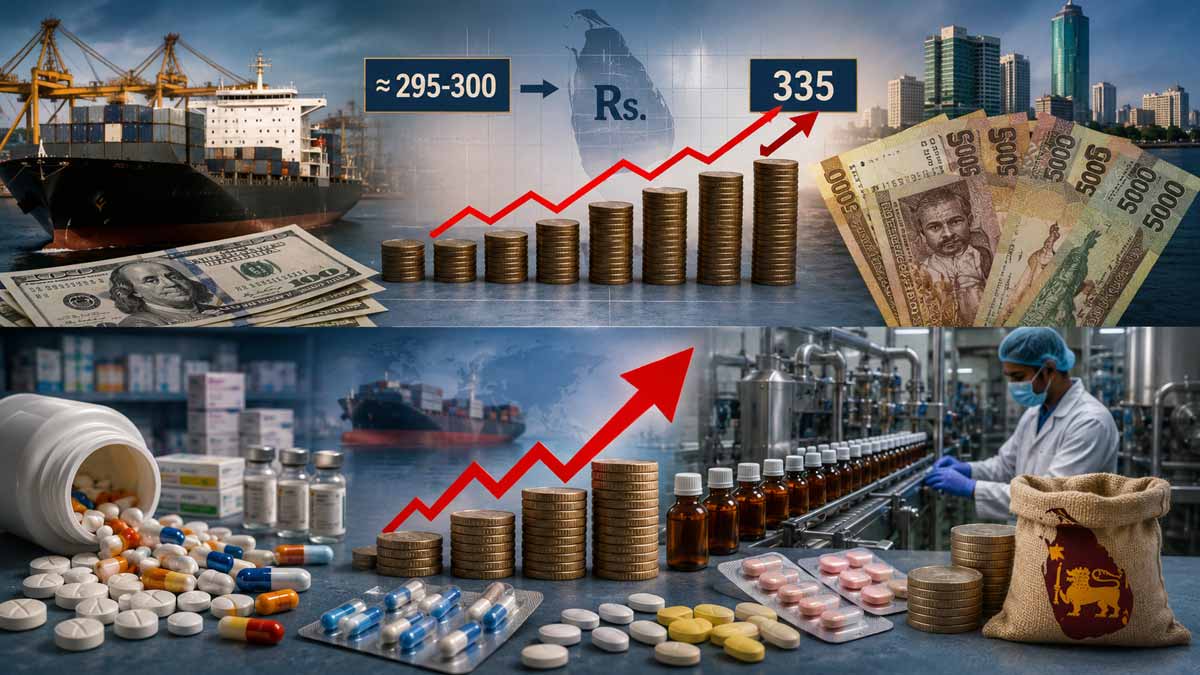
Over 2025 the rupee was busted from around 295 to 309 to the US dollar by purchasing dollars to create money and denying convertibility to the public selectively while giving dollars to the government and honoring the excess money.
The central bank has selectively resisted appreciation both in January and February 2026 buying over 600 million dollars, and also over July purchasing 348 million dollars in positive shocks to the rupee, while depreciating in 'negative' shocks.
In 2018, foreign investors also bought into bonds in the monetary stability seen in 2017 after rates were hiked, but they fled in 2018 when exchange rate as the first line of defence was deployed and excess money was created including by monetizing Hambantota port sale proceeds with buy-sell swaps.
Data show that dollar deposits of banks were monetized through buy-sell swaps at the height of the ME crisis inflating money supply. Sri Lanka also does not seem to count excess liquidity as reserve money in a further complication of data transparency.
Democracies cannot function when state agencies, especially those with coercive powers, do not act according to a rule of law (predictable way), and instead act in arbitrary or unpredictable (flexible) ways.
There is growing knowledge about how a country without war was driven into default through flexible policies and trying to boost growth with inflationism.
Sri Lanka is now seeing high inflation, above the controversial 7 percent negotiated by macro-economists from the government under which 2026 bout of monetary instability and forex market panic was created. (Colombo/Aug13/2026)









Comments
Be the first person to comment and join the debate