
Share your email and we'll share the latest news
Exclusive economic intelligence, political and business coverage
Sunday, October 18 2026
Sunday, October 18 2026

MONETABRIEF – A Sri Lankan chef convicted of murdering his Bhutanese co-worker at Canberra’s National Zoo and Aquarium has had his prison sentence reduced to 26 years and six months, Australian media reported.
Jude Luckshan Wijesinghe, 32, pleaded guilty to fatally stabbing Tshewang Choden 14 times after trapping her in a storeroom at the zoo in 2023.
He later appealed against his original 30-year sentence.
The Australian Capital Territory Court of Appeal set aside the original sentence and imposed a new term of 26 years and six months, the Australian Broadcasting Corporation (ABC) reported Wednesday.
The court also reduced the non-parole period from 20 years to 18 years.
Wijesinghe will therefore be eligible to apply for release in 2041, rather than 2043, although parole is not automatic and will depend on the relevant authorities’ decision.
The original sentence was imposed by ACT Supreme Court Chief Justice Lucy McCallum in December 2025. She described the killing as premeditated “murderous violence” and said it was among the most serious offences dealt with in the Australian Capital Territory.
Chief Justice McCallum stopped short of imposing a life sentence.
While accepting that Wijesinghe’s mental illness provided “some explanation” for the murder and reduced his moral culpability, she ruled that it did not justify a reduction in the overall sentence because of the “very serious objective features” of the offence.
Wijesinghe appealed, arguing that the sentencing court had failed to properly account for his mental impairment.
The appeal was heard by Justices Darryl Rangiah, Andrew Muller and Jon White. In their written reasons, the judges said the original sentencing decision contained errors in its treatment of both his guilty plea and mental condition.
The judges said Chief Justice McCallum had accepted that the guilty plea had practical value by avoiding a trial, but had reflected that discount only in the non-parole period and not in the head sentence.
“To apply a discount for a plea of guilty only to the non-parole period and not to the head sentence is contrary to principle,” the judges said.
They also ruled that Wijesinghe’s mental condition should have been considered when determining the total sentence, rather than only when setting the minimum period before parole could be sought.
However, the Court of Appeal unanimously rejected the argument that his mental illness reduced the objective seriousness of the offence. The judges upheld the finding that the attack was deliberate and exceptionally grave. (Colombo/Sept. 2/2026)

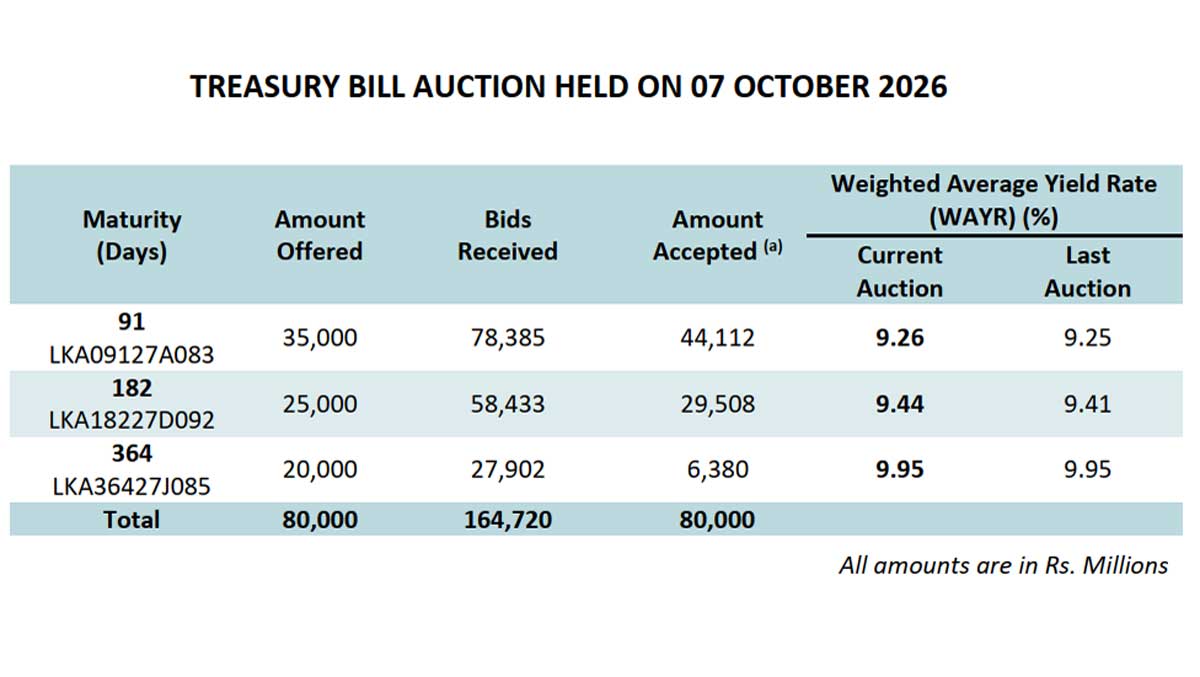
| 3 month bill | 9.26% | 1bp ▲ |
| 12-m bill | 9.95% | 2bp - |
| Gold (Ounce) | $4187 | - ▼ |



















Comments
Be the first person to comment and join the debate