
Share your email and we'll share the latest news
Exclusive economic intelligence, political and business coverage
Monday, October 26 2026
Monday, October 26 2026
MONETABRIEF – Standard and Poor's have confirmed sri Lanka's CCC+ rating, saying budgets are better, but has issued a warning on the external outlook, after the country's currency collapsed on a previous rate cut and exchange policy errors.
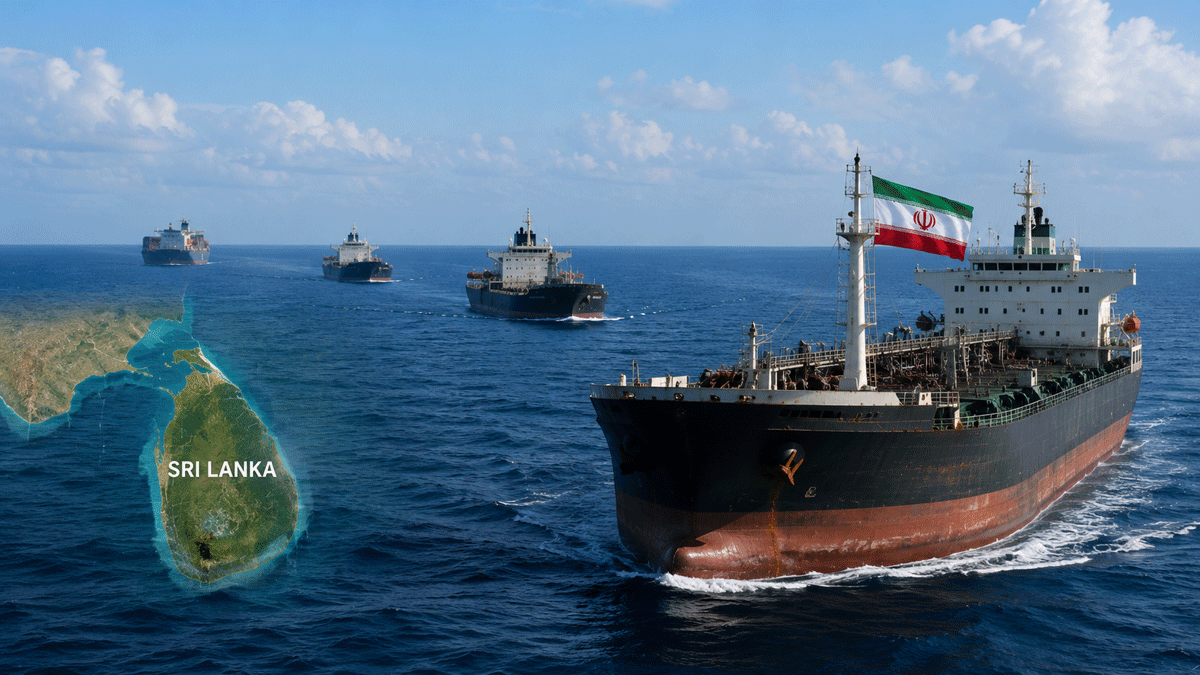
"While the fiscal outlook is more benign, Sri Lanka's external outlook is becoming more challenging due to the rapidly rising import bill and continuing uncertainties posed by the Middle East war," S&P said.
"Fuel imports rose more than 100% year on year in rupee terms in April and May and the currency has depreciated around 8 percent against the U.S. dollar in the first half of the year. This has eroded external buffers.
"We do not expect the deterioration in the external position to be significant. This is due to the government's actions to stabilize the currency, including raising the policy rate by 100 bps in May, shortening the export proceeds conversion timeframe, and allowing the currency to act as a shock absorber to avoid draining reserves excessively."
The warning on Sri Lanka's external sector comes shortly after Pakistan was upgraded by S&P with praise for its currency appreciation.
State Bank of Pakistan has been steadily reducing its domestic assets, S& P said. Sri Lanka stopped running deflationary policy in the current phase of the IMF program, reducing the ability of the central bank to retain collected reserves.
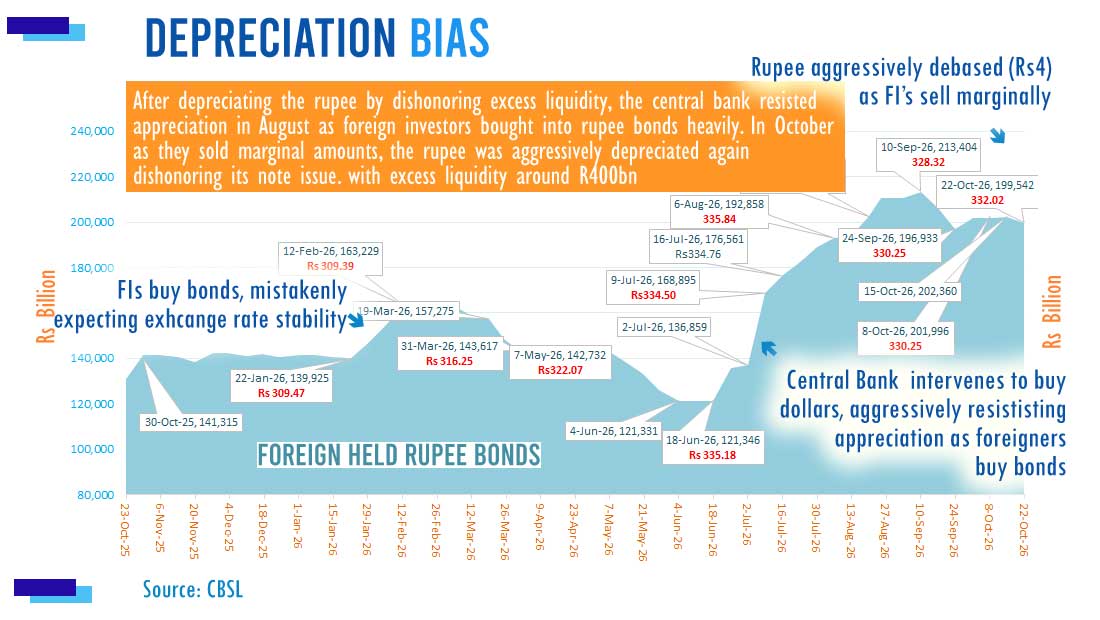
Pakistan's rupee aprpeciated from 280 to 278 from December to July 2026, while Sri Lanka and India's rupee collapsed.
In Sri Lanka like some other defaulting countries, the central bank has a monopoly on dollar supply and effectively blocks the Treasury from building reserves.
Maintaining external stability is simple, analysts have pointef out, if parliament is prepared to restrain the central bank's inflationism and its depreciation bias and its constant violation of classical economic principles in the form of Hume's price-specie flow mechanism.
Sri Lanka's rupee collapsed, far away from the war, as countries like Dubai and Qatar which in the middle of the war zone held their currencies easily without a policy rate and activist monetary and exchange policy.
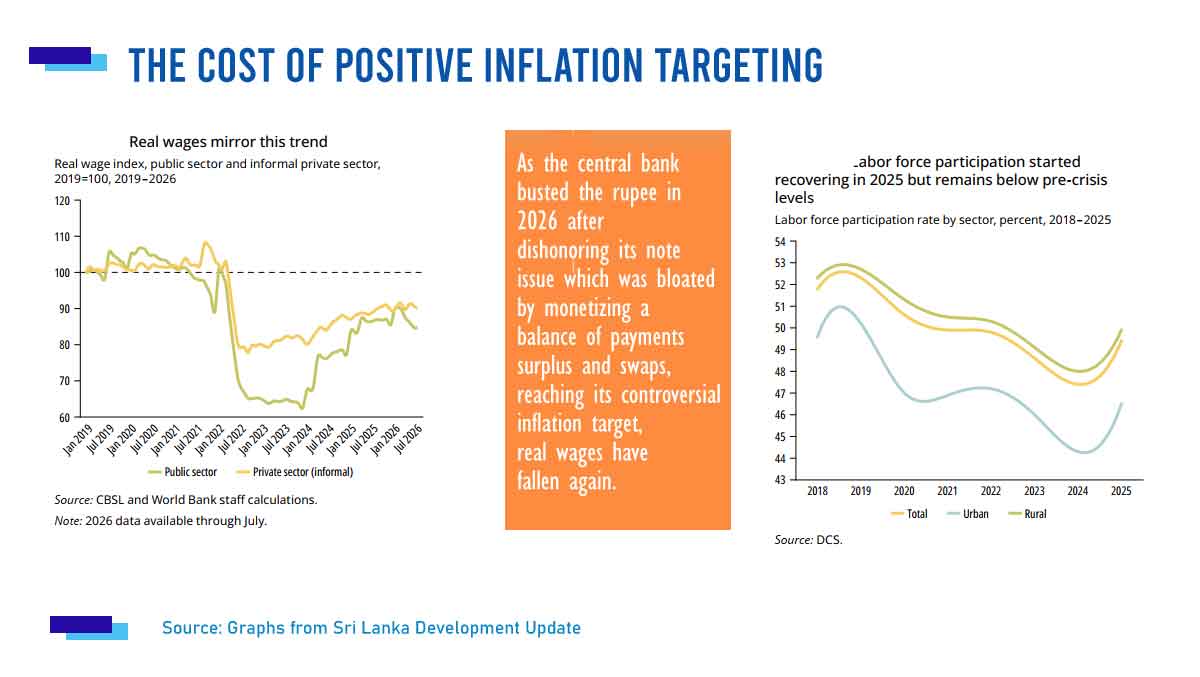
Sri Lanka's currency collapse in the first quarter came amid a budget surplus. The central bank has long blamed budget deficits, not its rate cuts and activist monetary policy for inflation and rupee depreciation, both of which are monetary phenomena.
The full statement is reproduced below:
Sri Lanka 'CCC+/C' Ratings Affirmed; Outlook Stable
Overview
• Sri Lanka's economy has remained resilient in the face of multiple external shocks, with strong revenue growth continuing to support fiscal repair and a steady decline in the government's debt servicing cost.
• The country's external position may weaken this year, however, due to a higher import bill and the Middle East war's effects on remittances and tourism earnings. This could slow the rebuilding of reserves.
• We are affirming our sovereign credit ratings on Sri Lanka at 'CCC+/C'.
• The outlook on the ratings is stable, reflecting our expectation that higher external uncertainty is partly mitigated by robust economic and revenue growth.
Rating Action
On July 27, 2026, S&P Global Ratings affirmed its long- and short-term foreign and local currency sovereign credit ratings on Sri Lanka at 'CCC+/C'. The outlook on the long-term foreign and local currency ratings is stable. We have revised the transfer and convertibility assessment to 'B-' from 'CCC+'.
Outlook
The stable outlook reflects our expectations that the conditions allowing for continued economic growth and fiscal repair in Sri Lanka will persist over the next six to 12 months. We expect improvements in fiscal indicators even as economic growth decelerates and current account deficits return. Risks to external demand, inflation, and financing conditions are significant. Hence, we do not expect material improvements to sovereign credit support over this period.
Downside scenario
We could lower the ratings on Sri Lanka if we see indications of renewed risks of funding and liquidity stresses. Developments that could precede such signs include significantly weaker external or fiscal performances, leading to funding pressures.
Upside scenario
We could raise the ratings if we believe that economic growth will continue and will help to drive further improvements in Sri Lanka's external and fiscal metrics. This would allow the government to accumulate more credit buffers and improve its ability to manage its repayment needs.
Rationale
The 'CCC+' ratings reflect our views that Sri Lanka's creditworthiness is vulnerable and dependent upon favorable financial and economic conditions but the government does not face a near-term credit or payment crisis.
Sri Lankan government debt levels are high. General government interest burden, at about 45% of revenue, is also heavy. We also see a temporary weakening of Sri Lanka's external and fiscal balances due to recent exogenous shocks, including Cyclone Ditwah in late 2025 and war in the Middle East.
We believe official financing should continue to help the government to meet its financing needs, and the country's economic recovery and structural reform efforts to anchor fiscal and external improvements should remain intact.
Institutional and economic profile: Higher energy costs could temporarily derail growth without harming underlying economic drivers
• Higher energy and input costs could dampen Sri Lanka's economic growth in the next few quarters as the Middle East war continues to disrupt energy and stockfeed supply chains. Disruption to flights and economic activities in that region could also reduce tourism earnings and remittances.
• However, we expect the impact on economic activities to be temporary due to the government's proactive policies to secure energy and fertilizers supply.
• Political stability and policy predictability have improved following the strong mandate that the National People's Power (NPP) party won at the presidential and parliamentary elections in late 2024.
We expect the impact of exogenous shocks, particularly the Middle East war and Cyclone Ditwah, to be temporary. In both cases, the government's policy responses have contained the economic damage. For instance, the government's post-cyclone emergency relief helped to restore key transport connectivity to the most-affected regions, even though substantial reconstruction work remains. The timely disbursement of assistance and cash transfers to vulnerable groups supported consumption.
After the closure of Strait of Hormuz, Sri Lanka was one of the first countries to introduce fuel rationing and a shorter work week to preserve energy supplies. The government also acted early to secure fuel and fertilizer supplies, even at high costs. This has helped to minimize disruption to economic activities, particularly the agricultural and industrial sectors.
As a result, Sri Lanka's economy remained largely resilient. Real GDP grew 4.8% in the fourth quarter of 2025 and 5.1% in the first quarter of 2026, exceeding our earlier expectations.
Sri Lanka is more vulnerable than many countries in the region to a prolonged disruption in the energy markets, however, given its high reliance on imported crude oil and fertilizers, limited storage options, and weak external buffers following its 2022 economic crisis.
Despite the government and state-owned enterprises such as Ceylon Petroleum Corporation (CPC) and Ceylon Electricity Board taking on some of the burden, substantial costs will be passed onto consumers. CPI inflation had risen to 6.8% as of June 30, 2026. With the currency also under pressure, the central bank has raised the policy rate 100 basis points (bps) in May 2026, which aims to anchor inflation expectations.
Renewed escalations in the Middle East might also affect tourism earnings and remittances in Sri Lanka. Even though Middle Eastern tourists accounted for a small share of arrivals, around one-third of visitors to Sri Lanka transit through aviation hubs in the Middle East. The region also accounts for 40% of remittances, which have become an increasingly important pillar of Sri Lanka's current account.
In addition, Sri Lanka could face higher risks from a more severe El Nino event in 2026 and 2027. More adverse weather events, such as droughts and flooding, could affect Sri Lanka's sizeable agricultural economy and strain electricity generation.
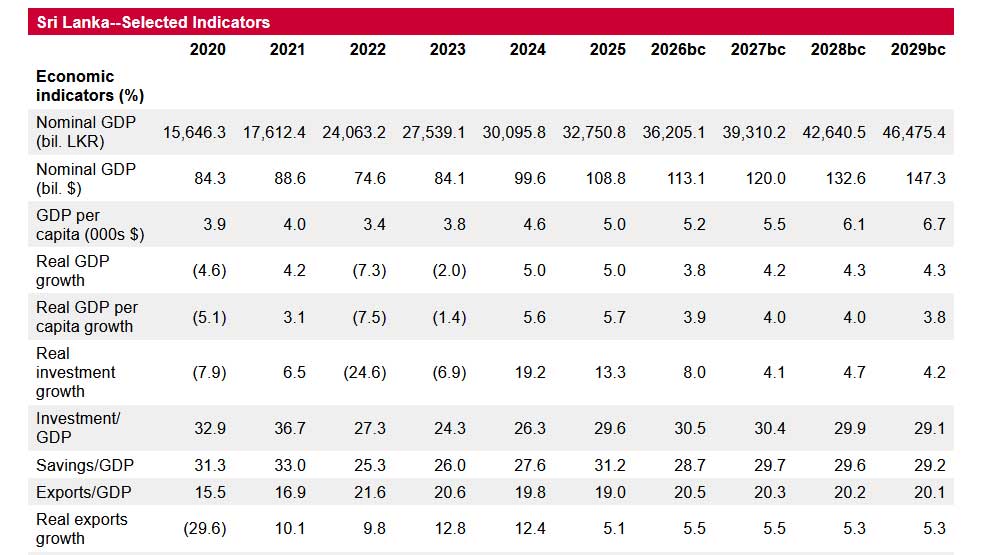
Against this backdrop, we expect Sri Lanka's economic growth to slow to 3.8% in 2026, with the negative effects more pronounced the longer that energy markets are disrupted. We forecast real GDP growth to rebound to 4.2% in 2027 as the energy supply chain normalizes.
This would put Sri Lanka's 10-year weighted average per capita real GDP growth at 3.1%, which is in line with peers with similar income levels and indicates that the Sri Lankan economy has largely shaken off the effects of the 2022 crisis. We believe Sri Lanka's GDP per capita would reach US$5,200 in 2026 despite a weakening Sri Lankan rupee. The government's ability to address chronic underspending in capital infrastructure would likely be key to further increases in the country's potential growth.
The ruling NPP secured a supermajority parliament following the 2024 general elections and controls most local councils following elections in May 2025. This situation is relatively uncommon for Sri Lanka, which has historically been characterized by frequent political factionalism and crossovers. We believe the government's strong mandate and policy responses to recent crises demonstrate improved political stability and policy predictability. However, a longer track record would be a stronger indication of a structural improvement in Sri Lanka's institutional settings.
We anticipate the government will continue the reform agenda under the current International Monetary Fund (IMF) Extended Fund Facility program, particularly in implementing revenue-based budget repair, cost-recovery pricing for utilities, and other structural reforms of public financial and debt management. The government has demonstrated strong commitment to the IMF program, meeting most of the quantitative indicators and structural benchmarks, albeit some with delays, even when they are politically challenging.
Flexibility and performance profile: Fiscal deterioration is likely contained as pressure increases on the external position
• While revenue growth remains strong, higher spending on reconstruction and subsidies will widen the deficit this year.
• Debt remains high, with an exceptionally heavy interest burden.
• The external position has worsened due to a surging import bill, greater currency volatility, and uncertainty over remittances and tourism earnings.
Sri Lanka's fiscal position has improved significantly since 2022, underpinned by a series of revenue measures and robust economic growth. The performance in 2025 was particularly strong due to the lifting of all vehicle import restrictions and the pent-up demand for vehicles. Overall revenue surged 34% in 2025 to reach 16.7% of GDP. The fiscal deficit narrowed to 2.3% of GDP and the primary balance rose to a record 5.4%.
This outperformance in revenue continued in the first five months of 2026, posting growth of 30%, even when compared with a strong base in the same period of 2025. Besides revenue measures, such as the repeal of the Simplified Value-Added Tax scheme and increasing excise duties, the sustained growth in revenue is driven by a broad-based recovery in economic activities. The government's commitment toward additional revenue measures, including the introduction of a property tax, is likely to lead to a more sustained path of fiscal consolidation.
The external position has worsened due to a surging import bill, greater currency volatility, and uncertainty over remittances and tourism earnings.On the expenditure front, we expect higher spending due to post-disaster relief and reconstruction as well as increased subsidies to CPC and groups most affected by higher energy costs. As a result, we project that the fiscal deficit will widen to 5% of GDP this year before narrowing toward 4% by 2029.
Importantly, the government's debt servicing burden has fallen due to strong revenue growth and the phasing out of expensive debt incurred in 2022. Even after factoring higher coupon payments from triggering the MLB upsides, we expect Sri Lanka's interest-to-revenue ratio to improve to 39% by 2029 from 64% in 2024. This is still onerous and much higher than most other countries.
We forecast net general government (GG) debt, including state-owned enterprise (SOE) guarantees, will be about 92% of GDP for 2026. Given the economy's strong performance and the appreciation of the Sri Lankan rupee from the 2023 level, it is likely that the upside threshold in Sri Lanka's macro-linked bonds (MLBs) will be breached. This would trigger higher coupon payouts of 1.75%-2% over 2029-2032 and higher principal payouts of 17%-22%, depending on the bond series.
We expect net GG debt to decline to about 83% in 2029. In addition to the higher principal payout from the MLBs, we have added the Chinese renminbi (RMB) 10 billion currency swap with the Chinese central bank to government debt data. Sri Lankan banks also purchase substantial quantities of government debt, with aggregate exposure significantly exceeding 20% of system assets.
While the fiscal outlook is more benign, Sri Lanka's external outlook is becoming more challenging due to the rapidly rising import bill and continuing uncertainties posed by the Middle East war. Fuel imports rose more than 100% year on year in rupee terms in April and May and the currency has depreciated around 8% against the U.S. dollar in the first half of the year. This has eroded external buffers.
We do not expect the deterioration in the external position to be significant. This is due to the government's actions to stabilize the currency, including raising the policy rate by 100 bps in May, shortening the export proceeds conversion timeframe, and allowing the currency to act as a shock absorber to avoid draining reserves excessively.
Remittances, particularly in the first five months, have held up well. We estimate inflows from the IMF program and other multilateral organizations at around US$1.7 billion this year. These flows could mitigate the deterioration in the trade balance.
However, the risks to Sri Lanka's external position and external financing capacity will increase if the Middle East war drags on. Growth in remittances, which continued at more than 30% year on year in May, slowed to 9% in June. With tourist arrivals falling nearly 10% in June, tourism earnings are unlikely to recover substantially. Gross official reserves fell to US$6.45 billion in June from US$6.88 billion in May.
We expect the current account to flip to a deficit of 1.7% of GDP in 2026. Gross external financing needs as a share of current account receipts and usable reserves will widen to around 110% this year from 104% in 2025 before improving to 106% by 2029. This still compares favorably with the precrisis average of more than 120%. We expect external debt net of public and financial sector external assets to average 103% of current account receipts from 2026-2029.
Inflation has risen sharply due to the energy crisis, but this supply-induced inflationary shock is likely to be temporary. Even though we continue to view Sri Lanka's monetary settings as a credit weakness, policy credibility will likely improve with a longer record of policy autonomy following the passage of the Central Bank Act in 2023. We also note that extensive foreign exchange restrictions imposed during the previous period have largely been removed. Remaining minor restrictions will likely be phased out in the next two years.

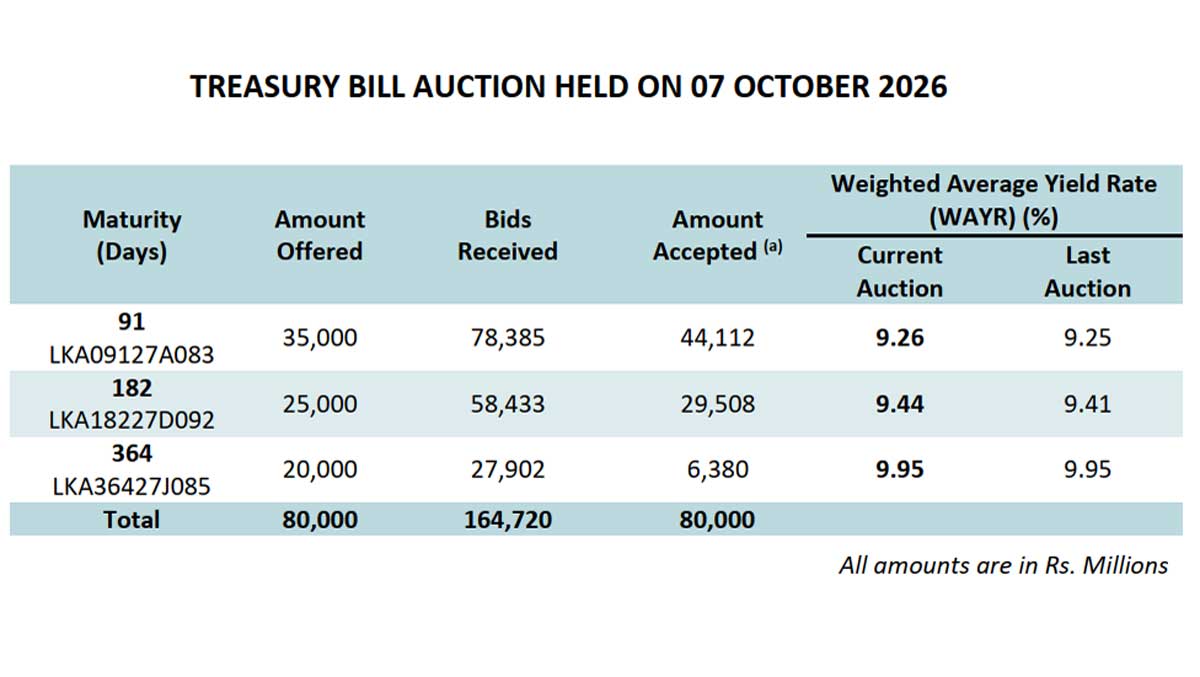
| 3 month bill | 9.26% | 1bp ▲ |
| 12-m bill | 9.95% | 2bp - |
| Gold (Ounce) | $4187 | - ▼ |










Comments
Be the first person to comment and join the debate