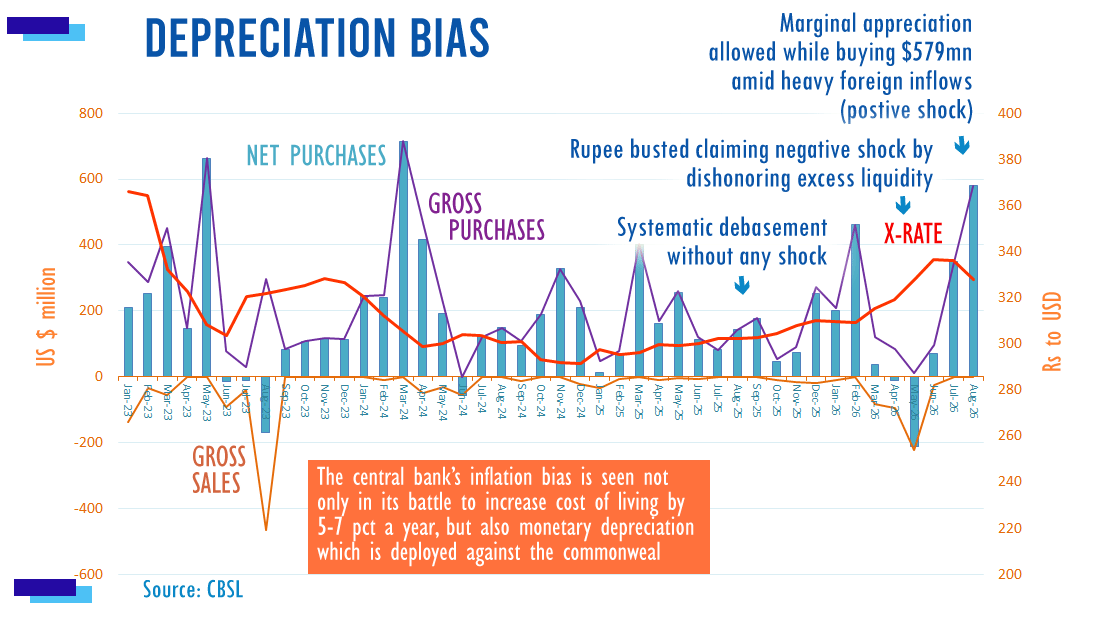
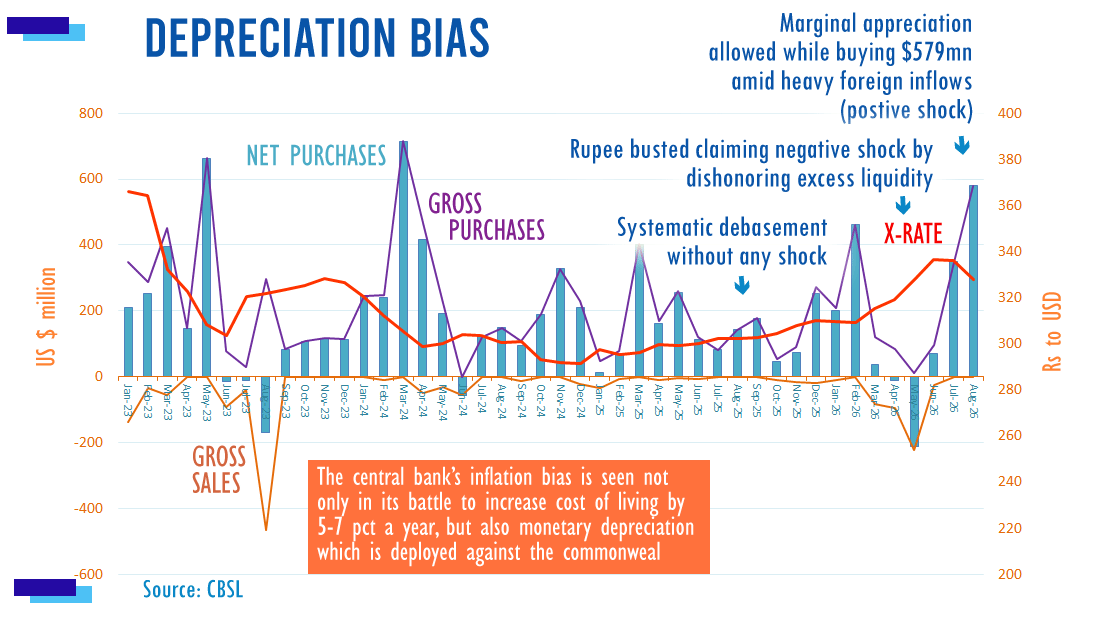
MONETABRIEF – Sri Lanka's central bank has bought 579 million US dollars in August 2026, official data showed only allowing marginal appreciation amid positive external and domestic shocks to the rupee.
In August the rupee was only allowed to appreciate around 8 rupees from 336 to 328 to the US dollar which also improved confidence among exporters and importers.
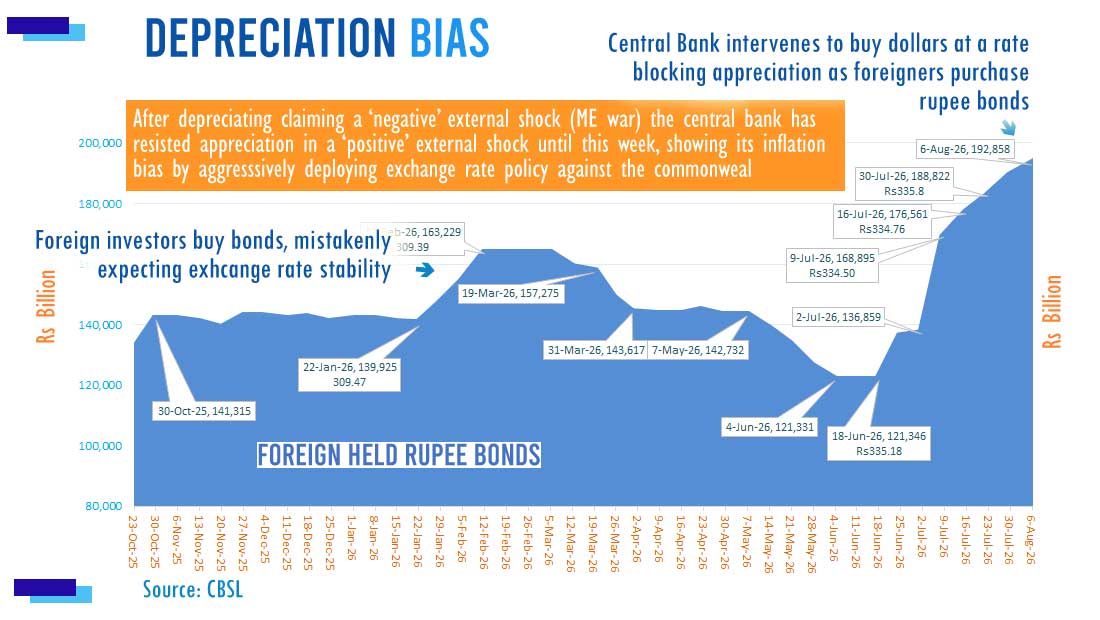
In July 348 million dollars were bought at 336 without any appreciation allowed, creating excess liquidity as foreign investors bought into the rupee bonds in a so-called 'positive' external shock.
Appreciation tends to trigger more 'positive' domestic shocks as well in the form of delayed importer covering of bill, early exporter sales and forward sales.
In turn it also makes banks sell down their net open positions.
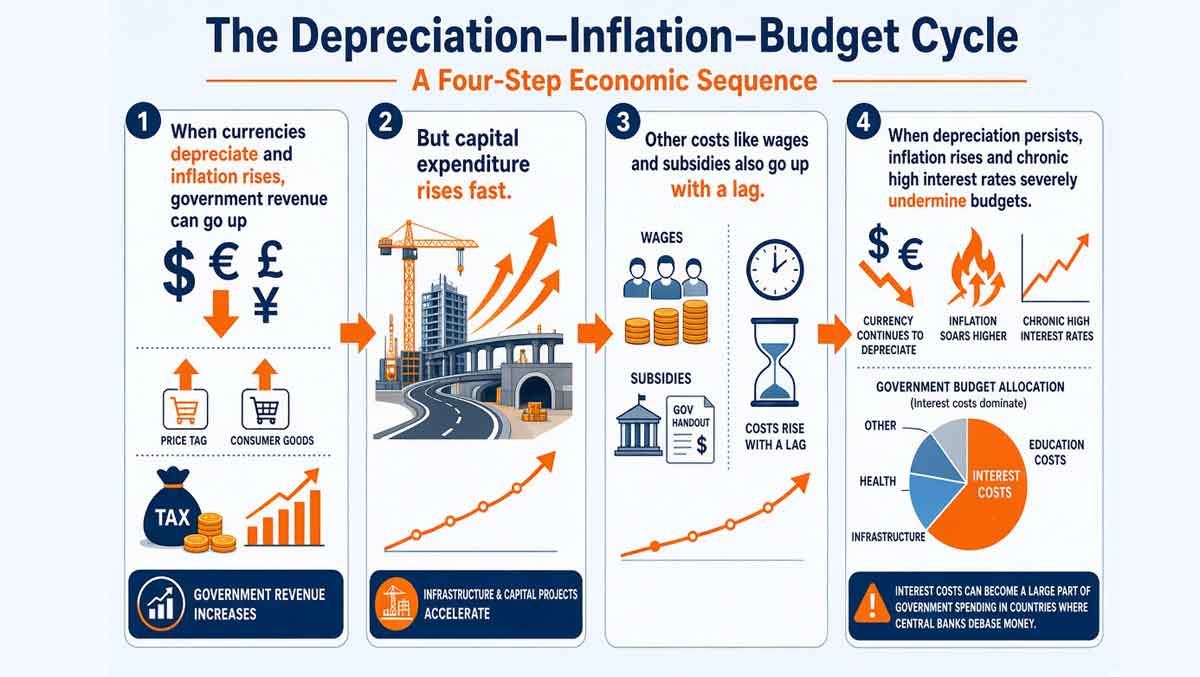
The opposite happens when the central bank dishonors its note issue and busts the currency under 'exchange rate as the first line of defence'.
In March the rupee was busted from 309 to 340 by the central bank claiming a (negative) external shock as the oil bill rose.
The government at the time raised fuel prices quickly and neutralized the effect on the balance of payments by matching external to internal demand, through there was some delay in raising electricity prices.
The busted rupee made the political cost of adjusting fuel prices greater.
The rupee had been systematically depreciation over 2025 as well, without any external shock to 309 to the dollars.
In December after cyclone Ditwah reduced private credit, giving a positive shock to the rupee, against appreciation was prevented at 309 to the US dollar by heavy dollar purchases.
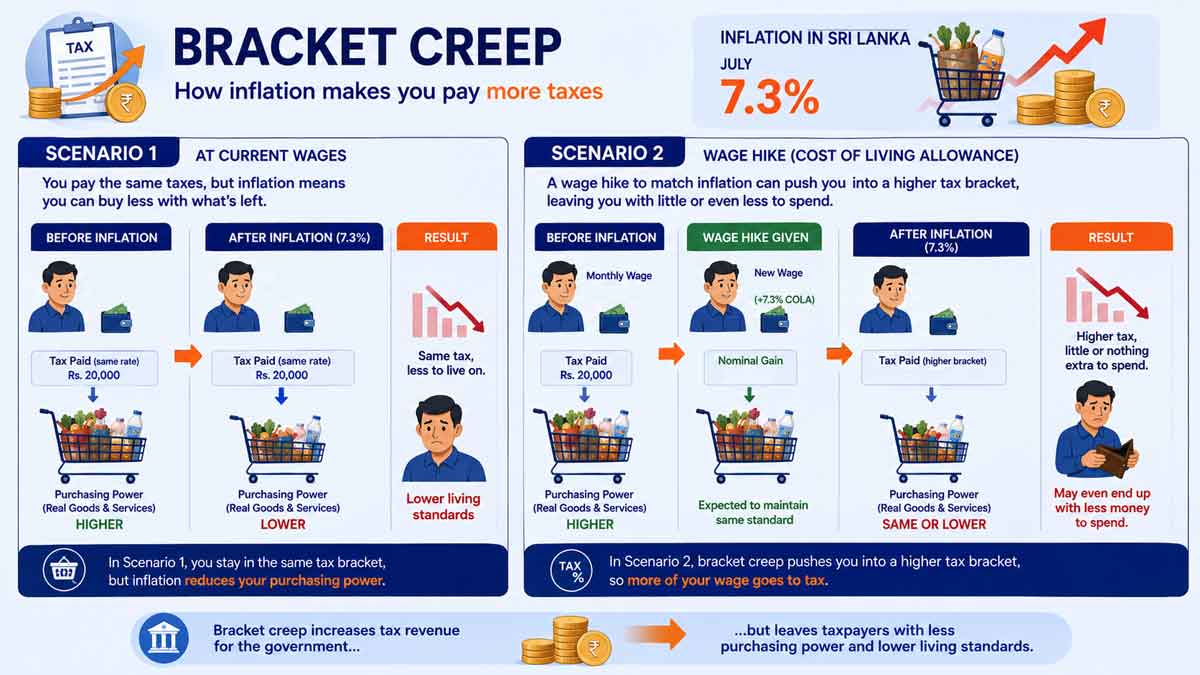
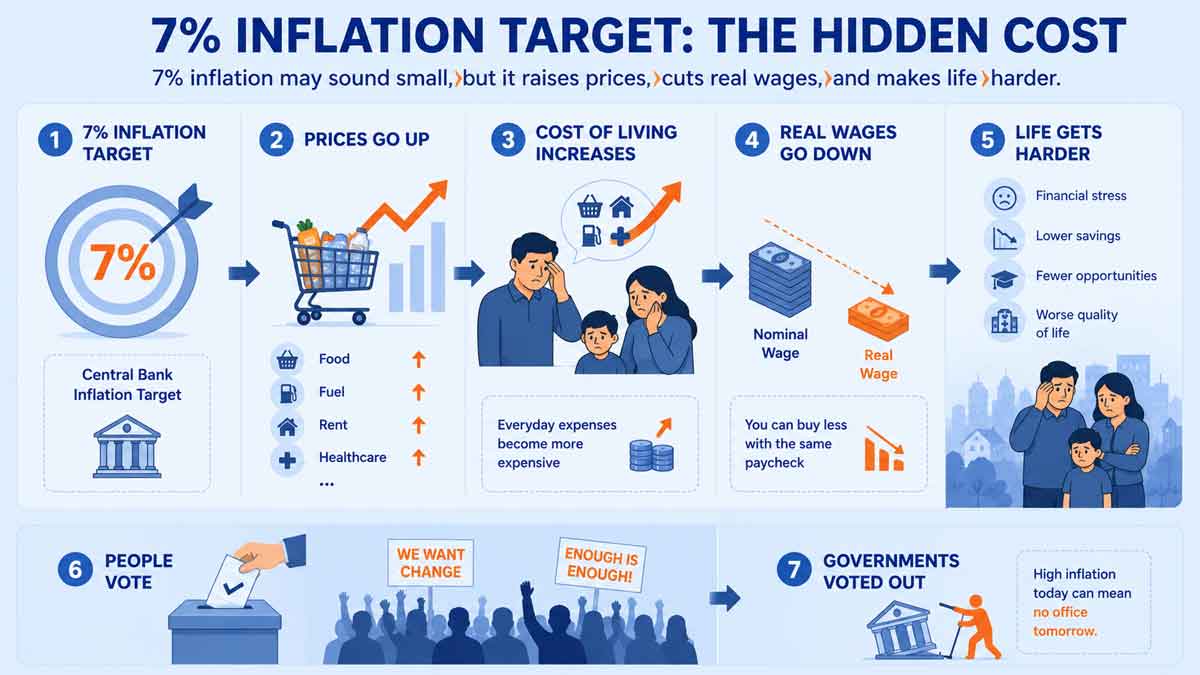
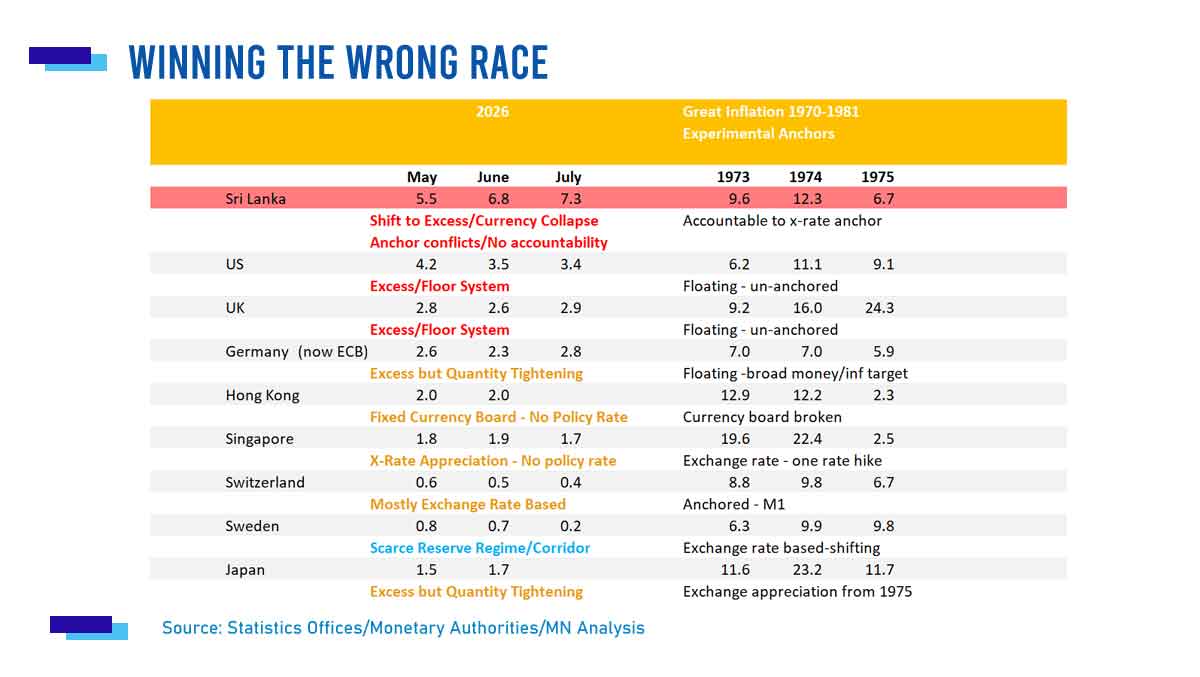
The currency collapse, by dishonoring notes allowed the central bank to meet its controversial 5 to 7 percent inflation target.
Analysts have pointed out that before macro-economics and the age-of-inflation, economics was once based on moral philosophy.
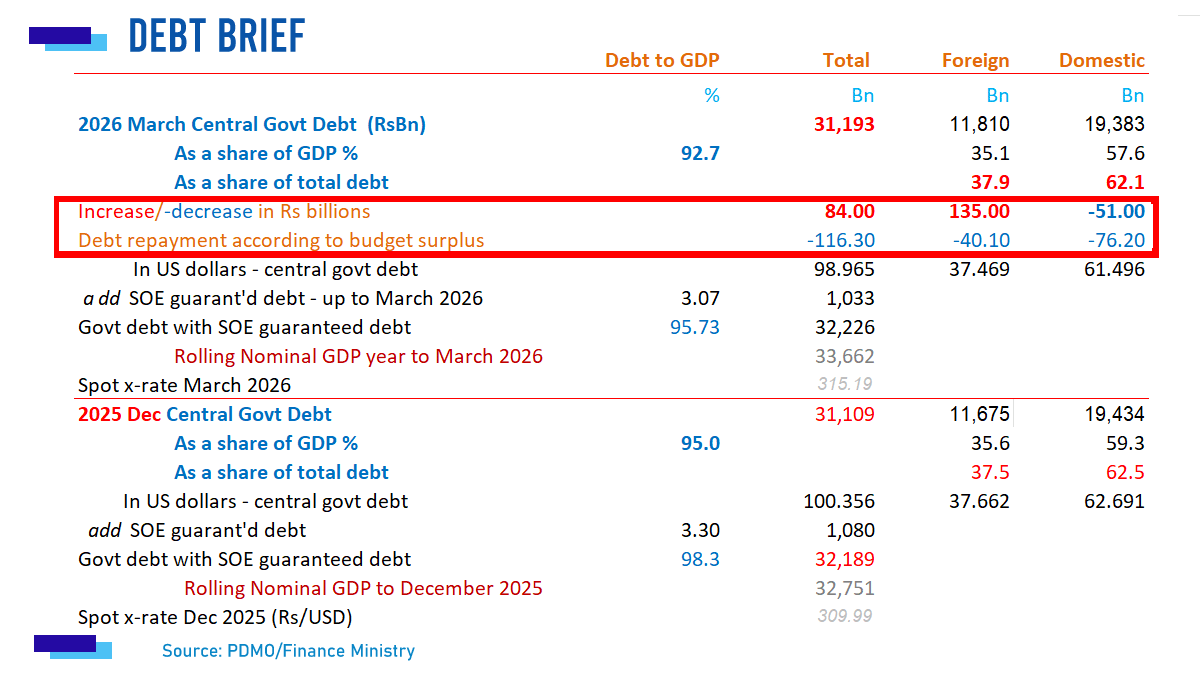
The central bank is now lobbying heavily to keep its inflation target. After seven decades of blaming budget deficits and politicians for external trouble, the rupee was busted in 2026 amid a budget surplus, shattering the narrative.
History has shown that only parliaments can restrain inflation biased central banks, either by breakings is money monopoly or by bringing specific laws to reduce discretion (flexibility).
Inflation "can be called an instrument of unpopulär, i.e. of anti-democratic, policy, since since by misleading public opinion it makes possible the continued existence of a system of government that would have no hope of the consent of the people if the circumstances were clearly laid before them," classical economist Ludwig von Mises explained.
Ironically in Sri Lanka a democractically elected government has raised taxes to run a budget surplus (not unlike in the US in 1951) when the central bank is resorting to inflationism and debasement, which is in turn undermining its credibility.
The rupee was similarly busted in 2018 to discredit the economic policies of the 2015-2019 administration and bring it to public disrepute, using flexible or discretionary inflation targeting.
There is now greater knowledge of how inflationism is undermining democracy, promoting de-liberalization.
After the currency collapse in 2026, exchange controls relaxation were reversed and import tax on, on vehicles - a frequent target instead of excess liquidity - has been tightened. (Colombo/Sept05/2026)













Comments
Be the first person to comment and join the debate