
Share your email and we'll share the latest news
Exclusive economic intelligence, political and business coverage
Saturday, October 24 2026
Saturday, October 24 2026
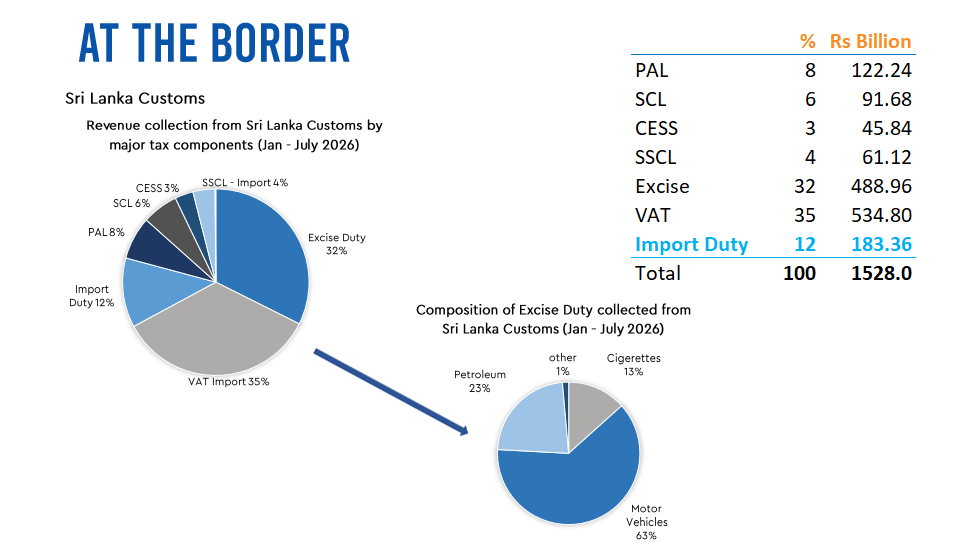 PROTECTION : In Sri Lanka import duties and other border taxes are quick to come when the central bank cuts rates and trigger BoP crises, firing de-liberalization but they are slow to go.
MONETABRIEF – Import duties, which drive corruption by encouraging undervaluation, brought only 183.3 billion rupees compared to the total 1,528 billion collected by Sri Lanka Customs up to July 2026, official data show.
Import duties are imposed in Sri Lanka mainly to allow politically powerful domestic manufacturers to exploit customers at higher than world prices by not paying the required taxes to the government (tax arbitrage), leading to revenue losses.
The current administration re-imposed import duties on cars, which allows local assemblers to take (arbitrage) the taxes.
Sri Lanka started to hike import duties from 1952 as the central bank printed money to create a forex shortage, starting the island's post independent path to de-liberalization, internal strife to become a lagging nation in Asia.
The import surcharges imposed in the 1952 crisis was made permanent in the following year as forex shortages continued.
The PAL tax was imposed after the 2001 currency crisis. The PAL tax was imposed on imports including raw material for exports at a lower rate. There was an IMF program in that period.
The CESS taxes were originally enacted in a mis-guided effort to boost exports by keeping the prices of exported raw commodities lower than world prices (world price less CESS) for value added exporters hurting export-oriented farming in particular.
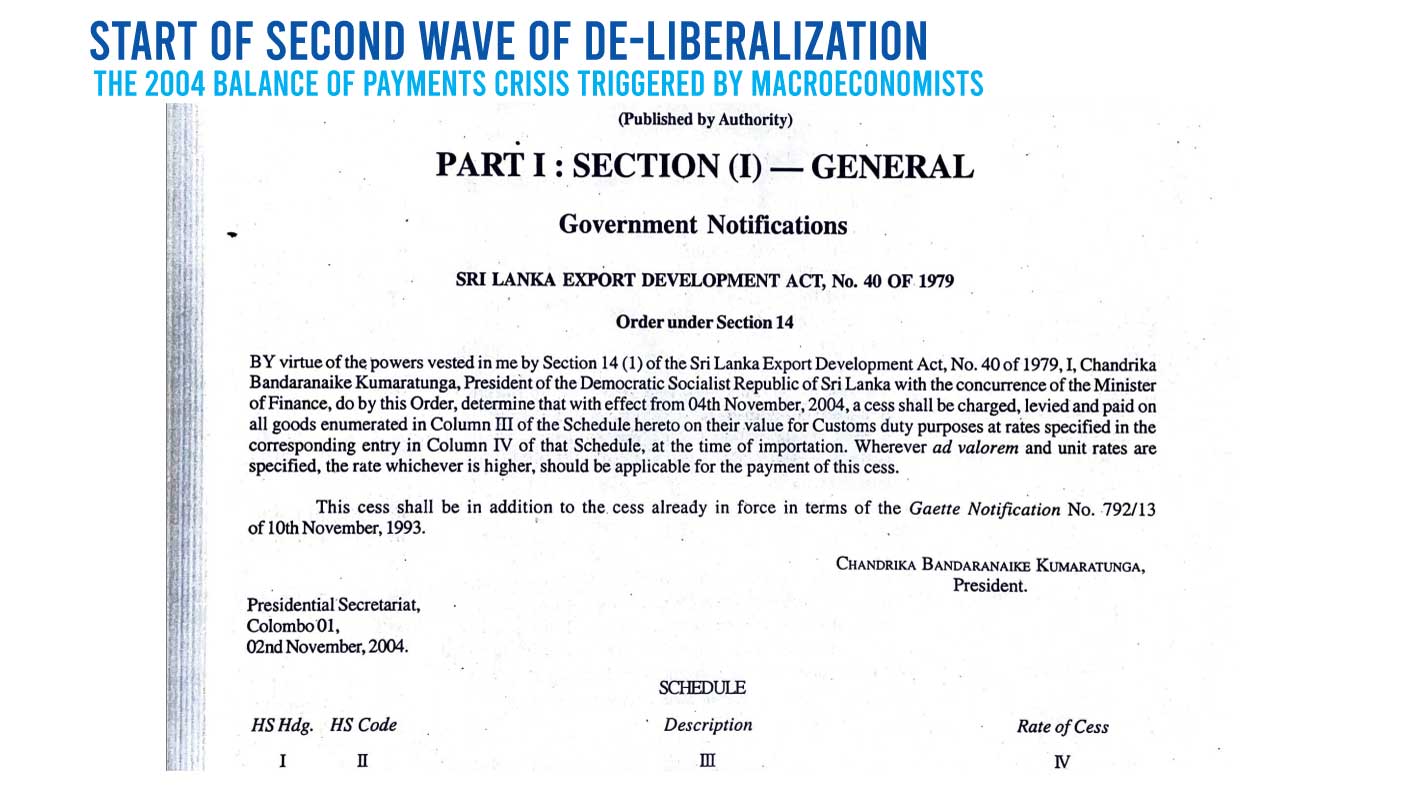
Sweeping CESS taxes was imposed in the 2004 currency crisis. In 2004 monetary policy was run by Deputy Governor W A Wijewardene and currency trouble came from vetoes by macro-economists in the Treasury involving actual true fiscal dominance, and the central bank did not print money on its own unlike after 2015 under mid-corridor (single policy rate) doctrine.
Quick to Come, Slow to Go
The Treasury, which was under the control of macro-economists, slapped a 20 plus page CESS gazette as the rupee came under pressure from just 60 billion rupees printed in 2004.
While new taxes and surcharges are imposed after rate cuts by the central bank trigger external crises, they are very slow to be taken off as protectionists cling to them, sometimes funding political campaigns.
The 2004 CESSes which created a new class of protectionists, are to be taken off only from 2028, delaying Sri Lanka's export competitiveness outside of special zones.
Corruption
The high taxes slammed as macro-economists print money then lead to undervaluation, mis-declaration and corruption.
Price controls may also follow, triggering further corruption and disrespect for the law.
Though Singapore is now known as a nation with little corruption, when the British returned after World War II, it was ridden in corruption due to controls brought during the 'Banana Money' period.
The British Military Administration was dubbed the Black Market Administration as it continued Japanese-era controls.
After the current IMF program, Customs have got new powers over firms in export zones, and some some exporters say they are harassed with demands for documentation going back to a decade.
Unlike in countries like Vietnam where export firms can easily sell domestically, local sales require exhaustive documentation due to protectionist taxes.
The SSCL was a new tax associated with the 2020 rate cuts and currency crisis which ended in external default, and was continued in the IMF program.
The Special Commodity Levy (SCL) came in the so-called 'food crisis', a commodity bubble fired by the Federal Reserve along with the housing bubble by running an 8 year cycle with artificially low rates for 're-flation'.
At the time the Trade Ministry proposed under Minister Bandula Gunawardene the SCL as a single tax with the good intention of avoiding the cascading taxes from PAL, VAT and import duty.
However, it is now imposed for protection to keep food prices high and protect farmers.
A Tax on Imports is a Tax on Exports
All import duties – supposedly imposed for developing infant industries – become a tax on exports - by not only making inputs expensive but also driving up food prices, which drive up wages or make people who cannot make ends meet migrate out to the Middle East.
High corporate income taxes have somewhat similar effects, and personal income tax a more direct effect.
The first country to resist protection and 'competitive exchange rates' and become an export powerhouse was Hong Kong after World War II which had a currency board style regime and free trade.
The strategy was copied by Taiwan about a decade later, under the tutelage of Chinese-American economist Sho-Chieh Tsiang, a star student of Austrian economist Friedrich Hayek at the London School of Economics. He fixed the New Taiwan dollar at 40 to the US dollar ending an inflationary spiral. The Taiwan dollar is now around 31 to the US dollar.
Taiwan initially gave tax rebates to avoid the problem of 'effective taxation' import duties. Taiwan then moved to free trade zones in 1965, initially linked to Kaohsiung port after a Kwoh-Ting Li, a top administrator, later Finance Minister, saw an Italian free port at Trieste.
Singapore then followed in the late 1960s. After separating from Malaysia, Singapore dismantled the 'common market' of import protection in a single day and eliminated all import duties after re-establishing a currency board for monetary stability.
In the 1970s, as Taiwan appreciated its currency in the wake of the collapse of the Bretton Woods and started to collect high levels of reserves with deflationary policy, import duties were reduced. (Colombo/Sept09/2026)

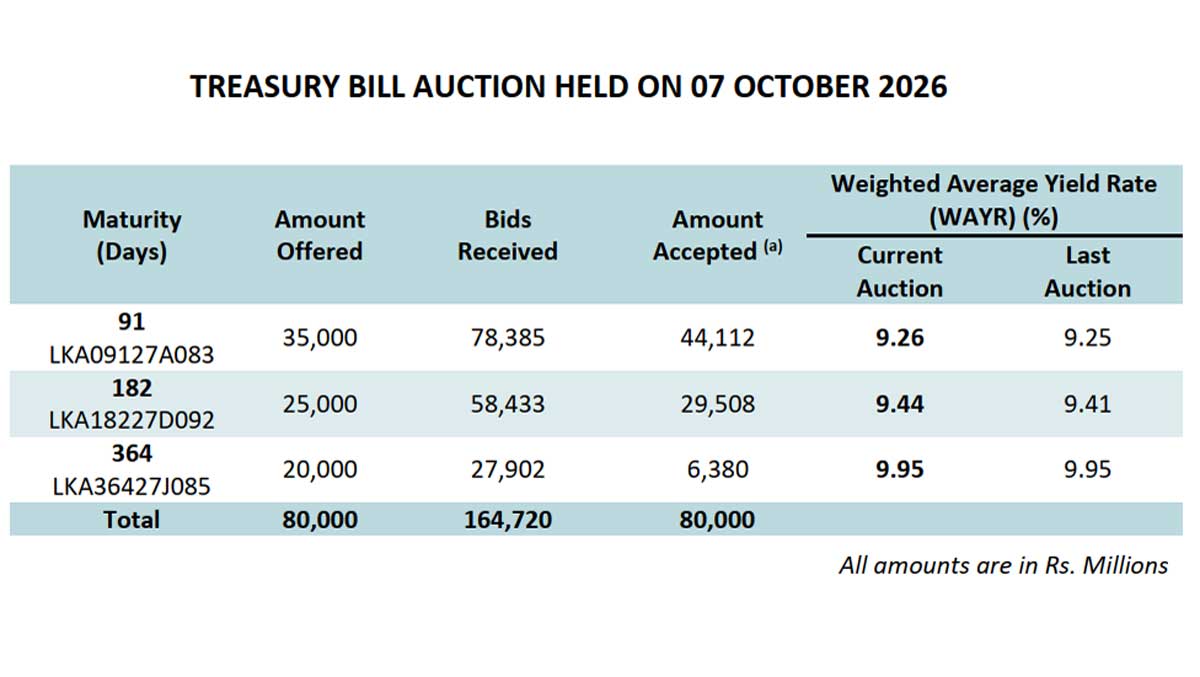
| 3 month bill | 9.26% | 1bp ▲ |
| 12-m bill | 9.95% | 2bp - |
| Gold (Ounce) | $4187 | - ▼ |






Comments
Be the first person to comment and join the debate