MONETABRIEF – China's Asian Infrastructure Investment Bank does not hold gold, but investment managers see many reasons including geopolitical uncertainty for holding gold, the lenders' Treasurer said in Sri Lanka.
Gold is unattractive to certain investors, in particular to fixed-income investors like him, as it did not pay interest, Domenico Nardelli, Treasurer, Asian Infrastructure Investment Bank, said at a reserve management conference in Colombo.
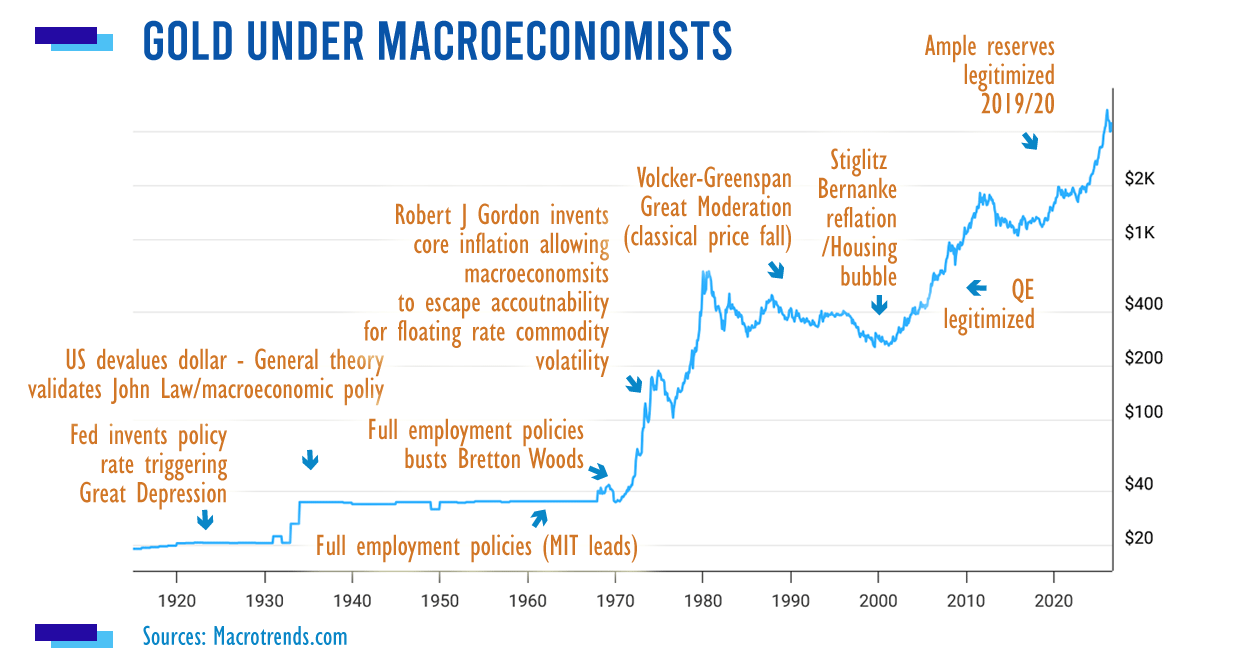
Gold prices rose sharply in the run up the housing bubble as the Federal Reserve fired a massive housing bubble.
Gold shot up again amid quantity easing and the massive money printing seen during covid and the emergence of the abundant/ample reserve regime which was announced in 2019 rejecting the need to return to a scarce reserve regime.
Over the past two years gold has shot up above 4,500 dollars an ounce.
"This has renewed discussions as to whether gold or more gold should be added to certain portfolios," Nardelli said.
"I do not need to defend the case of gold here in the presence of many central bankers in the room. You are probably the biggest experts in the field.
"Suffice to say that some features of gold are indeed extremely appealing, like gold having no credit risk, there is no issuer that needs to repay gold. Of course, it is reasonably liquid, offers protection against inflation, (which is) very important."
"There is, however, one feature, in my view, that is contributing to making gold
more sought after in today's market… It is the geopolitical context.
Gold has intrinsic value, and as such, can be viewed as an insurance for any portfolio in almost any market situation he said.
"In particular, when conflict and uncertainties are on the rise, so will be the value of gold.
If that is true, I believe we may not have seen the peak in gold prices yet.
"We don't own gold. But this is a question that from time to time pops up in our discussions with management, my colleagues do raise the issue."
When the Federal Reserve invented the policy rate in 1920 gold was only 20 dollars an ounce. Under the US constitution (Congress shall coin money) gold has been 20 dollars an ounce for almost 200 years.
When indiscriminate open market operations and the policy rate (earlier private central banks only only discounted bills for profit until gold prices went up), triggered the roaring 20s bubble and the Great Depression the Fed's charter was not terminated.
All monetary excesses in earlier ages had led to collapses of the central banks (eg Bank Royale) and a return to gold or parliament strictures against it (Bank of England).
Instead, Keynesianism (stimulus) and 'monetary policy' was legitimized reviving trade/current account Mercantilism.
Currency collapses came in swift succession in the 1930s in many central banks.
In 1934 gold was devalued to 35 US dollars an ounce under President Roosevelt (Gold Reserve Act).
Activists went to court citing the requirement for sound money under the constitution, but failed to reign in New Deal macro-economists.
Gold started to rise in the 1960s after Paul Samuelson and others revived stimulus as 'full-employment policies'. The Bretton Woods collapsed.
After the final collapse of the Smithsonian gold soared to 800 dollars, until Paul Volcker who learned money from two refuges Austrian economists, was appointed as Fed Chief.
His successor Greenspan also generally pricked asset price bubbles (he did not target inflation), and gold prices fell to 284 dollars by the late 1990s, when Stiglitze-Bernanke reflation started firing the housing bubble.
Post-housing-bubble quantity easing, deliberate fiscal stimulus (spending one's way out of trouble or policy support) has now shattered budgets and people have begun to distrust US long bonds as well, with overall US policy-making being reduced to classic regime uncertainty.
What is generally referred to as 'geopolitical risk' is mostly regime uncertainty generated by the use of executive orders by Donald Trump.
Similar regime uncertainty from executive orders issued during the New Deal by President Roosevelt also led to an extended depression.
But unlike in the Depression when then US Treasury secretary had already cut the First World War debt, this time, US fiscal metrics are in very bad shape with extended stimulus or IMF style policy support, with no hint of sanity returning.
Like Sri Lanka in 2019 (and the UK in the early 1970s) there is a belief in the US that statistics (GDP is the denominator in Debt to GDP ratio and deficit) can solve the problem with econometrics edging out classical economics. (Colombo/Sept14/2026)















Comments
Be the first person to comment and join the debate